
The e-NAM platform set out to solve a problem that has shaped Indian farm incomes for decades: a farmer selling produce at a local mandi has almost no way to know if a better price exists two districts away.
A decade after launch, the e-NAM platform has grown into one of the largest digital agricultural marketplaces in the world — but it has also run into real, well-documented limitations that any honest account of it needs to include.
This guide covers exactly how the e-NAM platform works, what it has actually achieved by the numbers, where independent research says it’s still falling short, and how a farmer registers and trades on it.
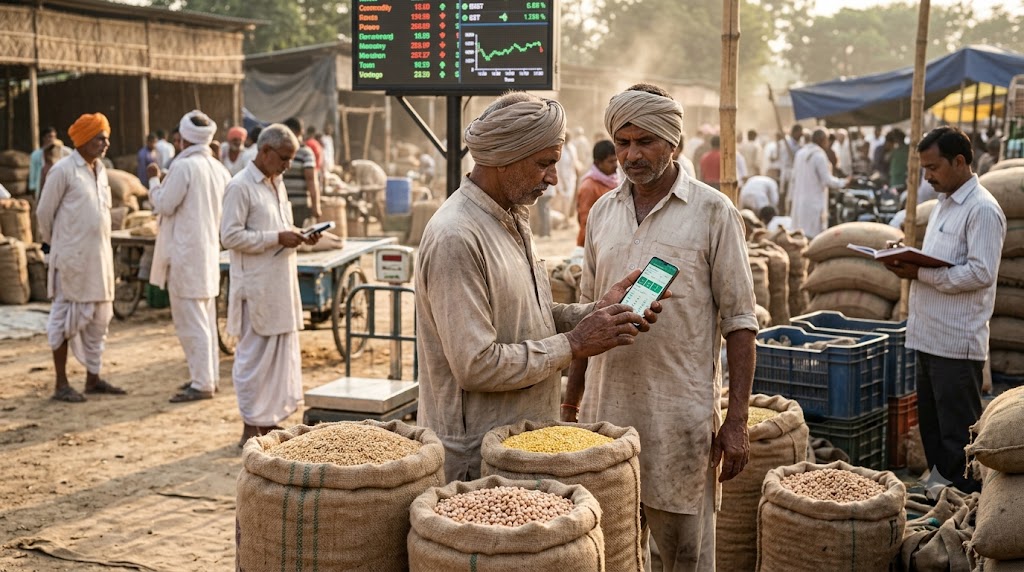
Table of Contents
What Is the e-NAM Platform?
The e-NAM platform — the National Agriculture Market — is a pan-India electronic trading portal launched by the Government of India in April 2016 to digitally integrate physical wholesale mandis into a single, unified national market for agricultural commodities.
According to the Press Information Bureau’s official explainer on the scheme, before e-NAM, agricultural trade in India operated through a network of regulated mandis under the Agricultural Produce Market Committee (APMC) framework — each governed independently, with limited inter-state integration and no shared price visibility.
The e-NAM platform was built to change that by linking mandis to a common online system for price discovery, competitive bidding, and direct electronic payment.
The platform is implemented by the Small Farmers Agribusiness Consortium (SFAC) under India’s Department of Agriculture and Farmers’ Welfare, and is accessible through the official e-NAM web portal and a companion mobile app launched in October 2016.
Where input-efficiency tools like nano fertilizer aim to lower the cost side of farming, e-NAM is squarely focused on the revenue side — helping farmers realize a fairer price for what they’ve already grown.
How the e-NAM Platform Actually Works, Step by Step
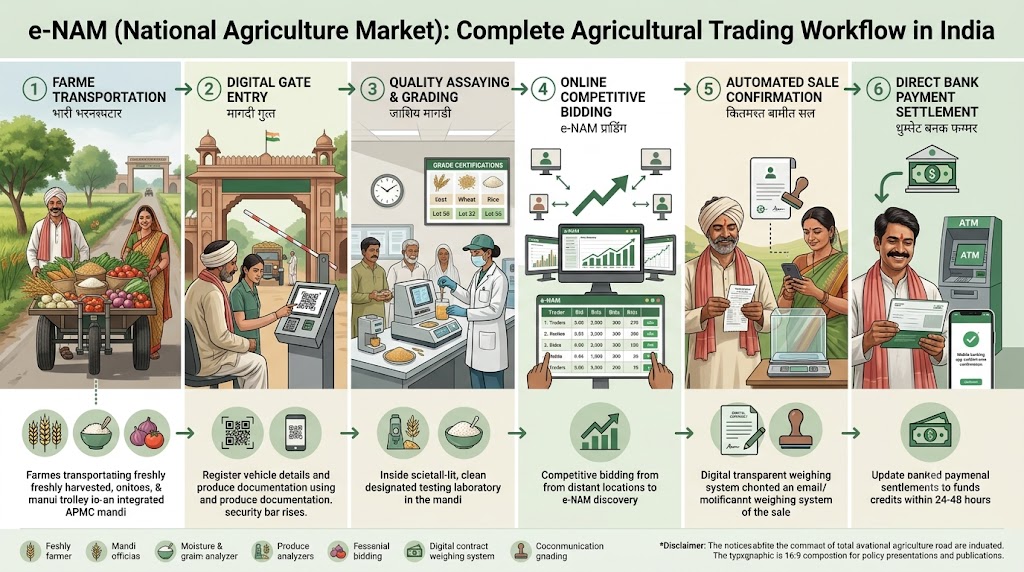
The trading process on the e-NAM platform follows a defined digital workflow rather than the informal negotiation typical of a traditional mandi sale.
- Digital gate entry. A farmer’s produce lot is logged into the system upon arrival at an integrated mandi.
- Lot creation with a unique identifier. Each batch of produce is assigned its own trackable ID within the system.
- Quality assaying. The produce is graded and tested for quality, with a growing number of mandis using automated, technology-assisted assaying to speed up this step.
- Online bidding. Registered traders and buyers — not just those physically present at that specific mandi — place competitive bids on the lot.
- Price discovery and sale confirmation. The highest qualifying bid determines the sale price, made visible to the farmer through the platform.
- Direct electronic payment. Sale proceeds are transferred directly into the farmer’s registered bank account, supported by NEFT, RTGS, internet banking, and UPI, rather than passing through informal cash settlement — the same kind of digital payment infrastructure increasingly used across other government schemes, including subsidy disbursal under the PM-KUSUM solar pump scheme.
A significant structural feature underpinning this process is the State Unified License, which allows a single trading license to let a trader bid across multiple mandis rather than requiring separate licensing in every location — a detail that directly targets the inter-state trade friction that limited pre-e-NAM mandi trading.
10 Powerful Benefits of the e-NAM Platform
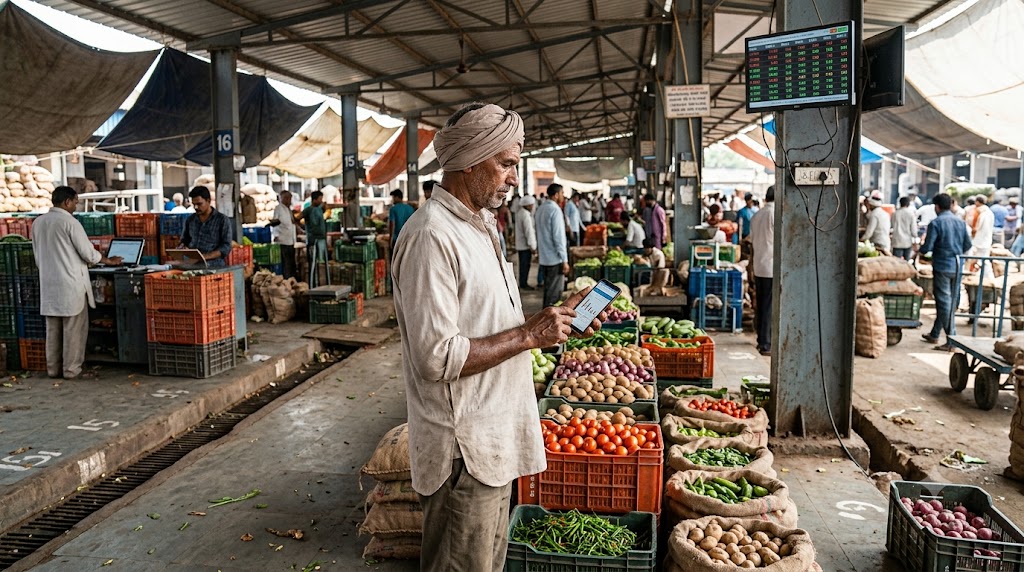
- Access to a much larger buyer pool. Farmers are no longer limited to whoever happens to be bidding at their local mandi on a given day.
- Transparent, competitive price discovery. Bidding happens in the open on the platform rather than through informal, sometimes opaque local negotiation.
- Direct payment to bank accounts. Reduced dependence on cash intermediaries also creates a documented financial transaction history for the farmer.
- Real-time price information access. The e-NAM mobile app provides free price information across 247 notified commodities, helping farmers judge whether a local price is fair before committing to a sale.
- Reduced dependence on middlemen. Direct digital transactions cut out several layers of informal intermediation common in traditional mandi trading.
- Inter-state trading enabled through unified licensing. A single State Unified License allows traders to bid across state boundaries, widening the effective market for a farmer’s produce.
- Formal financial record creation. Documented, bank-verified sales through e-NAM can support farmers’ access to institutional credit, since digital transaction history is increasingly used as supporting documentation by lenders.
- Reduced post-harvest losses through e-NWR integration. Warehouse-stored produce can be sold digitally without physical transport to a mandi, described in detail below.
- Grievance redressal built into the platform. A toll-free helpline (1800 270 0224) and online grievance system give farmers a formal escalation path that informal mandi trading never offered.
- Multilingual accessibility. A 12-language interface — including Hindi, Tamil, Telugu, Bengali, Marathi, and several other regional languages — lowers the literacy and language barrier to digital adoption for farmers across different states.
The Real Scale of e-NAM by the Numbers
Numbers here matter because they separate a scheme that sounds significant in a press release from one that’s genuinely reshaping trade volume.
As of March 2026, the PIB explainer confirms 1,656 mandis across 23 states and 4 union territories are integrated with the e-NAM platform, up from 1,389 mandis just two years earlier in 2024. More than 1.80 crore (18 million) farmers, 2.73 lakh traders, and 4,724 Farmer Producer Organizations are registered on the platform.
Cumulative trade since 2016 has reached 13.25 crore metric tonnes, worth a total of ₹4.84 lakh crore — up from ₹3.19 lakh crore in trade value just two years earlier in 2024.
Independent, nonpartisan analysis from PRS Legislative Research’s 2026-27 budget review of the Ministry of Agriculture provides useful cross-verification here, citing a slightly earlier figure of 1,522 integrated mandis as of January 2026 — a small, expected variance given the two-month reporting gap, and a reminder that any specific figure should be checked against the most current source before being treated as gospel.
The government provides financial assistance of up to ₹75 lakh per mandi to support the infrastructure — quality assaying labs, electronic weighing, computers, and cleaning and grading facilities — needed for a physical mandi to integrate with the digital platform.
It’s worth putting these figures in context against the platform’s own trajectory rather than treating them as static achievements. The jump from 1,389 to 1,656 integrated mandis between 2024 and 2026 represents continued, active expansion nearly a decade after launch, not a program that plateaued early.
Similarly, the near-linear growth in trade value — from ₹3.19 lakh crore in 2024 to ₹4.84 lakh crore in 2026 — reflects genuinely deepening usage rather than a one-time adoption spike followed by stagnation, which is the pattern often seen in government digital platforms that generate an initial registration surge but fail to sustain actual transaction volume over time.
That said, registered-farmer counts and integrated-mandi counts describe reach and infrastructure, not necessarily the depth of genuine, price-competitive trading happening at every single one of those 1,656 locations — a distinction explored further in the limitations section below.
e-NWR Integration: Turning Stored Produce Into Tradeable Assets
One of the e-NAM platform’s more significant recent developments is its integration with the Electronic Negotiable Warehouse Receipt (e-NWR) system, introduced under India’s Warehousing (Development and Regulation) Act, 2007.
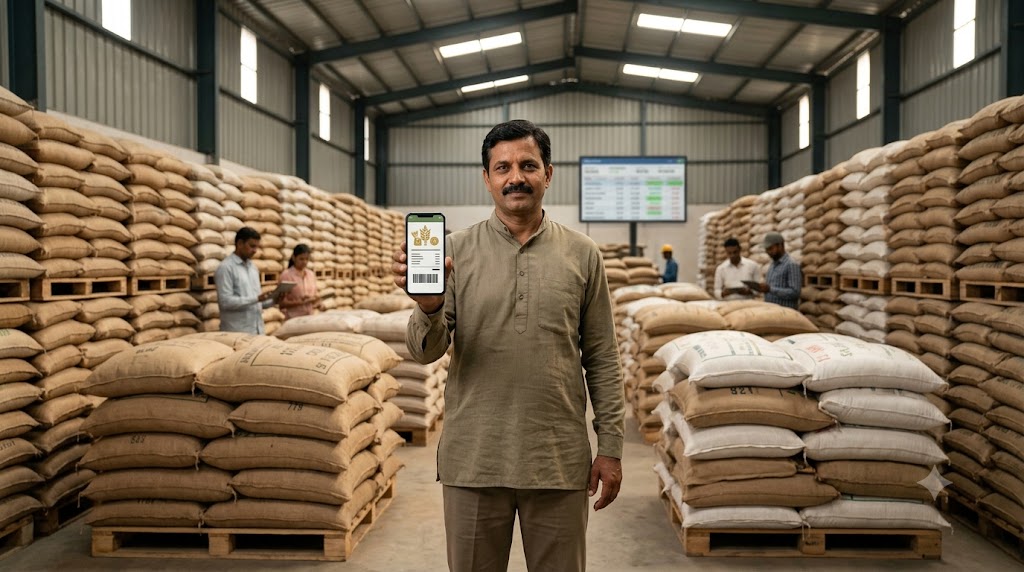
Under this integration, a farmer who stores produce in a warehouse accredited by the Warehousing Development and Regulatory Authority (WDRA) receives an e-NWR — a digital certificate of ownership for that stored commodity. That e-NWR can then be sold directly through the e-NAM platform, without physically transporting the produce to a mandi first.
This matters for two concrete reasons. First, it reduces the pressure toward distress sales — situations where a farmer sells immediately at harvest, often at a lower price, simply because they lack affordable storage and cannot wait for a better market moment.
Second, an e-NWR can itself be used as collateral for institutional credit, giving farmers a way to access financing against stored produce rather than needing to sell it immediately to generate cash flow — a financing angle that connects directly to the broader credit-access questions covered in our guide to the Kisan Credit Card scheme.
Where the e-NAM Platform Has Fallen Short: An Honest Look
A genuinely trustworthy account of the e-NAM platform has to include this section, and it’s the part most promotional coverage skips entirely.
Peer-reviewed agricultural economics research, including a systematic review of e-NAM implementation published through the Agricultural Economics Research Association, has identified structural challenges the platform continues to work through, organized around what researchers describe as three core gaps: infrastructure, institutions, and information.
On the infrastructure side, not every integrated mandi has a fully operational quality-assaying laboratory, which undermines the platform’s core promise of standardized, quality-linked pricing.
On the institutional side, a high-powered panel on integrating agricultural markets, chaired by a NITI Aayog member and reported by Business Standard’s coverage of India’s farm schemes, found that in some mandis, trades were still being conducted manually and only entered into the electronic system after the fact — a practice that, if widespread, undermines the platform’s transparency objective at its foundation.
PRS Legislative Research’s independent budget analysis adds a further data point worth taking seriously: the Standing Committee on Agriculture has separately recommended expanding e-NAM’s coverage specifically in states where APMC-regulated markets don’t yet exist, implying meaningful geographic gaps remain in the platform’s reach even a decade after launch.
None of this means the underlying model has failed — the growth in trade value and registered farmers over the past two years, documented above, is real and substantial.
But a farmer deciding how much to rely on the e-NAM platform for a specific commodity in a specific state should understand that platform maturity varies significantly by location, and that the ideal, fully transparent trading experience the scheme was designed to deliver is not yet uniformly realized everywhere it operates.
How to Register and Sell on the e-NAM Platform
- Check if your local mandi is integrated. Confirm your mandi’s e-NAM status through the official portal’s mandi directory before assuming access.
- Complete farmer registration. Registration is available through the e-NAM portal or mobile app, or in person at your local integrated mandi with assistance from mandi staff.
- Link your bank account. Since sale proceeds are transferred electronically, accurate bank account details are essential at registration.
- Bring produce for gate entry and assaying. Your lot is logged and quality-tested before being made available for online bidding.
- Monitor the bidding process. You can track bids on your lot through the platform rather than relying solely on mandi staff to relay information.
- Confirm payment receipt. Verify that sale proceeds have been credited to your registered account following a completed transaction.
- Use the grievance system if something goes wrong. The toll-free helpline and online grievance portal exist specifically to resolve registration, payment, or trading disputes.
e-NAM Platform vs Traditional Mandi Selling
| Factor | e-NAM Platform | Traditional Mandi Selling |
|---|---|---|
| Buyer pool | Traders across integrated mandis and states | Typically local buyers only |
| Price transparency | Competitive online bidding, visible pricing | Often informal, negotiated pricing |
| Payment method | Direct electronic transfer | Frequently cash-based |
| Quality assessment | Standardized assaying where labs are operational | Varies by mandi, often informal |
| Financial record creation | Documented, bank-verified | Limited or no formal record |
| Grievance mechanism | Toll-free helpline and online system | Informal, mandi-dependent |
This trade-off — a more transparent, better-documented sale process, with adoption maturity still varying by region — is why the e-NAM platform is best understood as a genuinely useful tool to check and use where it’s well-established locally, rather than a uniform national guarantee of a better price everywhere, every time.
Common Mistakes Farmers Make on the e-NAM Platform
- Assuming every mandi offers the identical experience. Platform maturity, active buyer participation, and assaying lab availability vary significantly by mandi and state.
- Not checking live price data before selling. The e-NAM mobile app’s free price information for 247 commodities is underused by farmers who could otherwise time or benchmark a sale more effectively.
- Skipping bank account verification at registration. Incorrect account details can delay payment after a completed sale.
- Not using the grievance system when problems occur. Farmers sometimes accept a delayed or disputed payment rather than formally escalating through the toll-free helpline or online portal.
- Overlooking the e-NWR pathway for stored produce. Farmers with warehouse-stored produce sometimes default to transporting it physically to a mandi rather than exploring direct e-NWR-based digital sale.
FAQs About the e-NAM Platform
1. What is the e-NAM platform?
The e-NAM platform, or National Agriculture Market, is a government-backed online agricultural trading platform launched in 2016. It connects participating agricultural mandis through a digital marketplace to support competitive bidding, price discovery, and electronic payments.
2. What are the main benefits of e-NAM for farmers?
The main benefits of e-NAM include wider access to buyers, competitive price discovery, digital payment, access to mandi price information, reduced dependence on informal intermediaries, and better documentation of agricultural transactions.
3. How does e-NAM help farmers get better prices?
e-NAM allows registered buyers to participate in competitive bidding for eligible produce at integrated mandis. This can increase competition among buyers and give farmers better information about prevailing prices. However, e-NAM does not guarantee a higher price for every farmer or commodity.
4. Is e-NAM registration free for farmers?
Yes, farmer registration on the e-NAM platform is free. Farmers can register through the official e-NAM portal or mobile application, and assistance may also be available at participating mandis.
5. How can farmers register on the e-NAM platform?
Farmers can register through the official e-NAM portal or mobile app. Depending on the local system, farmers may also receive registration assistance at an integrated mandi. Accurate personal and bank account details are important for completing registration and receiving electronic payments.
6. Can farmers sell directly through e-NAM?
Farmers can sell eligible agricultural produce through the e-NAM system when their produce is brought to an integrated mandi and processed according to that mandi’s procedures. The produce generally goes through gate entry, quality assessment, online bidding, sale confirmation, and payment.
7. Does e-NAM guarantee a higher price than a traditional mandi?
No. e-NAM does not guarantee a higher selling price. Its purpose is to improve market access, competition, and price discovery. The final price depends on factors such as commodity demand, quality, quantity, location, and buyer participation at the time of sale.
8. What is e-NWR and how is it connected to e-NAM?
e-NWR stands for Electronic Negotiable Warehouse Receipt. It is a digital warehouse receipt representing stored agricultural commodities. Through e-NWR integration, eligible stored produce can potentially be traded through e-NAM without first physically moving the commodity to a mandi.
9. What commodities can be traded on e-NAM?
e-NAM supports a wide range of agricultural commodities, including cereals, pulses, oilseeds, fruits, vegetables, spices, and other notified commodities. The exact commodities available for trading can vary according to the applicable mandi and platform arrangements.
10. How can farmers get help if they face a problem on e-NAM?
Farmers facing registration, payment, trading, or other platform-related problems can use the e-NAM grievance redressal system or contact the official e-NAM helpline. Farmers should also confirm the current procedure with their local integrated mandi because implementation can vary by location.
11. Is the e-NAM platform the same as the government’s crop insurance or credit schemes?
No. e-NAM specifically addresses agricultural marketing and price discovery; it is a distinct program from schemes like crop insurance for farmers or the Kisan Credit Card scheme, though a farmer can and often should use multiple government schemes together as part of an overall risk and income strategy.
About the Author
This article was researched and written by the Farm Sutras Editorial Team, fact-checked against the Press Information Bureau’s official explainer, PRS Legislative Research’s independent budget analysis, the official e-NAM government portal, and peer-reviewed agricultural economics research — each linked below for independent verification.
This is an editorial compilation of publicly available data, not a professional agricultural marketing consultancy; confirm current mandi-specific status directly with your local e-NAM coordinator or the platform’s helpline before making a selling decision.
Sources Cited in This Article
- Press Information Bureau — Explainer: National Agriculture Market (e-NAM)
- Official e-NAM Government Portal
- PRS Legislative Research — Demand for Grants 2026-27 Analysis: Agriculture and Farmers Welfare
- Agricultural Economics Research Association — Agricultural Marketing Reforms and e-National Agricultural Market (e-NAM) in India: A Review
- The Tribune — e-NAM Expansion Coverage and State-Level Implementation Reporting
Final Thought
The e-NAM platform’s core achievement is real: over a decade, it has built genuine digital infrastructure connecting more than 1,600 mandis and nearly 18 million farmers, with trade value that has grown meaningfully even in just the past two years.
But its documented gaps — uneven assaying infrastructure, pockets of manual trade entry undermining transparency, and geographic coverage that still excludes states lacking APMC markets — are just as real, and worth knowing before assuming a uniformly transformed experience at every mandi in the country.
The most useful way to approach the e-NAM platform in 2026 is as a genuinely valuable price-discovery and market-access tool to actively check and use — not as a guarantee, but as one more resource worth verifying against your specific mandi’s actual, current level of digital maturity before you decide how much to rely on it for a given sale.