
Climate-resilient crops have moved from a research-lab concept to a practical necessity for farmers in 2026. Extended droughts, erratic monsoon timing, sudden heat spikes during flowering, and unpredictable flooding are no longer occasional disruptions they are becoming a normal part of the growing season in many regions, and conventional seed varieties are increasingly struggling to keep up.
This guide covers what climate-resilient crops actually are, how they’re bred, which varieties are performing best right now, and how a farmer should realistically decide whether to switch.
Table of Contents
What Are Climate-Resilient Crops?
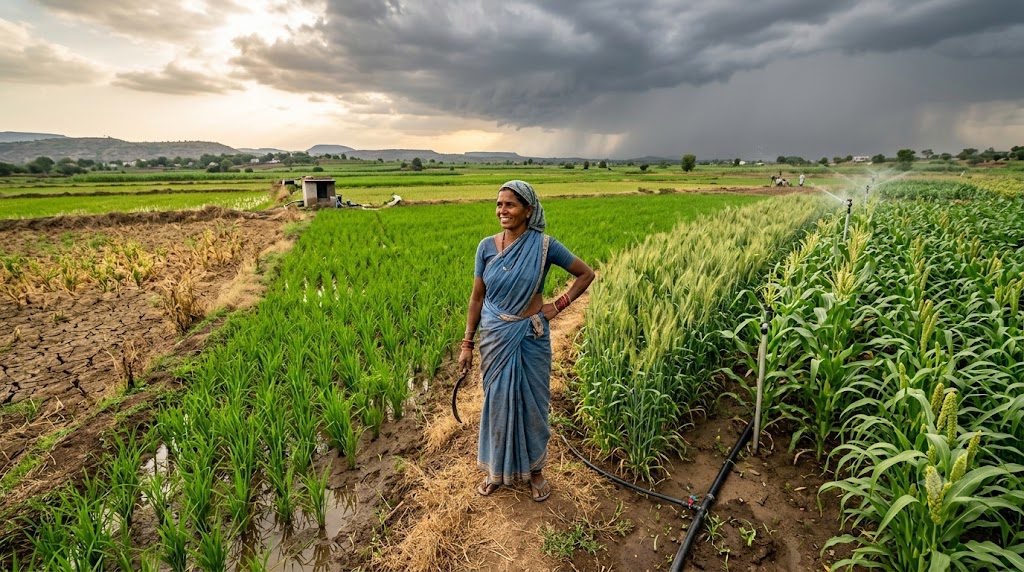
Climate-resilient crops are plant varieties bred or engineered to maintain acceptable yield and quality under environmental stress conditions that would significantly damage conventional varieties primarily drought, extreme heat, flooding, and soil salinity.
Unlike a general “hardy” plant, climate-resilient crops are developed through deliberate breeding programs that target specific stress-tolerance traits: deeper root systems for drought escape, heat-shock protein activity for temperature tolerance, submergence-tolerance genes for flood survival, or ion-exclusion mechanisms for salt-affected soils.
The goal is not to eliminate the effect of stress entirely, but to narrow the yield gap between a normal season and a stressed one, so a bad weather year results in a manageable loss rather than a catastrophic one.
Why Climate-Resilient Crops Are Trending in 2026
Several converging pressures are pushing climate-resilient crops from a niche research topic into mainstream farm planning conversations this year.
1. Drought conditions are expanding in major growing regions. Recent agricultural reporting has flagged drought expansion as an active concern for the 2026 growing season in several key production areas, directly affecting corn and soybean output expectations.
2. Input costs are rising sharply. USDA projections put total farm production expenses for 2026 at nearly $493 billion, with fertilizer and soil conditioner costs alone forecast to rise over 15% year-over-year a cost environment where a failed or underperforming crop is far more expensive to absorb than it was even two years ago.
3. Water competition is intensifying. Farmers in several regions are increasingly competing for water access with industrial and data-center demand, adding a new layer of water-scarcity pressure that climate-resilient crops are specifically designed to handle better than conventional varieties.
4. Breeding technology has accelerated. Advances in genomics, AI-driven phenotyping, and multi-omics analysis are allowing seed developers to identify and combine stress-tolerance traits far faster than traditional breeding cycles ever allowed.
5. Net farm income pressure makes yield stability more valuable than peak yield. With net farm income forecast to decline in 2026 even before accounting for inflation, the year-to-year yield stability that climate-resilient crops offer is becoming more valuable to many farmers than chasing maximum yield in only the best seasons.
How Climate-Resilient Crops Are Developed
Modern development of climate-resilient crops draws on several converging scientific approaches rather than a single breeding method.
- Genomic selection : researchers identify specific genetic markers associated with drought tolerance, heat tolerance, or flood survival, allowing breeders to select promising plants earlier in the breeding cycle without waiting for full field trials.
- Marker-assisted breeding : desirable stress-tolerance genes are tracked and combined across generations more precisely than traditional phenotypic selection alone allows.
- Multi-omics analysis : combining genomics, transcriptomics, and metabolomics data helps researchers understand not just which genes matter, but how a plant’s full biological system responds under stress.
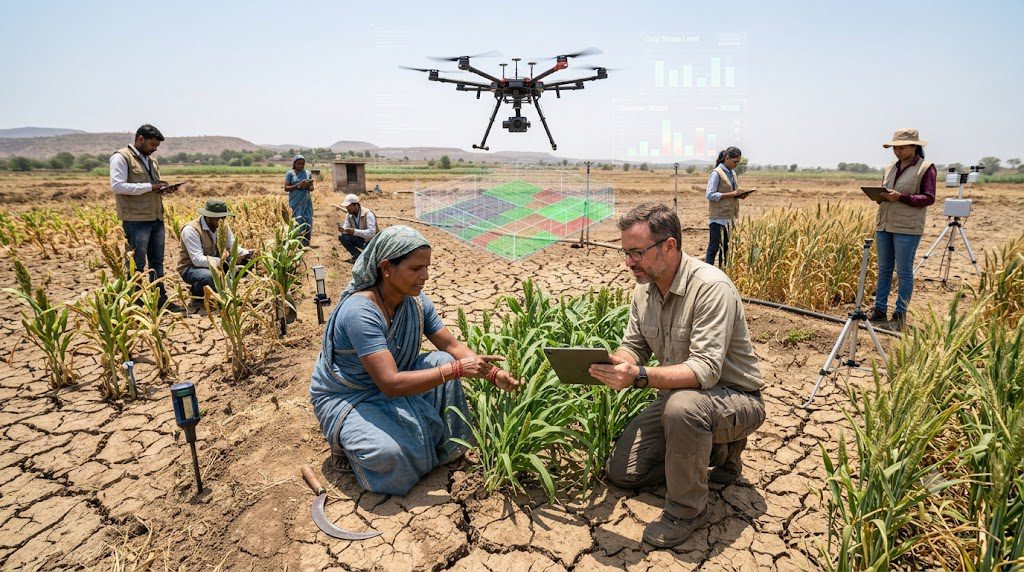
- AI-driven phenotyping : drone and hyperspectral imaging technology now allows researchers to monitor thousands of test plants for stress response traits far faster than manual field observation.
- Gene editing and transgenic approaches : in some programs, targeted gene-editing techniques are used to directly introduce or enhance specific stress-tolerance traits, subject to regulatory approval in each country.
This combination of approaches is why climate-resilient crop development has accelerated meaningfully over the past several years compared to traditional decade-long breeding timelines.
Types of Climate-Resilient Crops
Climate-resilient crops are generally bred to address one or more of the following stress categories.
Drought-Tolerant Varieties
Bred for deeper or more efficient root systems, reduced water loss through leaf structure, and physiological drought-escape mechanisms like earlier flowering timed to avoid peak dry periods.
Heat-Tolerant Varieties
Focused on maintaining pollen viability and grain-fill under high temperatures, which is critical since heat stress during flowering is often more yield-damaging than heat stress at other growth stages.
Flood and Submergence-Tolerant Varieties
Bred with genes that allow the plant to survive complete submergence for an extended period, a trait that has been particularly transformative for rice varieties in flood-prone growing regions.
Salinity-Tolerant Varieties
Bred with ion-exclusion or ion-compartmentalization mechanisms that allow the plant to grow in soils with elevated salt content, relevant for coastal and irrigation-affected saline soils.
8 Powerful Ways Climate-Resilient Crops Help Farmers
- Reduced total crop loss in bad seasons. The core value of climate-resilient crops is narrowing the gap between a normal-year yield and a stress-year yield, rather than requiring a perfect season to break even.
- More predictable income planning. Yield stability across variable seasons makes it easier for farmers to plan input purchases, loan repayment, and household budgeting.
- Lower dependency on emergency irrigation. Drought-tolerant climate-resilient crops reduce how heavily a farm depends on supplemental irrigation during dry spells, which matters as water access becomes more contested.
- Better performance under heat stress during flowering. Since flowering-stage heat damage is one of the most yield-destructive stress events, heat-tolerant climate-resilient crops directly protect the most vulnerable point in the growth cycle.
- Faster recovery after flooding. Submergence-tolerant climate-resilient crop varieties can resume normal growth after floodwaters recede, rather than suffering total crop death.
- Expanded usable farmland. Salinity-tolerant climate-resilient crops make marginal, salt-affected land productive again, effectively expanding a farm’s usable growing area without new land investment.
- Reduced reliance on rescue chemical inputs. Crops under less physiological stress generally require less emergency fungicide or pesticide intervention, since stressed plants are typically more disease- and pest-susceptible.
- Improved compatibility with crop insurance planning. Lower variance in yield outcomes can support more favorable risk profiles when combined with crop insurance for farmers, since insurers and farmers alike benefit from more predictable loss patterns.
Notable Climate-Resilient Crop Varieties Already in Use
Several climate-resilient crop varieties have moved well beyond experimental trials into widespread farmer adoption.
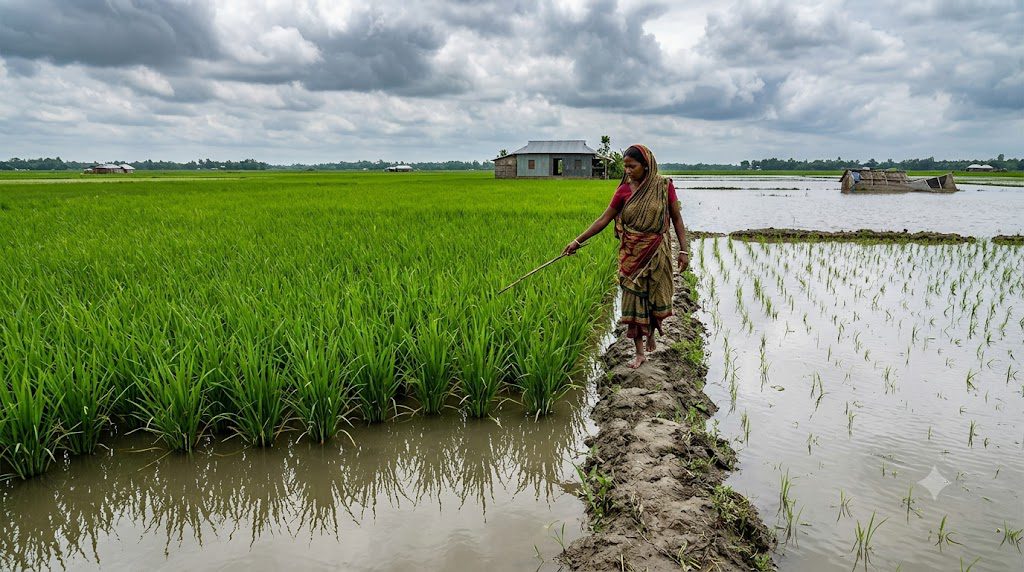
- Submergence-tolerant rice varieties carrying flood-tolerance genes have been widely adopted in flood-prone rice-growing regions of South and Southeast Asia, allowing fields to survive complete submergence for over a week without total crop loss.
- Drought-tolerant maize hybrids developed through international breeding collaborations have shown meaningfully better yield retention under water-stress conditions compared to standard hybrids in sub-Saharan Africa and parts of South Asia.
- Heat-tolerant wheat varieties bred for improved grain-fill under high terminal-season temperatures are increasingly recommended in regions where late-season heat spikes have become more common.
- Traditional millets : sorghum, pearl millet, and finger millet are increasingly promoted as naturally climate-resilient crops due to their inherently low water requirement and tolerance for poor, marginal soils, even without additional breeding intervention.
The Science Behind Stress Tolerance
Understanding roughly how climate-resilient crops survive stress helps explain why some varieties perform dramatically better than others under the same field conditions, rather than treating “stress tolerance” as a vague marketing label.
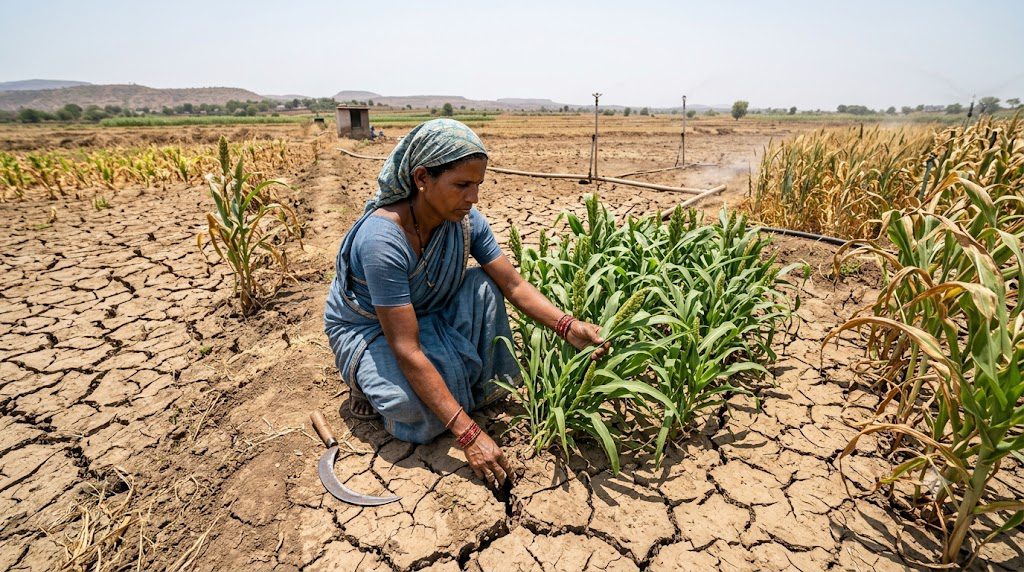
Plants respond to drought and heat stress through a combination of physiological, biochemical, and structural adaptations. Some varieties rely on drought escape accelerating their flowering and grain-fill timeline so the most vulnerable growth stages finish before peak dry-season stress arrives.
Others rely on drought avoidance, developing deeper or more extensive root systems that access soil moisture unavailable to shallow-rooted conventional varieties. A third strategy, drought tolerance at the cellular level, involves biochemical protection mechanisms that allow plant cells to maintain function even as water availability drops.
Heat tolerance in climate-resilient crops often centers on maintaining pollen viability during flowering, since pollen is frequently the most heat-sensitive structure in a plant’s reproductive cycle a few degrees of excess heat during a narrow flowering window can cause disproportionate yield loss compared to the same heat stress at other growth stages. Breeding programs increasingly prioritize this specific trait because protecting flowering-stage function has a larger yield payoff than general whole-plant heat tolerance.
For flood tolerance, the breakthrough trait in several widely adopted submergence-tolerant rice varieties is a gene that essentially tells the plant to conserve energy and stay dormant while submerged, rather than exhausting its energy reserves trying to grow toward the surface a counterintuitive strategy that dramatically improves post-flood recovery compared to varieties that respond to submergence with rapid, energy-depleting elongation growth.
This kind of trait-specific breeding targeting the exact physiological bottleneck that causes yield loss under a specific stress, rather than breeding for generic “toughness” is what separates modern climate-resilient crop development from older, less precise stress-tolerance breeding efforts.
Regional Adoption Patterns Worth Knowing
Adoption of climate-resilient crops has not moved at the same pace everywhere, and understanding why helps set realistic expectations for availability in your own region.
South and Southeast Asian rice-growing regions have seen some of the fastest and most extensive adoption of submergence-tolerant varieties, largely because flood risk in those regions is severe, well-documented, and directly tied to a widely grown staple crop, which made the case for rapid public breeding investment and distribution especially strong.
Sub-Saharan African maize-growing regions have seen substantial adoption of drought-tolerant hybrids through international breeding collaborations aimed specifically at smallholder farmers, often distributed with support from development-focused seed programs rather than purely commercial channels.
In regions with less concentrated breeding investment or more fragmented seed distribution systems, farmers may find that the newest climate-resilient crop releases take longer to reach local seed dealers, even when the underlying research already exists.
This gap between “developed” and “locally available” is one of the most underappreciated practical barriers to climate-resilient crop adoption, and it’s worth checking directly with a local agricultural extension office rather than assuming a variety covered in international agricultural news is automatically available through your usual seed supplier.
Climate-Resilient Crops vs Conventional Varieties
| Factor | Climate-Resilient Crops | Conventional Varieties |
|---|---|---|
| Peak-season yield potential | Comparable, sometimes slightly lower | Often higher under ideal conditions |
| Yield under drought/heat stress | Significantly better retained | Sharp yield decline |
| Seed cost | Often higher upfront | Generally lower |
| Water requirement | Lower to moderate | Higher, especially under stress |
| Risk profile | Lower variance across seasons | Higher variance across seasons |
| Availability | Improving, but region-dependent | Widely available |
This trade-off slightly lower peak potential in exchange for meaningfully better worst-case performance is the central decision farmers face when evaluating climate-resilient crops against the varieties they currently grow.
Cost and Availability of Climate-Resilient Seeds
Seed cost for climate-resilient crops varies significantly by crop type, region, and whether the variety comes through a public breeding program or a private seed company.
Publicly developed climate-resilient crop varieties, often released through national agricultural research systems, are frequently priced comparably to standard certified seed, since public breeding programs are typically funded to prioritize accessibility over profit margin. Privately developed hybrid climate-resilient crops, particularly drought-tolerant maize hybrids from commercial seed companies, generally carry a price premium reflecting the additional breeding investment.
Availability remains the bigger practical constraint in many regions. Not every climate-resilient crop variety developed in a research program has reached full commercial seed distribution, and farmers in some areas may need to work through local agricultural extension offices or seed cooperatives to access the latest released varieties rather than finding them through standard commercial seed retailers.
How to Choose the Right Climate-Resilient Variety for Your Farm
- Identify your dominant stress risk first. A farm primarily facing drought needs a different climate-resilient crop variety than one primarily facing flood risk don’t choose based on general marketing claims.
- Consult local agricultural extension services. Regional recommendations matter enormously, since a variety bred for one climate zone may underperform in a different one even within the same stress category.
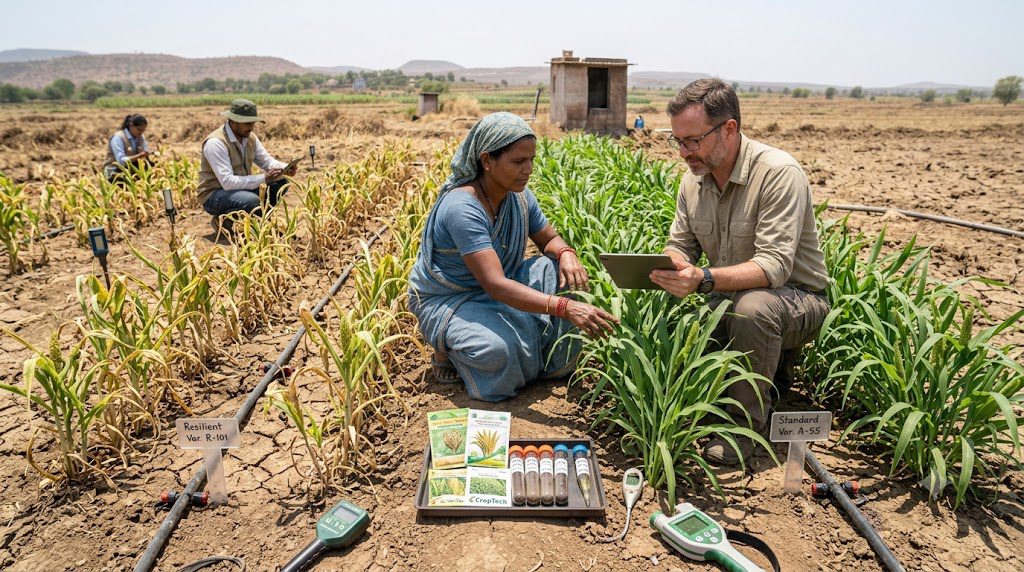
- Start with a trial plot. Before converting your full acreage, run a climate-resilient crop variety alongside your existing variety for at least one season to compare real performance on your specific soil and conditions.
- Check certification and seed source. Purchase only from verified agricultural cooperatives or licensed seed dealers to avoid counterfeit or mislabeled seed, a documented risk as demand for climate-resilient crops grows.
- Factor in your existing input program. Some climate-resilient crop varieties perform best paired with specific fertilization or irrigation adjustments check variety-specific agronomic guidance rather than assuming standard practices apply unchanged.
Common Mistakes When Switching to Climate-Resilient Crops
- Converting the entire farm in one season. Without a trial comparison, farmers can’t verify whether a given climate-resilient crop variety actually performs well under their specific local conditions.
- Assuming “climate-resilient” means “no water needed.” Drought-tolerant climate-resilient crops still require adequate water for optimal yield they simply suffer less damage when water is limited, rather than needing none at all.
- Ignoring regional variety recommendations. A climate-resilient crop variety proven in one climate zone may not transfer well to a different soil type or rainfall pattern.
- Skipping agronomic adjustment. Treating a new climate-resilient crop variety with the exact same fertilization and spacing practices as the old variety can understate its real yield potential.
- Buying uncertified seed to save money. Counterfeit or mislabeled seed sold as “climate-resilient” without proper certification is a growing risk as demand outpaces verified supply in some regions.
Limitations Farmers Should Understand
Climate-resilient crops are a genuine agronomic advance, but they aren’t a complete solution to climate risk on their own.
- They reduce risk; they don’t eliminate it. Even the best drought-tolerant variety will suffer yield loss under sufficiently extreme or prolonged stress conditions.
- Peak-season yield can be marginally lower. Some climate-resilient crop varieties trade a small amount of ideal-condition yield potential for significantly better stress-condition performance a trade-off that only pays off if stress conditions actually occur.
- Regional trial data may be limited. Newer climate-resilient crop releases may not yet have multi-season local performance data specific to your exact growing region.
- They work best combined with other practices. Climate-resilient crops paired with the soil-health improvements discussed in our biochar for soil health guide and the input-efficiency gains from nano fertilizer tend to outperform climate-resilient seed choice alone.
FAQs About Climate-Resilient Crops
Are climate-resilient crops genetically modified? Some are developed through gene-editing or transgenic methods, while many others are produced through conventional marker-assisted breeding without genetic modification the specific method varies by crop and breeding program, and regulatory status differs by country.
Do climate-resilient crops cost more than regular seed? Publicly developed varieties are often priced comparably to standard certified seed, while privately developed hybrid climate-resilient crops typically carry a price premium reflecting additional breeding investment.
Can climate-resilient crops completely prevent drought-related crop loss? No. They significantly reduce yield loss under stress compared to conventional varieties, but severe or prolonged extreme conditions can still cause meaningful damage even to a well-bred stress-tolerant variety.
Which crops currently have the most developed climate-resilient varieties? Rice, wheat, and maize have the most extensively developed and field-tested climate-resilient varieties, given decades of dedicated international breeding investment in these staple crops.
Should I switch my entire farm to climate-resilient crops immediately? No. Agricultural extension guidance generally recommends a trial-plot approach first, comparing performance against your existing variety for at least one full season before scaling up.
Are traditional millets considered climate-resilient crops? Yes. Sorghum, pearl millet, and finger millet are widely recognized as naturally climate-resilient due to their inherently low water requirement and tolerance for marginal soil conditions, even without additional breeding intervention.
Final Thought
Climate-resilient crops aren’t a guarantee against a bad season, but they are one of the most direct tools available for narrowing the gap between a normal year and a disaster year which, given how unpredictable weather patterns have become, is often the more realistic goal to plan around.
Start with a trial plot matched to your specific stress risk, verify seed source and certification carefully, and treat the switch as a multi-season evaluation rather than a one-time decision, and climate-resilient crops can become a genuine stabilizing factor in your farm’s long-term risk profile.