
Table of Contents
Crop insurance for farmers exists for one blunt reason: a single bad season a flood, a hailstorm, a pest outbreak, or a drought can wipe out a year of investment in seed, fertilizer, labor, and land preparation. Without crop insurance for farmers, that loss falls entirely on the household. With it, a defined share of that loss is recoverable.
This guide walks through how crop insurance for farmers actually works, what it costs, what it covers, where most farmers lose out on claims, and the specific steps to take when a season goes wrong.
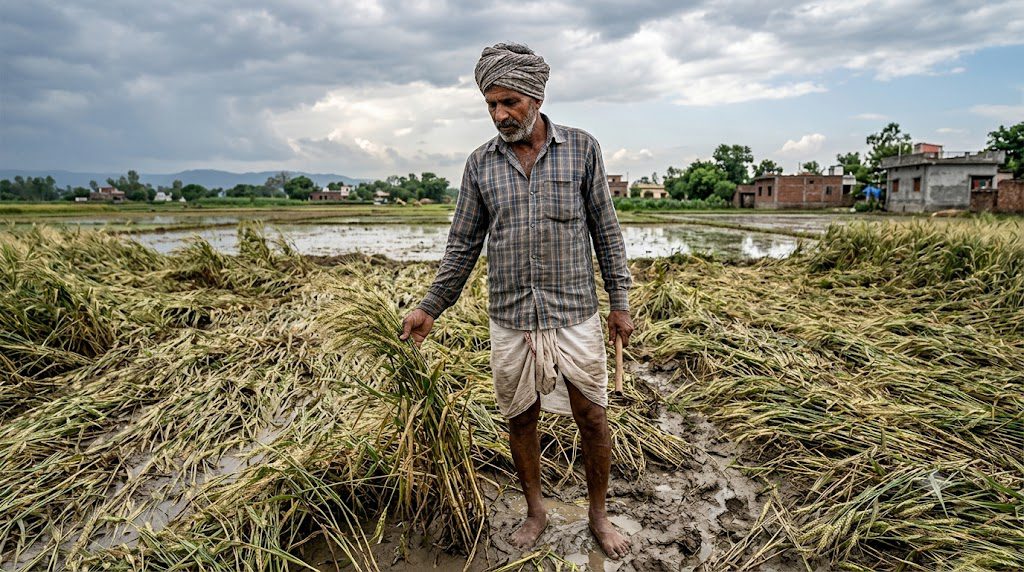
What Is Crop Insurance for Farmers?
Crop insurance for farmers is a risk-protection product, typically subsidized by government, that compensates farmers for financial loss when a notified crop is damaged or fails due to defined perils natural disasters, pest attacks, disease outbreaks, or, in revenue-based policies, a sharp drop in commodity prices.
Unlike a private savings buffer, crop insurance for farmers pools risk across a large number of policyholders and a government subsidy, which is why premiums can be kept low relative to the actual value of the protection provided.
Two broad categories exist:
- Yield-based crop insurance : pays out when actual harvest yield falls below a defined threshold compared to a historical average
- Revenue-based crop insurance : pays out when total revenue (yield multiplied by price) falls below a guaranteed level, protecting against price crashes as well as physical crop loss
Most government-backed crop insurance for farmers programs, including India’s flagship scheme, are structured primarily around yield-based protection.
Why Crop Insurance for Farmers Matters More in 2026
Several factors are making crop insurance for farmers a more urgent conversation this year than in the past.
1. Weather volatility is increasing. Erratic monsoon timing, unseasonal rainfall, and more frequent extreme heat events are raising the baseline risk every farmer carries into a season.
2. Input costs keep rising. As seed, fertilizer, and labor costs climb, the financial exposure from a single failed season grows larger every year, making crop insurance for farmers a bigger financial safety net in absolute terms.
3. Government enrollment deadlines are strict and seasonal. Programs like PMFBY operate on fixed enrollment windows tied to the Kharif and Rabi cropping seasons, and missing the deadline means no coverage for that entire season regardless of circumstances.
4. Digital claim processing has improved. Technology-based yield estimation and satellite/remote-sensing damage assessment are making crop insurance for farmers faster and less dispute-prone than the manual assessment processes of a decade ago.
5. Credit access is often tied to insurance. Many lending institutions now factor crop insurance for farmers into loan approval and interest terms, since it reduces the lender’s own risk exposure on agricultural credit.
How Crop Insurance for Farmers Works
The mechanics of crop insurance for farmers follow a consistent structure across most government-backed schemes, even though details vary by country.
- Notification of crops and areas. Government authorities notify which crops and which administrative areas (district, block, or county) are eligible for coverage in a given season.
- Enrollment before the deadline. Farmers enroll sometimes automatically if they hold a crop loan, and voluntarily if they don’t before the season’s cutoff date.
- Premium payment. Farmers pay a small percentage of the total sum insured, with the government covering the majority share of the actual premium cost.
- Loss event occurs. A qualifying peril damages the crop could be localized (a single farm hit by hail) or widespread (a regional drought).
- Loss reporting. For localized damage, the farmer must typically report the loss to the insurer within a strict window, often 72 hours, through a mobile app, toll-free number, or local agricultural office.
- Assessment. Either individual field assessment (for localized claims) or area-level yield estimation (for widespread calamities) determines the payout amount.
- Payout. Compensation is transferred, often directly to the farmer’s bank account, based on the assessed shortfall against the guaranteed yield or sum insured.
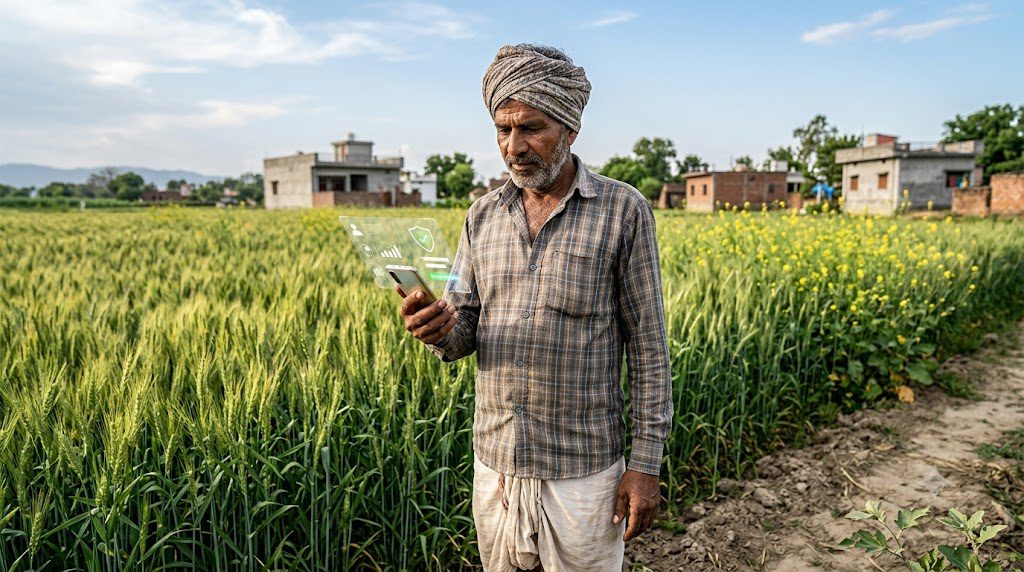
Types of Crop Insurance Coverage
Crop insurance for farmers typically bundles several distinct risk categories into one policy.
Standing Crop Coverage
Covers the period from sowing to harvest against widespread calamities like drought, flood, and pest attack the core protection most farmers rely on.
Post-Harvest Loss Coverage
Covers crops for a short window (often up to two weeks) after harvest, while they are drying in the field, against risks like unseasonal rain or cyclonic weather.
Localized Risk Coverage
Covers isolated, farm-specific damage from hailstorm, landslide, or lightning-caused fire events that affect individual farms rather than an entire region.
Prevented Sowing / Planting Coverage
Some crop insurance for farmers policies also cover situations where adverse conditions prevent sowing altogether, compensating for the inability to plant rather than crop failure after planting.
10 Essential Facts About Crop Insurance for Farmers
- Coverage is available for most notified crops, though the specific list of insurable crops varies by district, state, or county.
- Sharecroppers and tenant farmers are typically eligible, not just landowners, under most modern crop insurance for farmers schemes.
- Premiums are heavily subsidized. Farmers typically pay only a small fraction of the actual premium cost, with government absorbing the majority share.
- Enrollment is often automatic for loanee farmers, meaning those who take a crop loan may be enrolled by default unless they actively opt out.
- Claim reporting windows are strict. Missing the loss-intimation deadline often as short as 72 hours for localized damage is one of the most common reasons claims are rejected.
- Payouts can take time. Area-level assessments, especially after widespread calamities, require yield data collection that can delay settlement by weeks or months.
- Technology is speeding up assessment. Satellite imagery, drone surveys, and mobile-based crop-cutting experiments are increasingly used to reduce disputes and manual assessment delays.
- Coverage amount is tied to cost of cultivation. The sum insured is generally set based on the average cost of growing that crop in that specific district, not a flat national figure.
- Multiple schemes may coexist. Some regions offer both a national program and supplementary state-level or private crop insurance for farmers products that can be layered together.
- Non-renewal each season is common and risky. Because most schemes require season-by-season enrollment, farmers who don’t actively re-enroll can find themselves uninsured without realizing it until a loss event occurs.
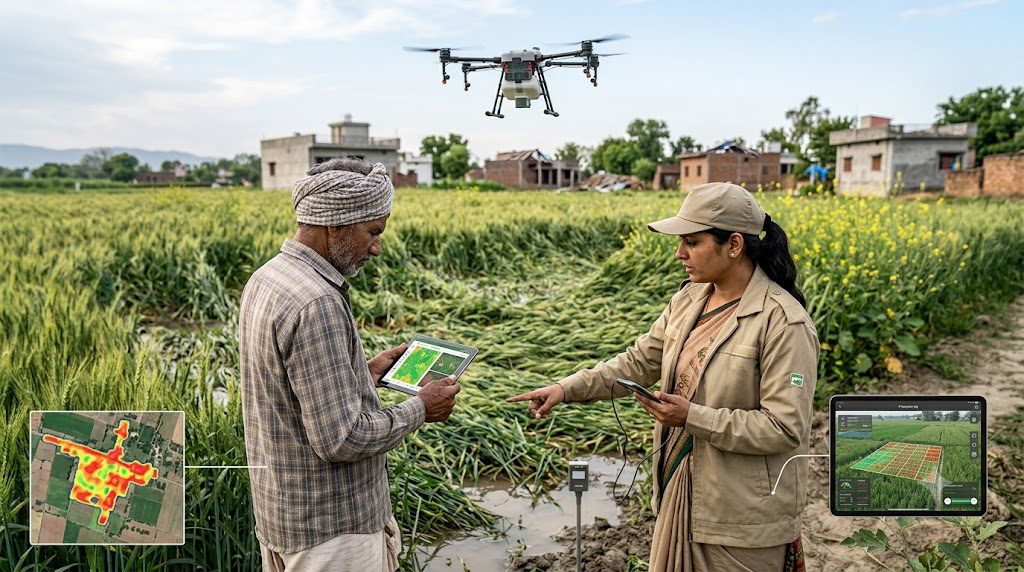
PMFBY: India’s Flagship Crop Insurance Scheme
The Pradhan Mantri Fasal Bima Yojana (PMFBY), launched in 2016, is the primary government-backed crop insurance for farmers program in India, replacing several earlier schemes with a single national framework.
Under PMFBY, farmer premium contributions are capped at a small percentage of the sum insured commonly around 2% for Kharif crops, 1.5% for Rabi crops, and a modestly higher rate for commercial and horticultural crops with the government covering the remaining premium cost.
The scheme is implemented through the National Crop Insurance Portal, where farmers can check notified crops for their district, calculate premium obligations, enroll, and track claim status. Enrollment for each cropping season operates on a fixed deadline, and farmers should confirm the current season’s cutoff date directly on the portal well in advance, since missing it forfeits coverage entirely for that season.
Reporting a localized crop loss under PMFBY generally requires notifying the insurer within 72 hours of the damage event a detail that trips up more farmers than any other part of the claims process, since damage assessment and documentation often get delayed past that narrow window during a stressful loss event.
Crop Insurance for Farmers in the United States
In the United States, crop insurance for farmers is administered through the Federal Crop Insurance Corporation, managed by the USDA’s Risk Management Agency (RMA), under the framework established by the Federal Crop Insurance Act.
The federal government subsidizes a substantial share of the premium cost, and the program covers well over 100 different crops, though not every crop is insurable in every county. Major row crops corn, cotton, soybeans, and wheat account for the large majority of total enrolled acreage nationally.
U.S. farmers can choose between yield-based multi-peril crop insurance, which protects against a wide range of natural perils including drought, flood, and pest damage, and revenue-based policies that also protect against price declines. Coverage is delivered through private insurance companies but reinsured by the federal government, combining private-sector service delivery with public-sector risk backing.
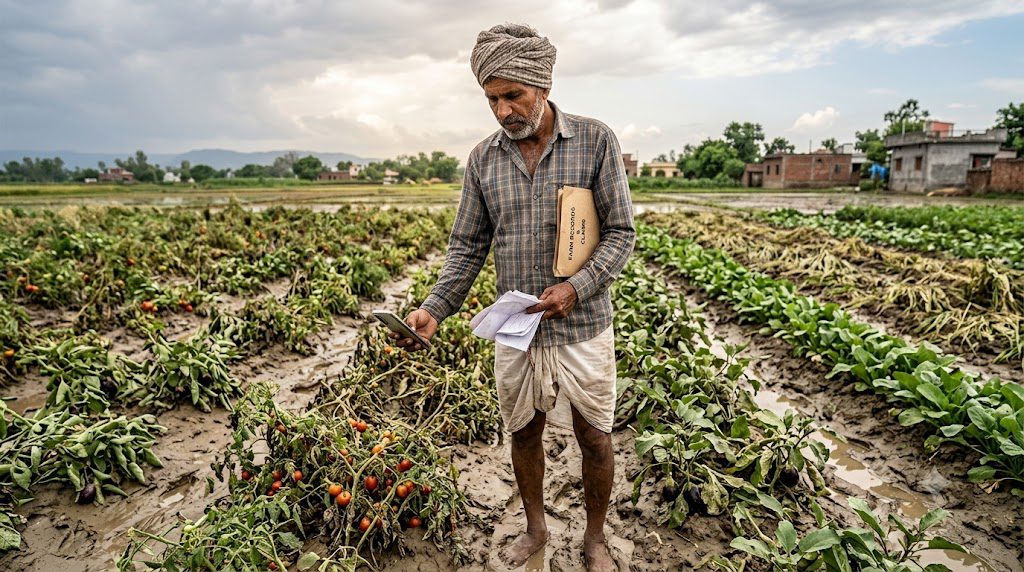
Crop Insurance Premium and Cost Breakdown
Actual out-of-pocket premium cost for crop insurance for farmers depends heavily on crop type, region, and coverage level, but the general structure is consistent.
| Crop Category | Typical Farmer Premium Share | Government Subsidy Share |
|---|---|---|
| Kharif food & oilseed crops (India) | ~2% of sum insured | Remaining balance |
| Rabi food & oilseed crops (India) | ~1.5% of sum insured | Remaining balance |
| Commercial/horticultural crops (India) | ~5% of sum insured | Remaining balance |
| U.S. multi-peril crop insurance | Varies by coverage level chosen | Averages roughly 60%+ of premium |
The sum insured itself the maximum payout ceiling is generally calculated from the average cost of cultivation for that crop in that specific district or county, which is why coverage amounts differ meaningfully even for the same crop grown in different regions.
How to Enroll in Crop Insurance for Farmers
- Check your notified crop list. Confirm which crops are eligible for crop insurance for farmers in your specific district or county for the current season.
- Gather required documents. Typically includes land records or proof of cultivation, identity documents, and bank account details for direct payout transfer.
- Enroll before the seasonal deadline. Whether through a bank (for loanee farmers), an online portal, or a local agricultural office, complete enrollment well before the cutoff date.
- Pay your premium share. Confirm the exact premium amount based on your crop, area, and district-specific sum insured before the deadline.
- Save your policy confirmation. Keep the policy number and confirmation details accessible, since you’ll need them if you ever need to report a loss.
- Mark the loss-reporting window on your calendar. Knowing the exact intimation deadline (often 72 hours) before a loss event happens saves critical time during an actual emergency.
How to File a Crop Insurance Claim: Step-by-Step
- Report the loss immediately. Use the mobile app, toll-free helpline, or local agricultural office designated by your crop insurance for farmers program do not wait to assess full damage first.
- Provide policy and loss details. Policy number, crop type, affected area, and cause of loss are typically required at the time of reporting.
- Allow field assessment. For localized claims, an assessor will typically visit to verify and document the damage.
- Track claim status online, where available, to monitor progress rather than relying solely on follow-up calls.
- Follow up in writing if delayed. If assessment or payout is significantly delayed, escalate through the official grievance mechanism rather than letting the claim quietly stall.
- Confirm payout against your sum insured. Compare the settlement amount received against your policy’s documented sum insured to verify accuracy.
Common Reasons Crop Insurance Claims Get Rejected
- Missed reporting deadline. This is, by a wide margin, the most common and most avoidable reason claims fail a 72-hour or similarly short window is easy to miss during an actual crisis.
- Crop or area not notified. Filing a claim for a crop or location not officially notified under that season’s crop insurance for farmers program results in automatic rejection.
- Incomplete or mismatched documentation. Discrepancies between land records, enrollment details, and claim documentation can delay or invalidate a claim.
- Cause of loss not covered. Some perils, particularly those resulting from poor agronomic practice rather than a genuine natural calamity, fall outside standard coverage.
- Lapsed enrollment. Farmers who assume a prior season’s enrollment carries forward automatically, when it does not, can discover too late that they were uninsured for the current season.
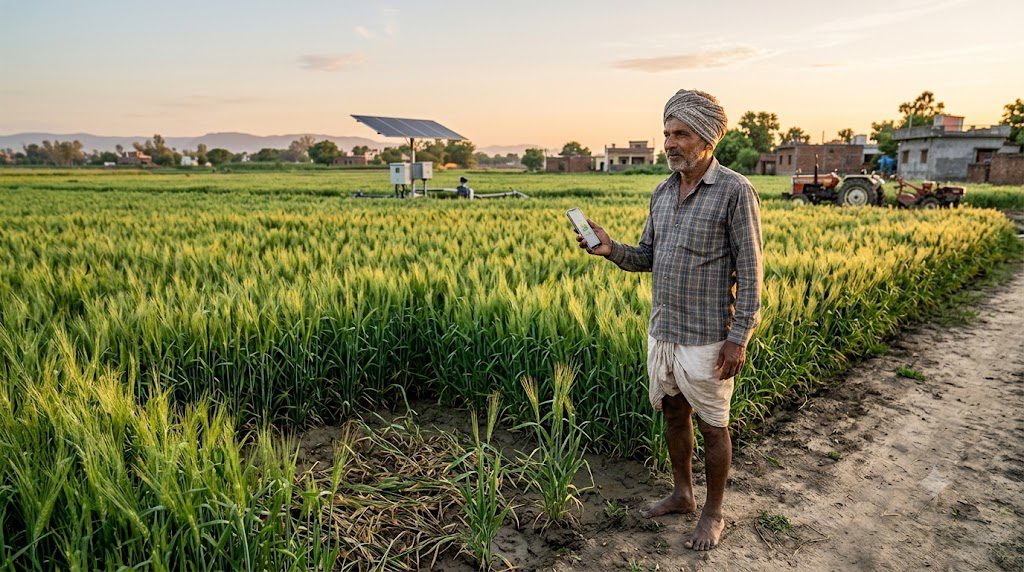
The Real Scale of PMFBY: What the Numbers Show
It’s worth looking at actual program-level numbers before deciding how seriously to take crop insurance for farmers, rather than treating it as an abstract government scheme.
Since its 2016 launch, PMFBY has paid out well over ₹1.83 lakh crore in crop loss claims to Indian farmers a payout figure that runs to roughly five times the total premium amount collected directly from farmers over that period.
That ratio is the clearest evidence that the subsidized-premium model is functioning as intended: farmers are receiving far more in claim value than they contribute in premium, with the difference covered by the government subsidy pool.
For the Kharif 2026 season specifically, the national enrollment deadline was set for July 31, 2026, administered through the National Crop Insurance Portal and delivered through a panel of empanelled insurers operating across different states and districts.
Deadlines like this are set well in advance and publicized through agricultural offices, but they still catch a meaningful number of farmers off guard each season particularly those who assume enrollment renews automatically.
The practical lesson from the payout data isn’t “insurance always pays out generously.” It’s that the farmers who actually receive the benefit are the ones who enrolled correctly, within the crop and area notification rules, and reported losses within the required window. The scheme’s overall generosity at a program level says nothing about an individual farmer’s outcome if the procedural basics were missed.
Common Mistakes Farmers Make With Crop Insurance
- Assuming enrollment carries over automatically. Except for loanee farmers under specific conditions, most crop insurance for farmers programs require active re-enrollment every single season.
- Waiting to “assess full damage” before reporting. The reporting clock starts at the moment of the damage event, not once you’ve calculated the total extent of loss delaying the report to get a complete picture is one of the most common ways farmers miss the intimation window entirely.
- Not confirming which crops are notified in their specific district. A crop can be insurable in a neighboring district and not in yours, and farmers sometimes discover this only after a loss occurs.
- Losing or discarding policy documentation. Policy numbers and enrollment confirmations are frequently needed months after enrollment, at a point when the original paperwork has already been misplaced.
- Treating the scheme as identical every season. Premium rates, notified crops, and even the administering insurer for a district can change season to season, so re-verifying details each cycle matters more than farmers often assume.
- Not escalating a stalled claim. Farmers sometimes wait passively for a delayed payout rather than using the official grievance or escalation mechanism available under most crop insurance for farmers programs.
Crop Insurance vs Self-Insuring: A Comparison
| Factor | Crop Insurance for Farmers | Self-Insuring (No Coverage) |
|---|---|---|
| Upfront cost | Low, subsidized premium | None |
| Protection against widespread calamity | Strong | None |
| Predictability of recovery | Structured payout process | Entirely dependent on personal savings |
| Access to credit | Often improves loan terms | May limit lender willingness |
| Risk in a bad season | Partial loss, recoverable | Full loss, unrecoverable |
This is why crop insurance for farmers is increasingly treated as a baseline risk-management tool rather than an optional add-on, particularly for farms already carrying debt from the practices covered in our sustainable farming guide.
FAQs About Crop Insurance for Farmers
Is crop insurance for farmers mandatory? In many programs, it is mandatory for farmers who have taken a crop loan (unless they actively opt out) and voluntary for non-loanee farmers, though specific rules vary by country and scheme.
How much does crop insurance for farmers actually cost? Farmer premium contributions are typically a small, capped percentage of the total sum insured, with government subsidy covering the majority of the real premium cost.
What happens if I miss the enrollment deadline? You forfeit coverage for that entire cropping season. Most schemes do not offer late enrollment exceptions, regardless of the reason for missing the deadline.
How long does it take to receive a crop insurance payout? Localized claims with individual field assessment can settle faster; widespread calamity claims requiring area-level yield data collection often take significantly longer, sometimes weeks to months.
Can tenant farmers and sharecroppers get crop insurance? Yes, most modern crop insurance for farmers schemes explicitly extend eligibility to sharecroppers and tenant farmers, not just landowners, provided they can demonstrate insurable interest in the crop.
Does crop insurance cover losses from poor farming decisions? No. Crop insurance for farmers covers defined natural perils, pest and disease outbreaks, and similar unforeseen events it does not cover losses attributable to negligence or avoidable poor agronomic practice.
Final Thought
Crop insurance for farmers is one of the few risk-management tools that costs relatively little upfront and can prevent a single bad season from becoming a multi-year financial setback. The value of the protection depends entirely on getting the basics right enrolling before the deadline, understanding your specific coverage, and knowing the exact reporting window before you ever need to use it.
The farmers who benefit most from crop insurance for farmers are rarely the ones who bought a policy and forgot about it. They’re the ones who treat the enrollment deadline and claim procedure with the same seriousness as planting and harvest timing itself.
Pingback: Kisan Credit Card Scheme: 9 Essential Benefits Every Farmer Should Know in 2026 -