
Table of Contents
Laser weeding technology is one of the few agritech categories in 2026 that has moved past the demo stage and onto real farms with real invoices attached to it. Instead of spraying a field or paying a crew to hand-pull weeds, a machine now drives (or is towed) through the rows, uses onboard cameras to tell a crop leaf from a weed leaf in milliseconds, and fires a high-powered laser that kills the weed with heat no chemicals, no blade, no soil disturbance.
This isn’t a lab concept. Carbon Robotics alone has over 200 LaserWeeder units deployed across U.S. farms, and the broader automated weeding robot market hit roughly $2.6 billion in 2025, growing at more than 27% a year the fastest growth rate of any agricultural technology segment right now.
This guide breaks down what laser weeding technology actually is, what it costs, who’s building it, which crops it works best on, and where the real limitations sit without the marketing gloss.
What Is Laser Weeding Technology?
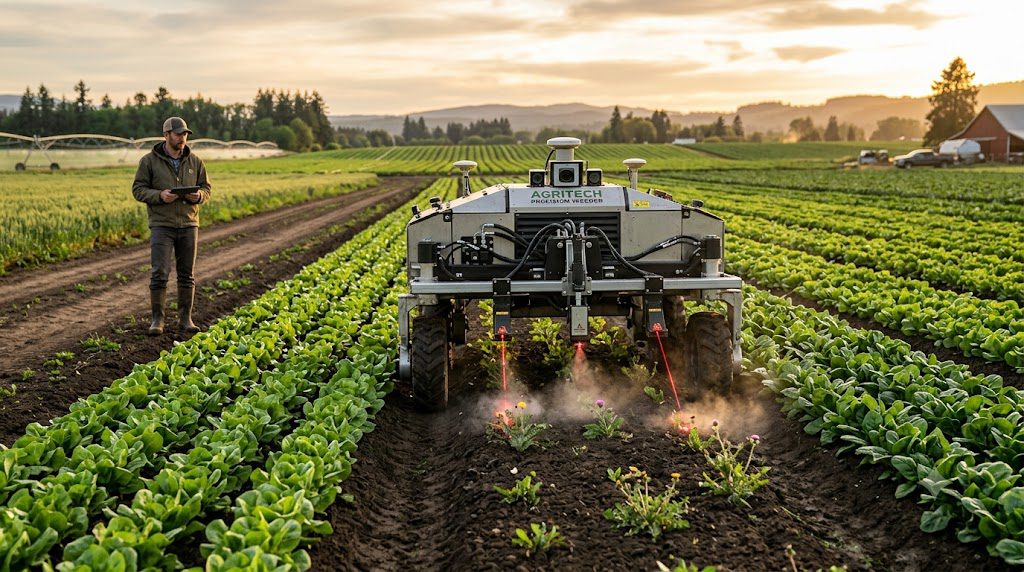
Laser weeding technology is a method of weed control that uses computer vision, artificial intelligence, and focused laser beams to identify and destroy weeds without chemical herbicides or mechanical tillage.
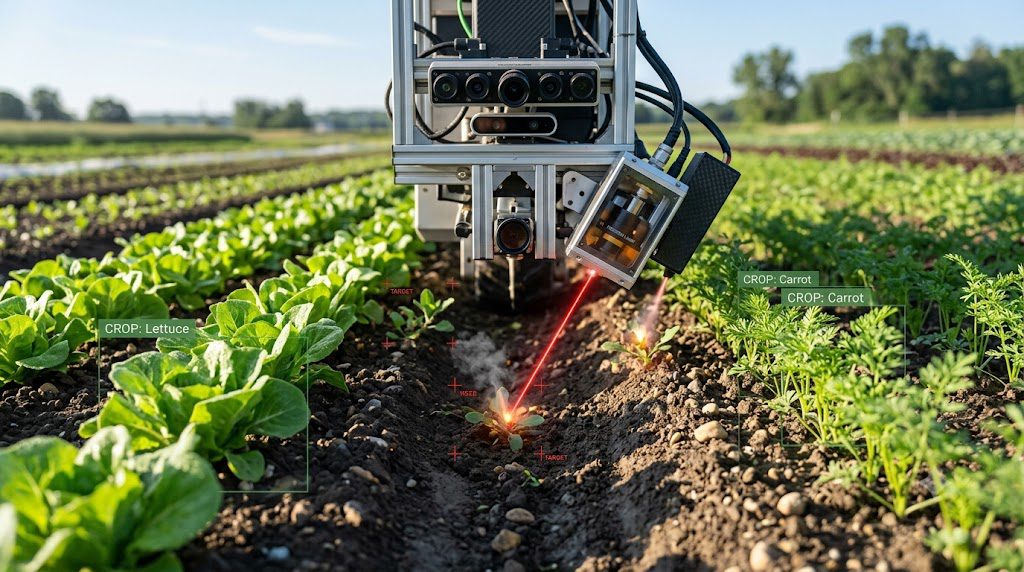
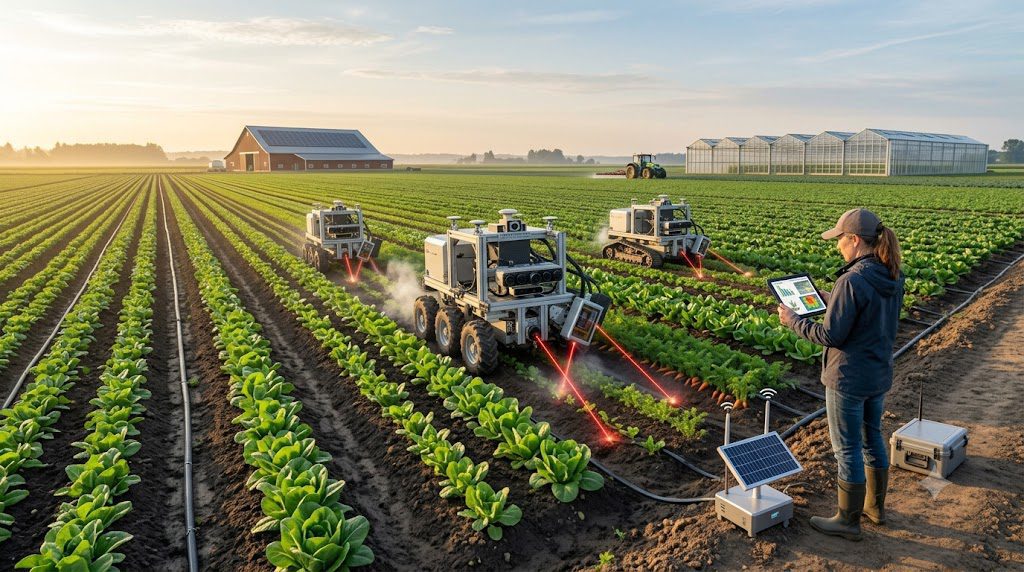
A typical system works like this: high-resolution cameras mounted on a rig scan the ground as it moves through a field. An onboard AI model, trained on thousands of images, distinguishes crop seedlings from weeds in real time. Once a weed is confirmed, a CO₂ laser fires at it with millimeter-level precision, damaging the plant’s growing point so it dies without ever needing a drop of herbicide.
The appeal is straightforward. Herbicide resistance is a growing problem, labor for hand-weeding is increasingly hard to find and expensive, and organic operations have almost no scalable non-chemical weed control option today. Laser weeding technology is being pitched as the answer to all three at once.
Why Laser Weeding Technology Is Trending in 2026
A few forces are pushing this category from niche to mainstream this year.
1. Labor shortages have gotten worse, not better. Agriculture faces an estimated 2.4-million-person annual farm labor gap globally, and hand-weeding crews are some of the hardest positions to fill season after season.
2. Herbicide resistance keeps climbing. Weeds resistant to common herbicide classes are spreading across major row-crop regions, making chemical-only strategies less reliable than they were a decade ago.
3. AI vision models finally got good enough. Distinguishing a weed seedling from a crop seedling in real time, in variable light, at tractor speed, was the technical bottleneck for years. Deep-learning models trained on massive image datasets have closed that gap enough for commercial deployment.
4. Robot-as-a-service pricing removed the capital barrier. Early laser weeders cost $500,000 to $1.2 million to buy outright, which priced out mid-sized farms entirely. Newer per-acre service models are changing that math.
5. Retailers and buyers are asking about chemical use. Supply chains increasingly want documented reductions in herbicide application, and laser weeding technology gives growers something concrete to point to.
6. Investment capital keeps flowing in. Carbon Robotics alone has raised more than $90 million across multiple funding rounds since 2021, and competitors are attracting similar attention from agtech-focused venture funds. That capital is funding faster iteration cycles, which means the vision models and laser hardware improve every season rather than every few years.
Taken together, these forces explain why laser weeding technology has moved from a trade-show novelty to a line item farm managers are actually budgeting for in 2026.
How Laser Weeding Technology Actually Works
The Vision System
Most laser weeding technology platforms use 10 to 12 high-resolution cameras paired with machine-learning models trained to recognize specific crop and weed species. This step happens continuously as the machine moves, not as a one-time scan.
The Laser Array
Once a weed is flagged, one of several onboard CO₂ lasers (commercial units use 20 to 30) fires at the weed’s growing point. Systems like Carbon Robotics’ LaserWeeder can identify and eliminate more than 200,000 weeds per hour, with laser targeting accurate to roughly 3 millimeters.
The Chassis
Some laser weeding technology units are fully autonomous and self-driving through the field using GPS guidance and geo-fencing. Others, like early LaserWeeder models, are pulled behind a standard tractor, meaning a driver still needs to be present even though the weeding itself is automated.
Field Speed
Depending on the platform, laser weeding technology systems currently cover 15 to 20 acres per day, which is a fraction of what a broadcast herbicide sprayer covers, but far ahead of any hand-weeding crew.
Laser Weeding Technology vs. Herbicides vs. Hand Weeding
| Method | Chemical Use | Speed | Cost per Acre | Soil Impact |
|---|---|---|---|---|
| Herbicide spraying | High | Very fast | Low upfront, ongoing chemical cost | Can affect soil microbiome over time |
| Hand weeding | None | Very slow | $700–$900/acre in labor | Minimal |
| Laser weeding technology | None | Moderate | Varies by model, often lower over time | Minimal no tillage, no chemical residue |
The honest takeaway: laser weeding technology doesn’t win on raw speed against a sprayer, but it wins decisively against hand-weeding on cost, and it’s the only method of the three that eliminates both chemical residue and labor dependency at the same time.
Real Costs and ROI: What Farms Are Actually Paying
Numbers here vary a lot by manufacturer and business model, so treat every figure as a starting point for your own due diligence, not a guarantee.
Purchase-model pricing: Carbon Robotics’ LaserWeeder units have listed in the $500,000 to $1.2 million range depending on size and generation, with smaller entry-level configurations reportedly closer to $25,000–$50,000 for scaled-down units aimed at specialty growers.
A documented case study: A Western Growers report on two Salinas Valley farms found that Braga Fresh, a 30,000-acre organic and conventional produce operation, previously hand-weeded organic baby leaf crops with three crews of 25 workers at roughly $900 per acre. After deploying two LaserWeeders across 4,700 acres, labor costs on that acreage dropped sharply, even after accounting for the machine’s own operating cost of roughly $267 per acre when run 18 hours a day on a 5-year depreciation schedule.
Robot-as-a-service pricing: FarmWise’s Titan platform, priced around $350,000 if purchased outright, is now largely offered as a per-acre service instead. Growers pay based on weed density rather than owning the machine, which removes the six-figure capital decision that keeps a lot of mid-sized farms out of this market entirely.
Reported savings ranges: Vendor-published ROI models suggest 77% to 80% reductions in herbicide or labor cost depending on the crop and prior weeding method, with payback periods estimated around two years for high-value, weed-intensive crops like onions, carrots, and leafy greens.
The pattern across every credible source: laser weeding technology pencils out fastest on labor-intensive, high-value specialty crops, not on cheap, low-margin row crops at least with current machine speeds and pricing.
7 Ways Laser Weeding Technology Is Changing Farms
- Cutting hand-weeding labor costs by up to 80% on crops like onions, carrots, and leafy greens where manual weeding was previously unavoidable.
- Reducing herbicide application by 77% to over 90% on farms that adopt laser weeding technology as a primary weed control method rather than a supplement.
- Opening a scalable path for organic certification by giving organic growers a non-chemical method that doesn’t depend on finding enough manual labor every season.
- Improving soil health indirectly by eliminating the tillage some farms used purely for mechanical weed control.
- Enabling night and low-light operation, since laser weeding technology systems use their own lighting arrays and don’t depend on daylight the way hand crews do.
- Creating a documentation trail for supply chain buyers who increasingly want proof of reduced chemical inputs, not just a claim.
- Shifting the farm labor conversation from “how do we find more workers” to “how do we supervise fewer, more skilled machine operators,” which is a structurally different staffing problem.
Major Players Building Laser Weeding Technology
Carbon Robotics is the most visible name in this space, having raised over $90 million across multiple funding rounds and deployed its LaserWeeder across more than 200 units in the U.S. and Canada. The company reports its systems have eliminated hundreds of millions of weeds across dozens of crop types.
FarmWise takes a different commercial approach with its Titan FT-35 platform, leaning into a robot-as-a-service model rather than outright machine sales, which has made it more accessible to mid-sized operations.
Smaller and emerging entrants are also testing laser and precision-targeting weeders for row crops like corn, soybeans, and wheat a segment none of the current commercial leaders have fully cracked yet, since existing machines are largely built for specialty crops under three feet tall.
If you’re comparing vendors, ask each one directly for a per-acre cost estimate based on your specific crop and weed density rather than relying on published averages, since pricing and performance both vary significantly by region and crop type.
Beyond these two, a wider field of startups is racing to build laser and precision-targeting weeders for markets the current leaders haven’t fully addressed, including row crops, vineyards, and orchard understories. None have reached the deployment scale of Carbon Robotics or FarmWise yet, but the competitive pressure is pushing prices down and field speeds up faster than early adopters expected even two years ago. Expect this list of major players to look different by 2028 as consolidation and new entrants both reshape the category.
Best Crops and Farm Types for Laser Weeding Technology
Laser weeding technology currently performs best on:
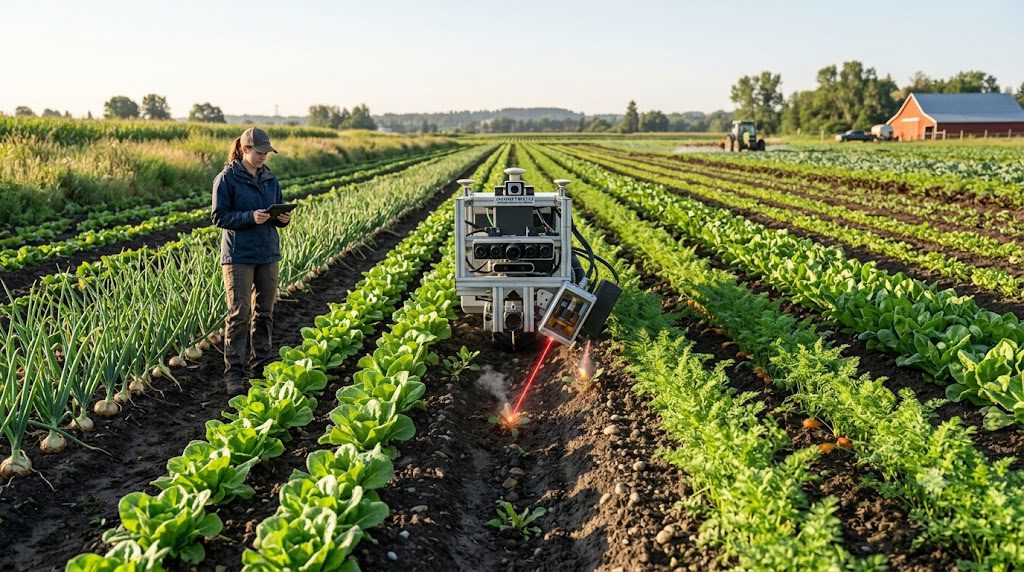
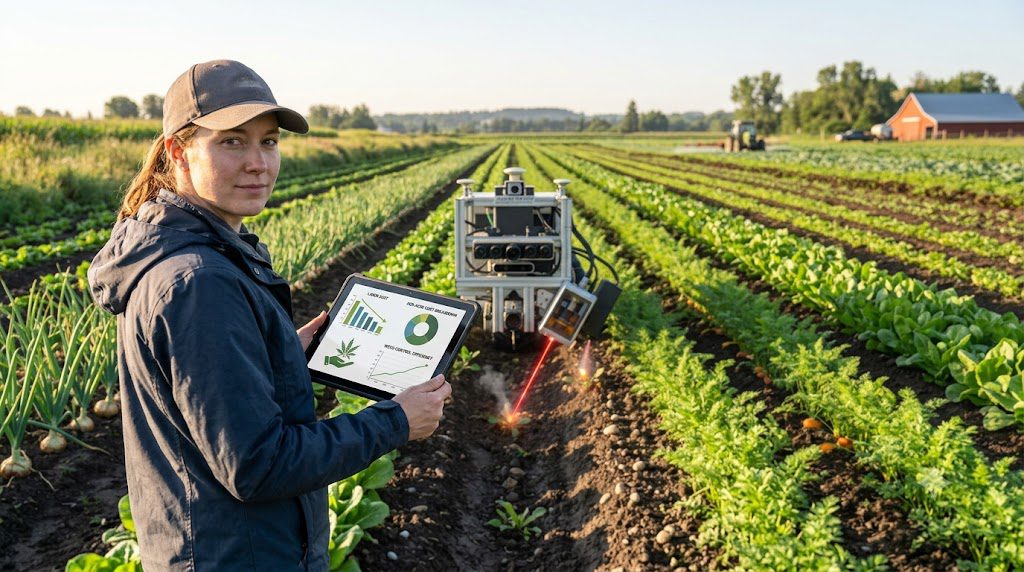
- Specialty vegetable crops such as onions, carrots, lettuce, broccoli, celery, and cauliflower
- Organic operations where herbicide use isn’t an option and hand-weeding has been the only alternative
- High-value, labor-intensive acreage where the cost of hand crews already justifies a capital investment
- Operations with consistent row spacing, since current machines are calibrated to specific bed and row configurations
It is currently a weaker fit for large-acreage commodity row crops like corn, soybeans, and wheat, where field speed and per-acre economics still favor herbicide programs though several manufacturers are actively testing that use case.
Environmental and Soil Health Benefits
Beyond the labor and cost angle, laser weeding technology carries genuine environmental upside. Eliminating herbicide application removes a source of groundwater and runoff contamination that has been a long-standing concern in intensive vegetable production regions. It also avoids the soil compaction and structural disruption that comes from repeated mechanical cultivation used purely for weed control.
For farms already pursuing sustainable farming practices or building documentation for carbon credit programs, reduced chemical inputs and lower tillage frequency can support the same soil-carbon and biodiversity metrics those programs already ask growers to track making this a rare case where a cost-saving technology and an environmental compliance goal point in the same direction.
There’s a secondary environmental angle worth naming directly: herbicide drift and runoff have been linked to declines in pollinator populations and nearby waterway health in intensively farmed regions. Because laser weeding technology uses heat rather than chemistry, it removes that drift risk entirely from the fields where it’s deployed. That’s not a marketing claim from a manufacturer it’s a straightforward consequence of not spraying anything at all.
The Learning Curve: What Adopting Laser Weeding Technology Means for Your Team
Buying or leasing a machine is the easy part. The harder, less-discussed part of adopting laser weeding technology is the operational shift it requires from your team.
Operators need new skills, not old ones. Running a laser weeder is closer to supervising a piece of precision equipment than driving a tractor. Most manufacturers provide initial training, but farms report a real learning curve in the first season around calibration, troubleshooting camera misreads, and understanding when the AI model needs retraining for a new crop variety.
Maintenance looks different too. CO₂ lasers, high-resolution cameras, and onboard computers require a different maintenance skill set than a diesel engine or a spray rig. Some farms have found it worth budgeting for a dedicated technician, either in-house or through the manufacturer’s service contract, rather than assuming existing equipment staff can absorb the work.
Expect a season of tuning, not instant results. Vision models perform better as they see more of your specific fields, weed pressure, and lighting conditions. Farms that treat the first season as a calibration period, rather than expecting maximum efficiency from day one, tend to report smoother adoption and more accurate long-term cost comparisons.
None of this is a reason to avoid the technology. It’s a reason to budget the transition honestly, the same way you would for any major piece of new equipment, rather than assuming a laser weeder slots into your existing workflow with zero adjustment period.
Limitations and Risks Worth Knowing
No credible source on laser weeding technology pretends it’s a universal fix. The real limitations include:
- High upfront capital cost for purchase models, which still puts this out of reach for many small and mid-sized farms without a service-based alternative
- Limited field speed compared to broadcast herbicide spraying, covering roughly 15–20 acres per day versus hundreds of acres for a sprayer
- Crop height restrictions, since most current systems are built for crops under three feet tall
- Weather and terrain sensitivity, with performance depending on consistent bed shape and manageable field conditions
- Limited row-crop validation, since most commercial success stories so far come from specialty vegetable operations rather than corn, soybean, or wheat farms
Any vendor claiming laser weeding technology is a drop-in replacement for every weed control method on every crop type is overselling the current state of the technology.
How to Evaluate Laser Weeding Technology for Your Farm
- Calculate your current hand-weeding or herbicide cost per acre as a baseline before evaluating any system.
- Identify your highest-value, most labor-intensive fields first rather than trying to convert your entire operation at once.
- Request a per-acre cost quote specific to your crop and weed pressure, not a generic published average.
- Ask whether a robot-as-a-service model is available if the outright purchase price is a barrier.
- Pilot on a limited number of acres for one full season before expanding.
- Track labor hours saved and herbicide volume reduced directly, so you have your own numbers instead of relying on vendor marketing.
For general precision-technology guidance, farms new to automation may also want to review how agricultural drones are used for crop scouting, since the two technologies increasingly work together drones for detection and mapping, laser weeders for the direct-action step.
Common Mistakes Farmers Make
- Comparing laser weeding technology only against herbicide cost, without factoring in the labor savings and long-term soil health value.
- Buying outright before testing a service model, locking in six-figure capital exposure before confirming fit for their specific crop.
- Assuming full-farm coverage is realistic in year one, when current field speeds make phased adoption far more practical.
- Ignoring crop height and row-spacing compatibility before signing a contract, then discovering the equipment doesn’t fit their existing planting configuration.
FAQs About Laser Weeding Technology
How much does laser weeding technology cost? Purchase prices for commercial units range from roughly $25,000 for smaller specialty-crop configurations up to $500,000–$1.2 million for large-scale platforms. Robot-as-a-service pricing is increasingly available on a per-acre basis instead.
Is laser weeding technology safe for crops? Yes, when properly calibrated. The AI vision system is specifically trained to distinguish crop plants from weeds before the laser fires, and manufacturers report weed-kill accuracy above 99% in field trials.
Does laser weeding technology work on organic farms? Yes, and it’s often a particularly strong fit, since it provides organic growers a scalable, non-chemical weed control method that doesn’t depend on finding enough seasonal hand-weeding labor.
What crops work best with laser weeding technology today? Specialty vegetable crops under three feet tall, including onions, carrots, lettuce, broccoli, and celery, currently have the most commercial deployment and validated results.
Can laser weeding technology replace herbicides completely? For the crop types it’s currently built for, many farms report reducing herbicide use by 77% to over 90%. Full replacement depends on crop type, field conditions, and whether the specific weed pressure a farm faces is one the system is trained to identify.
How fast is laser weeding technology compared to spraying? Slower. Current systems cover roughly 15 to 20 acres per day, which is far behind a broadcast sprayer’s coverage rate but far ahead of manual hand-weeding.
Do I need to hire new staff to run a laser weeder? Not necessarily new hires, but existing equipment operators typically need manufacturer-provided training before they can run and troubleshoot the system independently. Budget for a calibration season rather than assuming zero learning curve.
Final Thought
Laser weeding technology isn’t hype dressed up as innovation it has real deployments, real case studies, and real per-acre numbers behind it. But it’s also not a universal replacement for herbicides or hand labor yet, and it isn’t a plug-and-play upgrade either; it comes with a genuine operational learning curve that’s easy to underestimate before the first season.
It works best today on high-value specialty crops where labor costs are already high and chemical-free certification matters. If that describes your operation, it’s worth requesting a real quote and budgeting for a training season. If you’re running large-acreage row crops, it’s worth watching closely rather than buying in immediately.