
Table of Contents
What Is Agrivoltaics Farming?
Agrivoltaics farming is the practice of growing crops, raising livestock, or supporting pollinators on the same land where solar panels generate electricity. Instead of choosing between food production and energy production, this dual-use approach lets a single acre do both jobs at once.
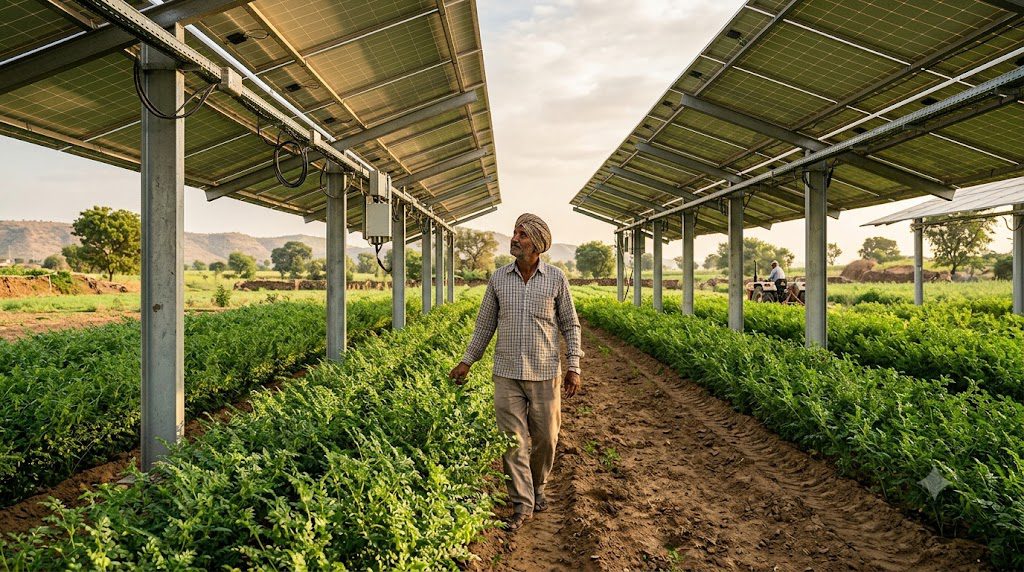
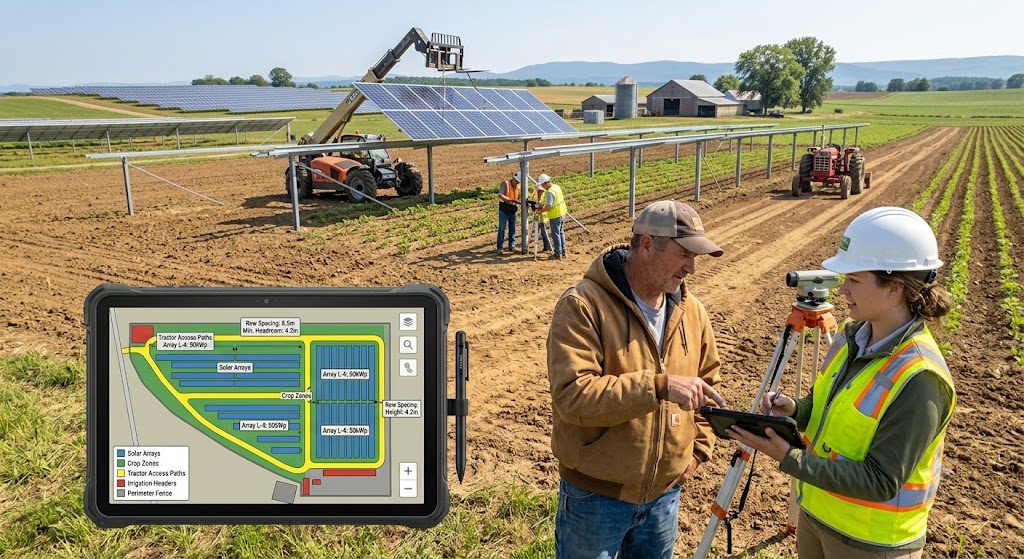
The panels in this kind of system aren’t mounted the way you’d see on a typical solar farm. They’re raised higher off the ground — often 6 to 15 feet instead of 3 feet — and spaced further apart. That extra height and spacing lets sunlight reach the plants below, lets tractors and combines pass underneath, and lets the array itself benefit from the cooling effect of the crops growing beneath it.
In simple terms: agrivoltaics farming turns the space above your field into a second crop.
The term comes from combining “agriculture” with “photovoltaics,” and you’ll also see it called agri-PV or dual-use solar. Whatever name gets used, the idea stays the same — colocating solar energy generation with active agricultural production rather than treating them as competing uses of land.
Why Agrivoltaics Is Trending in 2026
Agrivoltaics farming has moved from a research curiosity to a rapidly scaling commercial practice, and three forces are driving that shift this year.
- Land competition is intensifying. As solar developers look for large tracts of open land, farmland is often the easiest target. That has created friction between food security and energy goals — and agri-PV offers a way to satisfy both instead of picking one.
- Farm income is under pressure. Input costs, unpredictable weather, and thin commodity margins are pushing farmers to look for a second, more stable income stream. A solar lease or ownership stake tied to a dual-use array can generate steady revenue independent of crop prices.
- Climate volatility is real. Heat waves, erratic rainfall, and water scarcity are making it harder to grow some crops in full, unshaded sun. Agrivoltaics farming directly addresses this by using the panels themselves as a partial-shade and moisture-retention tool.
Research institutions have documented this shift concretely. The U.S. Department of Energy’s InSPIRE project, run through the National Renewable Energy Laboratory (NREL), has carried out field research across dozens of sites spanning crop production, grazing, and pollinator habitat. Globally, installed capacity for this kind of dual land use has grown rapidly over the past several years as more farmers and developers test the model. Government agencies, energy researchers, and farm publications have all flagged agrivoltaics as one of the defining agritech stories of 2026.
How an Agri-PV System Actually Works
A dual-use solar setup like this has three core components working together.
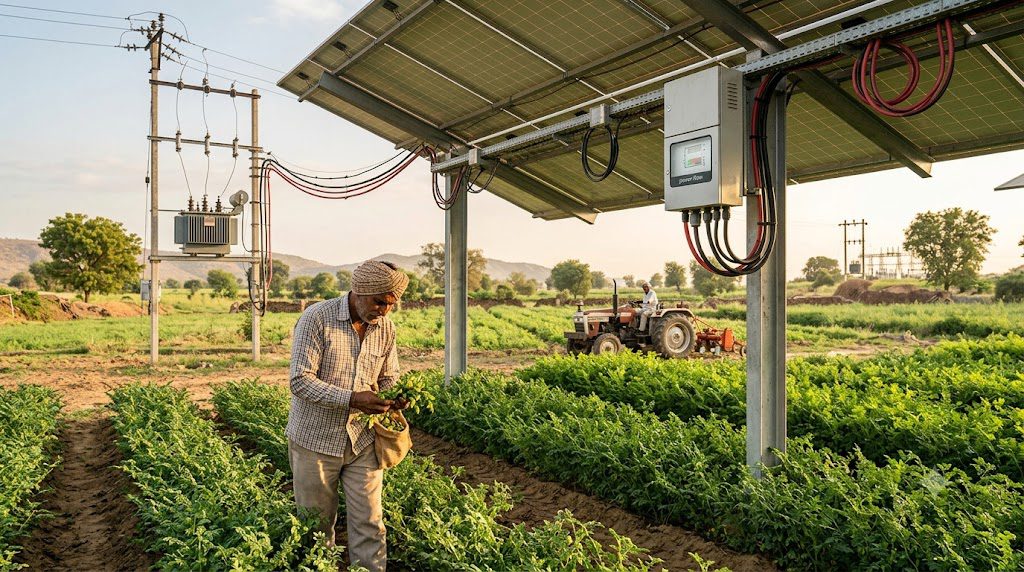
Elevated solar arrays. Panels are mounted on taller, wider-spaced racking than a conventional solar farm, which preserves enough light and headroom for crops, animals, or equipment underneath.
Adjustable or fixed tilt. Some systems use single-axis trackers that tilt panels through the day to balance electricity generation with the amount of light crops receive below. Others use a fixed tilt calibrated for the specific crop or grazing use planned for that field.
Shared land management. The same plot is scheduled and managed for both uses — planting and harvest cycles on one side, maintenance, cleaning, and grid connection on the other. Coordination between the two is what separates a functioning dual-use project from panels simply sitting over an unused field.
Together, these elements create a partial-shade microclimate. That shade lowers soil temperature, slows water evaporation, and — for the panels themselves — the cooling effect of transpiration from the plants below can help maintain higher efficiency during hot afternoons.
Agrivoltaics vs. Traditional Solar Farms vs. Traditional Cropland
It helps to see this practice next to the two models it sits between.
A traditional ground-mount solar farm clears vegetation, mounts panels low and close together to maximize electricity density, and removes the land from active food production for the life of the project — typically 20 to 30 years.
Traditional cropland with no solar infrastructure produces food or grazing income but generates zero energy revenue and offers no shade protection against increasingly frequent heat events.
Agrivoltaics farming sacrifices some peak solar output and some peak crop yield compared to running either activity alone at full intensity — but the combined output from both activities on the same acre is typically higher than running only one. That’s the entire economic case for this approach: not maximizing either output individually, but maximizing total land value.
If you’re already exploring regenerative agriculture practices on your farm, this dual-use model fits naturally alongside them — both are about extracting more sustainable value from the same footprint of land rather than expanding acreage.
7 Proven Ways Agrivoltaics Farming Boosts Yield and Income
1. Dual Revenue From the Same Acre
The single biggest reason farmers are adopting this practice is the ability to collect two income streams — crop or livestock revenue and solar electricity revenue — from land they already own or lease. Whether through a power purchase agreement, a solar lease payment, or direct ownership of the array, the energy side of the system often provides more predictable, weather-independent cash flow than farming alone.
2. Reduced Irrigation Needs
The shade from raised panels reduces direct sun exposure and slows evaporation from soil, which lowers how much water a crop needs to stay healthy. In arid and drought-prone regions, this is one of the most immediately measurable benefits of agri-PV, and it’s a major reason interest is growing fastest in water-stressed farming regions.
3. Crop Protection From Heat Stress
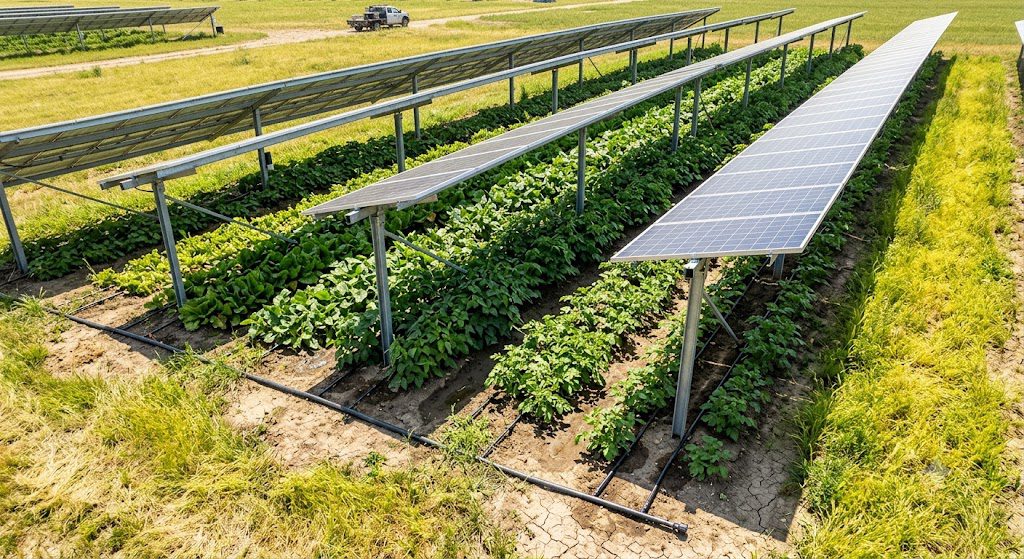
Many crops — leafy greens, berries, and certain vegetables among them — actually perform better under partial shade than in full, unbroken sun, particularly during heat waves. A dual-use layout like this uses the panels as a physical buffer, reducing leaf temperature and slowing moisture loss during the hottest parts of the day. This protective effect is becoming more valuable every season as extreme heat events increase in frequency.
4. Higher Solar Panel Efficiency
Solar panels lose efficiency as they overheat. In a dual-use array, the transpiration from crops growing underneath releases water vapor that cools the surrounding air, which can help panels run closer to their rated efficiency during peak afternoon heat compared to panels sitting over bare gravel or dirt.
5. New Grazing and Pollinator Income Streams
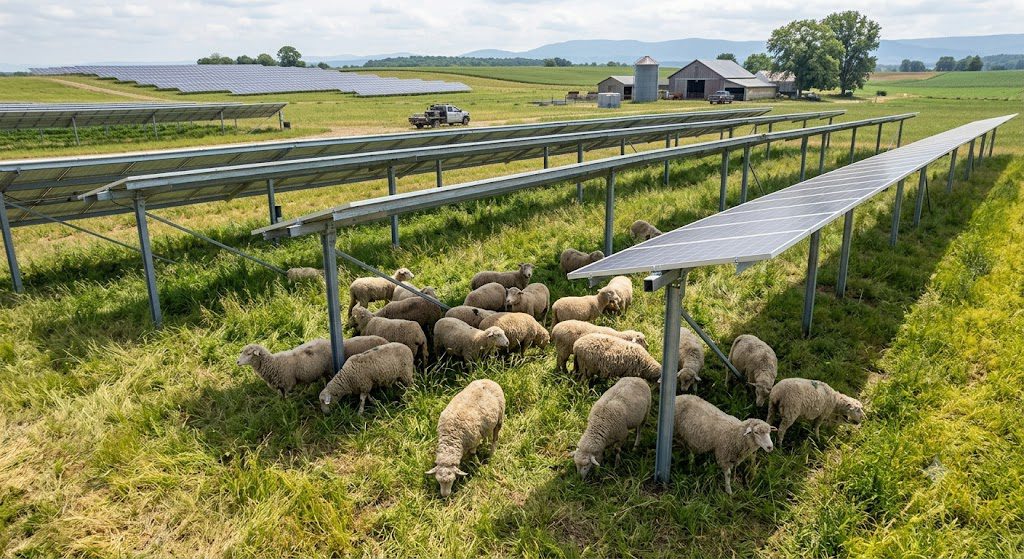
Not every dual-use project involves row crops. Many systems are built around livestock grazing — sheep are especially common, since they can move freely between panel rows and keep vegetation trimmed without damaging the array.
Others are designed as pollinator habitat, planting native flowering species beneath the panels to support bee populations and nearby crop pollination. Both approaches let a farm generate agricultural value from a solar site with lower labor and equipment requirements than row-crop production.
6. Better Land-Use Efficiency (Land Equivalent Ratio)
Performance in this field is often measured using the Land Equivalent Ratio, or LER — a calculation of how much separate land would be needed to produce the same crop and electricity output independently. Multiple field studies have found that a well-designed system can produce a combined output equivalent to 60% to 80% of what full-intensity crop production and full-intensity solar production would generate separately, but on a single piece of land instead of two.
7. Climate and Policy Incentive Access
Because this dual-use model keeps land in active agricultural use while still generating clean energy, it increasingly qualifies for incentives that a standalone solar farm wouldn’t — conservation program eligibility, rural clean energy grants, and, in some regions, more favorable land-use zoning than utility-scale solar alone. As governments look for ways to expand renewable energy without shrinking farmland, this dual-use model is positioned as the policy-friendly middle path.
Which Crops and Livestock Work Best Under Solar Panels?
Not every crop or animal system responds the same way to an agri-PV layout.
Leafy greens and shade-tolerant vegetables — lettuce, spinach, kale, and similar crops — are among the best-documented performers, since they benefit from reduced heat stress and lower water loss without needing full, direct sun all day.
Berries and certain fruiting crops often show improved quality under partial shade, particularly in regions where intense afternoon sun can scorch fruit or accelerate water stress.
Grazing livestock, especially sheep, are widely used in these systems because they thrive in the microclimate panels create, keep vegetation managed, and require far less specialized equipment than crop production between panel rows.
Pollinator habitat and native grasses are a low-maintenance option increasingly used at sites that prioritize ecosystem benefits and long-term soil health over direct crop output.
Full-sun row crops such as maize and soybean are generally the hardest fit for this approach, since they need consistent, unshaded sunlight throughout the growing cycle — though ongoing research continues to test partial-shade tolerant varieties.
The Real Cost of Setting Up an Agrivoltaics Farming System
Cost is the first practical question most farmers ask, and it’s a fair one — this kind of dual-use setup requires meaningfully more upfront investment than either farming or solar alone.
Elevated racking and mounting structures cost more than standard low-mount solar racking, since they need to support panels at greater height and often wider spacing, plus withstand the added wind load.
Grid connection and permitting can be a longer and more expensive process than a simple rooftop or small ground-mount system, particularly for larger installations feeding power back to the grid.
Financing structures vary. Some farmers finance and own the array outright; others lease their land to a solar developer who owns and operates the panels while the farmer continues managing the agricultural side underneath. Leasing models generally require far less upfront capital but also produce a smaller, steadier income compared to full ownership.
Payback timelines are typically measured in years, not months, but the combination of electricity revenue, reduced irrigation costs, and potential clean-energy incentives can shorten that timeline compared to relying on crop income alone.
Challenges and Mistakes to Avoid
Agrivoltaics farming isn’t a guaranteed win, and a few recurring mistakes explain most of the disappointing projects.
- Choosing the wrong crop for the shade level. A crop that needs full sun will underperform badly under a layout designed for a shade-tolerant species.
- Underestimating equipment clearance. If panel height and row spacing don’t account for the machinery you actually use, you’ll end up farming by hand where you used to use a tractor.
- Ignoring long-term maintenance access. Panels need periodic cleaning and repair; a layout that makes that difficult will cost more over the system’s lifetime than it saves.
- Treating it as a pure solar project. Agrivoltaics farming only works when the agricultural side is planned with the same seriousness as the energy side — not bolted on as an afterthought.
- Skipping a small pilot. Committing an entire farm to an untested layout before running a smaller test plot is one of the most common and costly mistakes growers make.
None of these issues make this approach impractical — they simply mean it needs careful, site-specific design rather than a one-size-fits-all template borrowed from a different climate or crop.
How to Start Agrivoltaics Farming on Your Own Land
- Assess your land and crop mix. Identify which fields and which crops or livestock are realistically shade-tolerant enough to fit a dual-use layout.
- Talk to a solar developer or agricultural extension office experienced specifically in agri-PV, not standard utility-scale solar.
- Decide between ownership and leasing. Match the financing model to how much capital and risk you’re able to take on.
- Design around your equipment. Confirm panel height and row spacing will accommodate the machinery you actually use.
- Run a small pilot plot first. Test crop performance, irrigation savings, and panel output on a limited area before scaling up.
- Track both sides of the ledger. Measure crop yield and energy output together, not separately, to understand your project’s real Land Equivalent Ratio.
- Check for incentive eligibility. Look into regional clean energy grants and conservation programs that may apply specifically to agrivoltaics farming projects. The InSPIRE Data Portal, maintained through Open Energy Information, is one of the most comprehensive public repositories of this research and a useful starting reference point for site design.
If you’re already using the kind of monitoring approach covered in our smart farming guide, the same soil moisture and yield-tracking tools apply directly to evaluating a dual-use pilot.
The Future of Agri-PV
Agrivoltaics farming is moving quickly from pilot projects to mainstream agritech infrastructure, and a few developments are shaping where it goes next.
- Smarter tracking systems are beginning to adjust panel tilt dynamically based on crop water stress and light needs rather than solar output alone.
- Bifacial panels, which capture reflected light from the ground as well as direct sunlight from above, are becoming more common in these systems because they perform well in the mixed-light conditions this setup creates.
- Expanding research networks, including NREL’s InSPIRE project, which now tracks activity across nearly 600 sites in the United States spanning grazing, crop production, pollinator habitat, and greenhouse applications, are producing region-specific guidance that makes new projects easier to plan with confidence.
- Policy support is expanding in multiple countries as governments look for ways to grow renewable energy capacity without converting productive farmland to energy-only use.
For more technical detail on system design and research findings, the U.S. Department of Energy’s InSPIRE project page is a strong external resource, as is the Food and Agriculture Organization’s work on sustainable land management, which increasingly references dual land-use models like this one.
Frequently Asked Questions
What is agrivoltaics farming in simple terms? It means growing crops or raising livestock underneath or between rows of raised solar panels, so the same piece of land produces both food and electricity.
Does this practice reduce crop yield? Some shade-sensitive crops see a modest yield reduction, but many shade-tolerant crops perform the same or better than in full sun, and the combined value of crop plus electricity output usually exceeds either activity alone.
How high are the solar panels in this kind of system? Panels are typically mounted 6 to 15 feet above the ground, compared to roughly 3 feet in a conventional ground-mount solar farm, to preserve light access and equipment clearance for the crops below.
Is agrivoltaics farming expensive to set up? Yes, relative to standard solar or standard farming alone — elevated racking, wider spacing, and grid connection add upfront cost, though leasing models can lower the initial capital a farmer needs to provide.
Which animals work best in an agri-PV layout? Sheep are the most widely used grazing animal because they manage vegetation effectively without damaging panels or racking.
Can smallholder farmers adopt this model? Yes, though most current large-scale projects are farmer-developer partnerships or leases rather than fully independent smallholder installations, since financing and grid connection can be barriers at very small scale.
How is performance measured in these systems? Researchers typically use the Land Equivalent Ratio, comparing the combined crop-plus-energy output of a dual-use system to what the same land would produce if used for only crops or only solar.
Where can I find credible research on this topic? The NREL InSPIRE project and its associated OpenEI data portal are among the most detailed public sources tracking agrivoltaics sites, crops, and outcomes across the United States.
Final Thought
Agrivoltaics farming isn’t a niche experiment anymore — it’s a practical response to a real conflict between farmland and energy development, and the data from research programs like InSPIRE shows it can work when the agricultural side is planned as carefully as the solar side. For farmers weighing rising input costs, water stress, and the search for a second income stream, this approach is one of the more concrete agritech opportunities worth evaluating this year, not five years from now.