
Table of Contents
What Is Biochar for Soil Health?
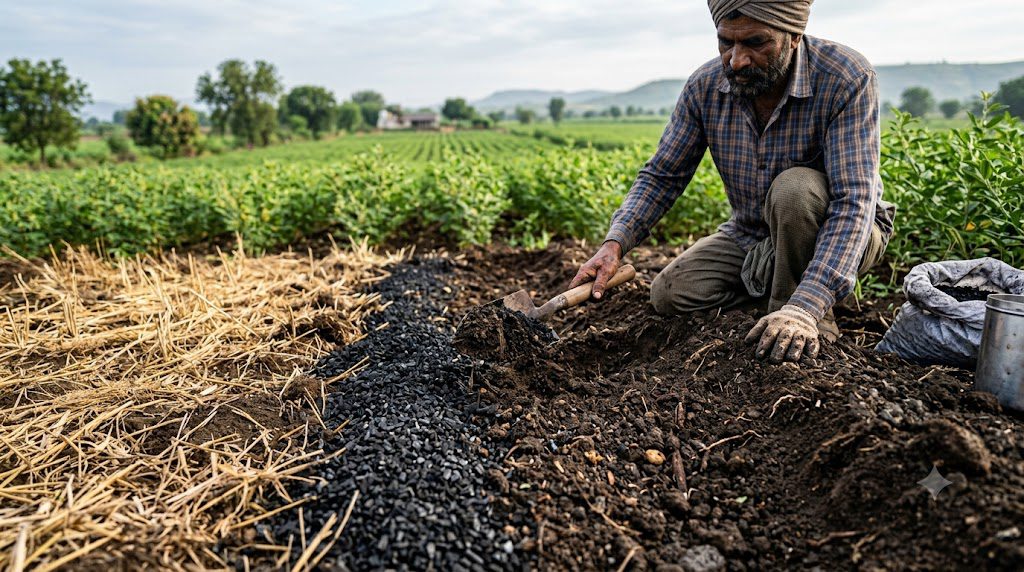
Biochar for soil health starts with a simple idea: instead of burning crop waste, wood chips, or manure completely, you heat that biomass in a low-oxygen environment until it turns into a stable, carbon-rich material that looks like charcoal but behaves very differently once it’s in the ground.
That process is called pyrolysis, and the result biochar doesn’t break down and disappear the way compost or manure eventually does. Its porous structure holds onto water, nutrients, and beneficial microbes for years, sometimes centuries, instead of weeks or months.
Farmers have quietly used versions of this technique for thousands of years. The Amazon basin’s “terra preta,” or dark earth, was created by Indigenous communities burying charred organic waste in ways that transformed poor tropical soil into some of the most fertile land ever recorded. What’s new in 2026 isn’t the concept it’s the science, equipment, and carbon-market economics now built around it.
Unlike a fertilizer that feeds a plant directly, using biochar for soil health is really about improving the soil’s physical and biological environment so that everything else you apply compost, manure, irrigation works more efficiently over the long run.
Why Biochar Is Trending in Farming Right Now
Biochar has moved from a niche permaculture technique into mainstream agricultural science for three overlapping reasons:
- Carbon markets need durable storage. Unlike cover crops or reduced tillage, which store carbon that can later be released if practices change, biochar locks carbon into a chemically stable form that resists decomposition for decades. That makes it attractive to carbon credit buyers looking for verifiable, long-lasting sequestration.
- Input costs keep rising. Because biochar improves nutrient retention, farmers using it well often report needing less fertilizer to achieve the same yield over time.
- Waste-to-value pressure. Crop residue, orchard prunings, and manure that used to be burned or landfilled can now be converted into a valuable soil input instead, which appeals to farms trying to close nutrient loops.
Public radio, agricultural extension offices, and national climate research agencies have all featured biochar as a “hot topic” in sustainable farming over the past two years coverage that’s driving a steady rise in search interest as more farmers ask whether it’s worth trying on their own land.
How Biochar Is Made
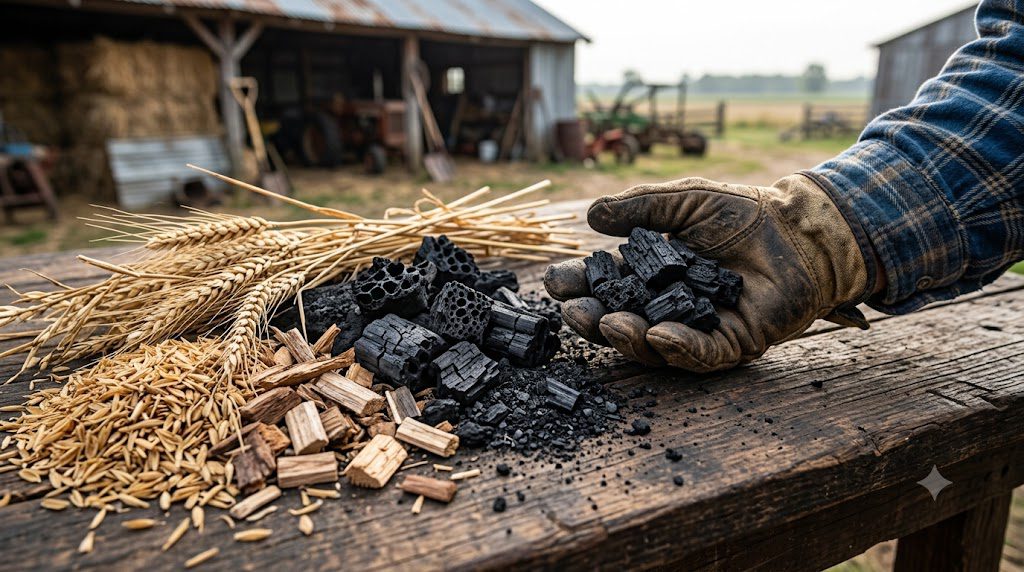
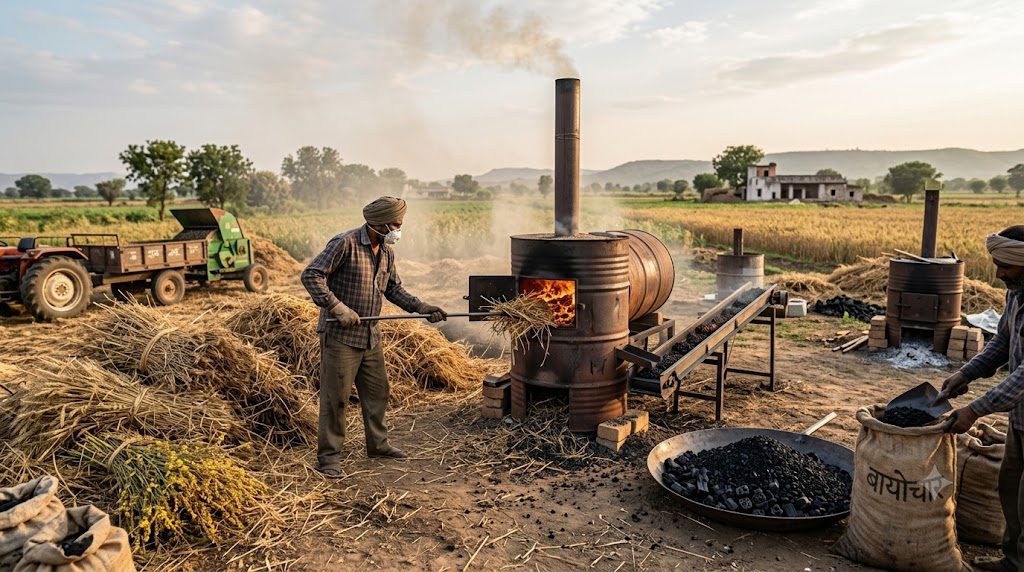
Biochar is produced through pyrolysis heating organic material to somewhere between 350°C and 700°C with very little oxygen present. Instead of the material combusting into ash, it carbonizes into a lightweight, porous carbon structure.
Feedstock options vary widely and often depend on what a farm already produces as waste:
- Crop residue (rice husks, corn stalks, wheat straw)
- Wood chips and orchard prunings
- Manure and bedding material
- Nutshells and other agricultural byproducts
The temperature and speed of pyrolysis change the final product’s properties. Lower, slower pyrolysis tends to retain more surface functional groups useful for nutrient exchange, while higher-temperature biochar is generally more stable and longer-lasting in soil.
Production methods range widely in cost and complexity:
- Cone pit / flame curtain kilns are the simplest and cheapest option, well suited to smallholder farms converting crop residue or prunings in small batches.
- Drum or barrel retorts offer more consistent temperature control than an open pit and are a common mid-scale option for farms producing biochar regularly.
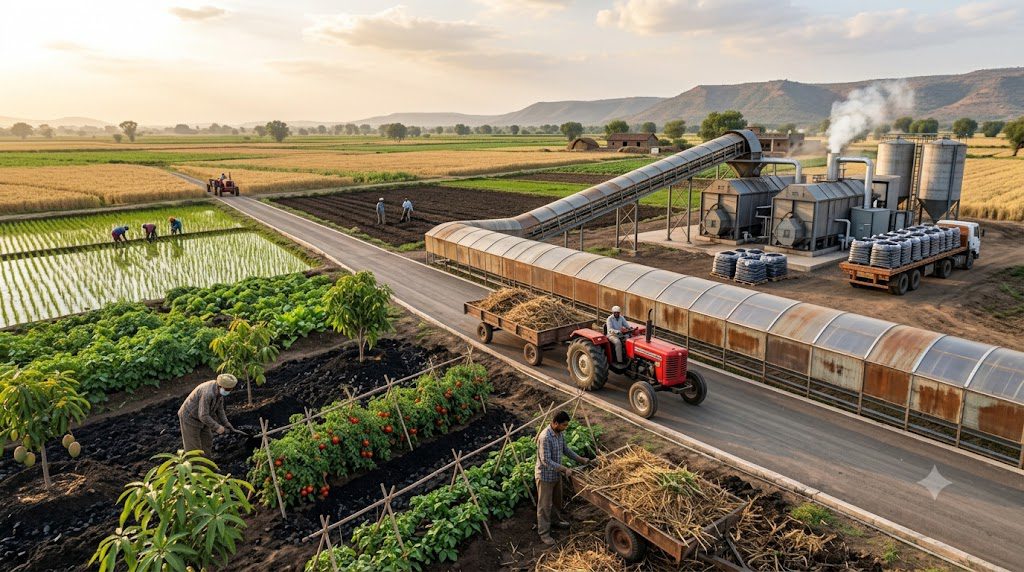
- Commercial pyrolysis units process larger volumes with tighter quality control, often used by regional producers who supply biochar to multiple farms or sell it as an agricultural input.
Whichever method is used, the underlying goal is the same: convert biomass that would otherwise be burned, left to decompose quickly, or discarded into a stable carbon form that keeps contributing to soil health for years rather than weeks.
Biochar vs. Compost vs. Regular Charcoal
It’s easy to lump biochar in with compost or ordinary charcoal, but the three behave very differently in soil.
Compost breaks down over months, releasing nutrients as it decomposes valuable, but temporary.
Regular charcoal (like the kind used for grilling) is often produced at lower, inconsistent temperatures and may contain additives unsuitable for soil use. It isn’t standardized for agricultural application.
Biochar for soil health is deliberately produced under controlled pyrolysis conditions specifically so it resists breakdown and provides a stable, long-term habitat for soil microbes rather than a quick nutrient release. It doesn’t replace compost or fertilizer it works alongside them, extending how long their benefits last in the soil.
If you’re already using regenerative agriculture practices like cover cropping and reduced tillage, biochar fits naturally into that system as an additional tool for building long-term soil carbon rather than a replacement for those practices.
7 Proven Ways Biochar Improves Soil Health
1. Increases Water-Holding Capacity
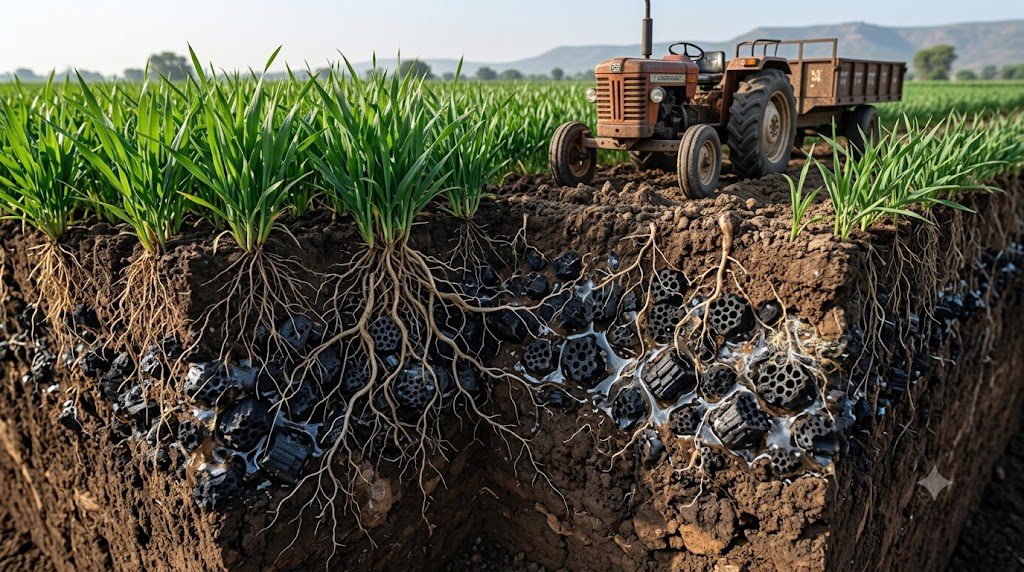
Biochar’s porous structure acts like a sponge, helping sandy or degraded soils hold significantly more water after irrigation or rainfall. This is one of the most consistently documented benefits of biochar for soil health, particularly in drought-prone regions where every drop of retained moisture matters.
2. Improves Nutrient Retention
Because biochar has a high surface area and cation exchange capacity, it can hold onto nitrogen, potassium, and other nutrients that would otherwise leach away with rainfall or irrigation. Over time, this reduces how much fertilizer is needed to maintain the same yield.
3. Provides Habitat for Beneficial Microbes
Biochar’s porous surface offers physical shelter for beneficial fungi and bacteria, protecting them from predation and environmental stress. A healthier soil microbiome supports better nutrient cycling and plant disease resistance.
4. Sequesters Carbon for the Long Term
Because pyrolysis converts biomass into a chemically stable carbon form, biochar can remain in soil for decades to centuries rather than breaking down within a growing season. This durability is exactly why biochar for soil health has become central to several agricultural carbon credit programs.
5. Corrects Soil pH in Acidic Soils
Many biochar types are naturally alkaline, which means applying them can help raise the pH of overly acidic soils similar to how agricultural lime is used, but with the added benefit of improved soil structure alongside the pH correction.
6. Reduces Fertilizer Runoff
By holding nutrients closer to the root zone instead of letting them wash away, biochar application can reduce nutrient runoff into nearby waterways a growing concern in regions with strict water quality regulations.
7. Recycles Farm Waste Into a Productive Input
Rather than burning or disposing of crop residue and manure, converting it into biochar turns farm waste into a long-term soil investment, closing the loop between what a farm produces and what it needs to stay productive.
How to “Charge” and Apply Biochar Correctly
Fresh, unprocessed biochar straight out of the kiln can actually rob soil of nutrients temporarily, because its porous surface will absorb whatever nitrogen and minerals are available nearby before it starts releasing them back. This is why experienced growers “charge” biochar before applying it.
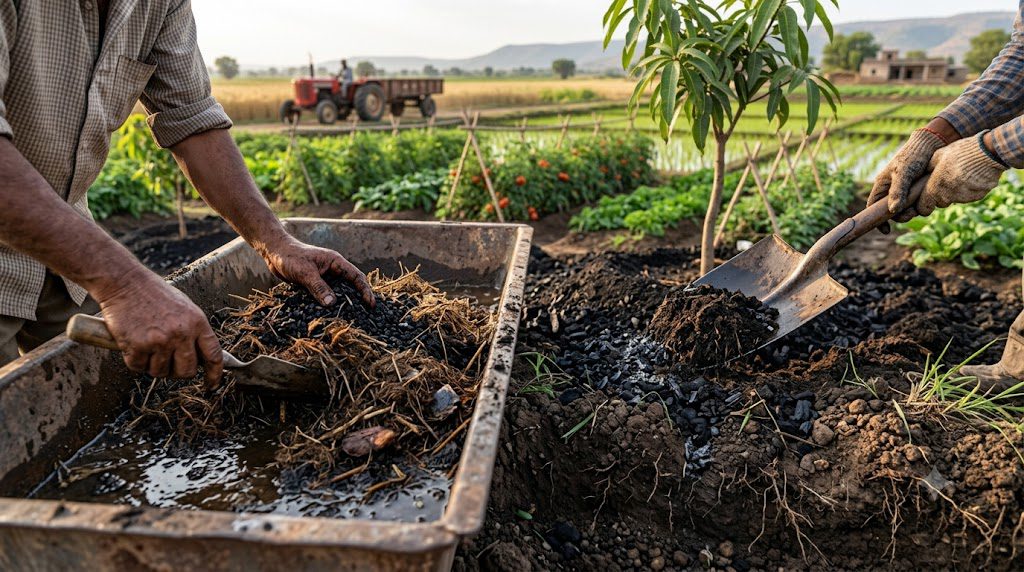
Charging typically involves soaking biochar in compost tea, diluted manure slurry, or a nutrient-rich liquid for one to several weeks before mixing it into soil. This pre-loads the pores with nutrients and microbes so the biochar starts contributing to soil health immediately rather than temporarily competing with your crop.
Once charged, biochar is usually mixed into the top 15–20 cm of soil rather than left on the surface, since incorporation improves contact with roots and soil biology. Application rates vary by soil type and crop, so a small test plot with before-and-after soil testing is the most reliable way to judge results on your specific land.
Which Crops Benefit Most From Biochar?
Not every crop or cropping system responds to biochar the same way, and understanding where it delivers the clearest return helps farmers decide where to test it first.
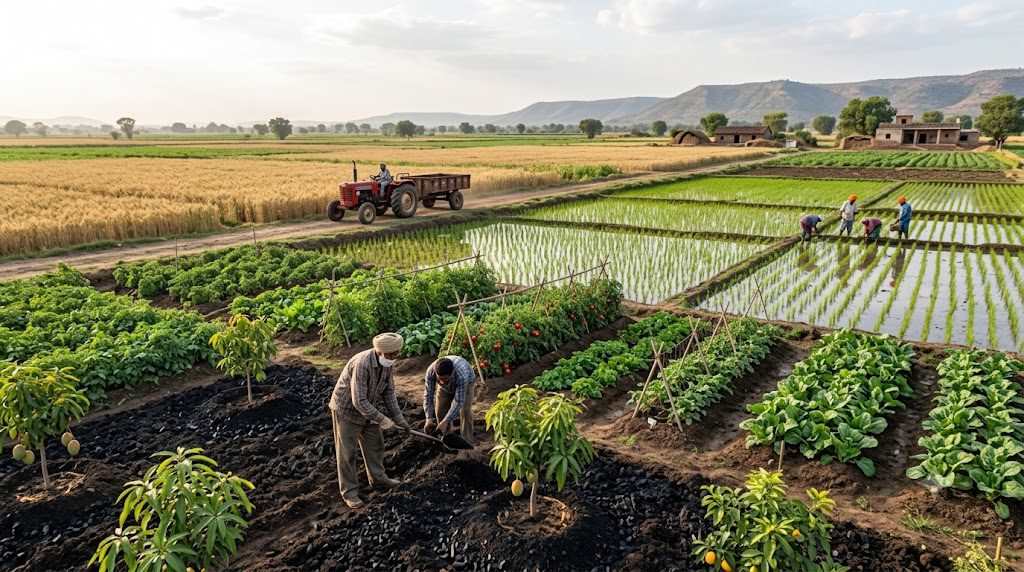
Rice paddies have shown some of the most consistent research results, since biochar’s water-holding properties pair well with flooded field management, and its stability helps offset methane emissions associated with paddy systems.
Vegetable and horticultural crops grown in sandy or low-organic-matter soils tend to respond well, particularly where irrigation costs are high and nutrient leaching is a persistent problem. Growers often see the clearest short-term benefit in these systems because vegetables are more sensitive to water stress than deep-rooted field crops.
Orchards and vineyards are increasingly using biochar made from their own prunings, closing a waste loop on-site while improving soil structure around perennial root systems that benefit from stable, long-term amendments rather than seasonal inputs.
Grain and row crops such as maize, wheat, and soybean generally see more gradual, longer-term benefits, since large-acreage application is costlier and the soil-building effect compounds over several seasons rather than appearing immediately.
Degraded or heavily compacted soils regardless of crop tend to show the most dramatic early improvement simply because there’s more room for structural and biological recovery. Farms starting from already healthy, high-organic-matter soil may see comparatively modest short-term gains.
The Real Cost of Biochar: Is It Worth the Investment?
Cost is usually the first question farmers ask, and it’s a fair one biochar isn’t free, whether you produce it yourself or buy it from a supplier.
Producing it on-farm requires either a simple kiln or cone-pit setup (low capital cost but labor-intensive) or a small pyrolysis unit (higher upfront cost but more consistent output and less manual labor per batch). Feedstock is often free if it comes from your own crop residue or prunings, which meaningfully improves the economics compared to purchasing biochar outright.
Buying commercial biochar is more convenient but adds a direct per-acre cost that needs to be weighed against expected fertilizer savings, yield stability, and any carbon credit income available in your region.
Return on investment typically isn’t immediate. Because biochar’s core value is long-term nutrient retention, water-holding capacity, and carbon storage that compounds over years most farmers should budget for a multi-season payback period rather than expecting first-year returns to justify the cost on their own. Where carbon credit programs recognize verified biochar application, that additional income stream can meaningfully shorten the payback timeline, which is one reason interest in biochar has grown alongside the broader expansion of agricultural carbon markets.
Challenges and Mistakes to Avoid
Biochar isn’t a magic fix, and a few common mistakes explain why some farmers report disappointing results.
- Applying biochar uncharged. Skipping the charging step can cause a temporary nutrient deficiency right when a crop needs it most.
- Using contaminated feedstock. Biochar made from treated wood, painted material, or contaminated waste can introduce heavy metals or toxins into soil.
- Over-application. More isn’t always better excessive biochar can alter soil pH and structure more than intended.
- Upfront cost and equipment access. Producing biochar at scale requires either purchasing equipment or sourcing it from a supplier, both of which add cost before benefits appear.
- Unrealistic short-term expectations. Biochar for soil health is a long-term investment; visible yield improvements often take one to three seasons to become clear as soil biology adjusts.
None of these issues make biochar impractical they simply mean it should be tested carefully rather than applied blindly across an entire farm.
In regions like India, where rice husk, sugarcane bagasse, and cotton stalk residue are widely available and often burned in the field contributing to seasonal air quality problems converting that same residue into biochar offers a way to address both a waste-management issue and a soil-health opportunity at the same time. Farms already exploring the water-saving irrigation practices covered in our organic farming in India guide may find biochar a natural next step, since both practices are aimed at getting more long-term value out of limited water and organic inputs.
How to Start Using Biochar on Your Own Farm
- Test your soil first. A baseline soil test helps you understand your existing pH, organic matter, and nutrient levels before adding biochar.
- Choose a clean feedstock. Use untreated crop residue, wood, or manure rather than contaminated or painted waste material.
- Produce or source biochar responsibly. Small farms can start with a simple kiln or cone-pit method, or purchase from a verified regional supplier.
- Charge it before applying. Soak biochar in compost tea or diluted manure for at least one to two weeks.
- Start with a test plot. Apply to a single field or bed first, and compare results against an untreated control area.
- Track soil health over multiple seasons. Re-test soil annually to measure real changes in water retention, organic matter, and nutrient levels.
- Explore carbon program eligibility. Some carbon credit and conservation incentive programs now specifically recognize verified biochar application, similar to the guidance published by the FAO on sustainable soil management.
Farms already using the kind of monitoring tools covered in our smart farming guide can track soil moisture and nutrient changes more precisely as biochar takes effect, rather than relying on guesswork.
The Future of Biochar in Agriculture
Biochar’s role in agriculture is expanding well beyond individual farm plots. Several developments are shaping where it’s headed:
- Standardized carbon credit protocols are making it easier to verify and monetize biochar-based carbon sequestration at scale.
- Regional biochar production hubs are emerging to convert municipal and agricultural waste streams into usable soil inputs, reducing the cost barrier for individual farmers.
- Livestock integration is an active area of research, with biochar being tested as a feed additive and manure treatment to reduce emissions and improve animal gut health.
- Government soil health incentives in multiple countries are beginning to include biochar application alongside cover cropping and reduced tillage as an eligible conservation practice.
Research from agencies like USDA Climate Hubs continues to track biochar’s long-term effects across different soil types and climates, which should make future application guidance more precise than the largely trial-and-error approach many farmers rely on today.
If you’re building toward a broader regenerative agriculture system on your farm, biochar is increasingly treated as a complementary layer rather than a standalone practice most effective when combined with composting, cover cropping, and reduced tillage rather than used in isolation.
Frequently Asked Questions
Is biochar the same as charcoal? No. While both come from heated organic material, biochar is produced under controlled pyrolysis conditions specifically for soil use, and using biochar for soil health depends on that controlled process ordinary charcoal isn’t standardized the same way and may contain unsuitable additives.
How long does biochar last in soil? Biochar’s carbon structure is highly stable and can persist in soil for decades to centuries, unlike compost or manure, which typically break down within a single growing season.
Do I need to charge biochar before using it? Yes, in almost all cases. Applying uncharged biochar can temporarily reduce available nutrients as the material absorbs them from the surrounding soil before releasing them back over time.
Can biochar replace fertilizer? No. Biochar improves nutrient retention and soil structure, but it isn’t a nutrient source itself. It works best alongside compost, manure, or fertilizer rather than as a replacement.
Is biochar suitable for all soil types? Not universally. Biochar tends to offer the biggest benefit in sandy or degraded soils with poor water and nutrient retention. Heavy clay soils or soils that are already alkaline may see smaller or different effects, which is why a small test plot is recommended before wider application.
Can smallholder farmers make their own biochar? Yes. Simple kiln or cone-pit methods can produce usable biochar at small scale using crop residue or wood waste already available on the farm, without requiring industrial pyrolysis equipment.
How much biochar should I apply per acre? Recommended rates vary widely by soil type, feedstock, and crop, typically ranging from a few percent up to around 10% of soil volume in trial studies. Because over-application can shift pH and structure more than intended, starting with a smaller test rate on a limited plot is the safest way to find what works for your specific soil.
Does biochar help with carbon credits? In some regions, yes. Because biochar’s carbon is chemically stable and can be verified through soil sampling, several carbon credit programs now specifically recognize documented biochar application as an eligible sequestration practice, though requirements and payout structures vary by program and location.
Final Thought
Biochar for soil health isn’t a quick fix or a trend that will fade next season it’s a genuinely old technique now backed by modern soil science, carbon markets, and a growing body of agricultural research. For farmers willing to test it carefully, charge it properly, and pair it with other soil-building practices, biochar offers one of the more durable ways to turn farm waste into long-term soil value.
Pingback: 7 Powerful Methane-Reducing Feed Additives for Cattle Farmers Need in 2026 -
Pingback: Climate-Resilient Crops: 8 Powerful Ways Farmers Are Adapting to Extreme Weather in 2026 -