
I built my first hydroponic fodder unit in a corner of my shed for less than ₹15,000.
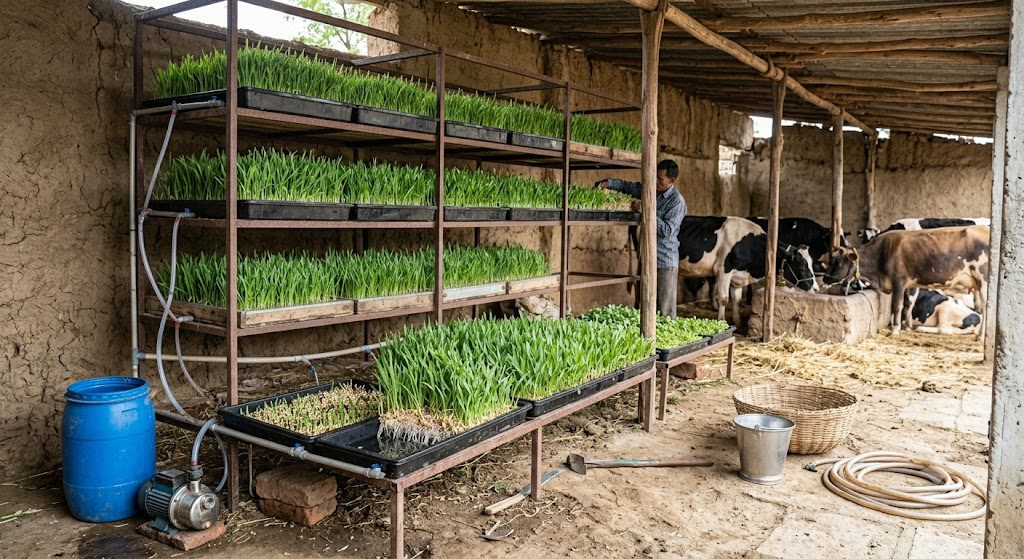
No soil. No sunlight. Just water, a few trays, and maize seeds. Seven days later, I pulled out a thick mat of green grass — about 25 kilograms of fresh fodder from 2 kilograms of seed. The whole thing stood about 8 feet tall and 4 feet wide.
That was three years ago. Today, that corner shed unit feeds two of my cows year-round, regardless of what the monsoon does.
Hydroponic fodder production isn’t a new idea. What’s new is how affordable it’s become for small and marginal dairy farmers in India. And with water scarcity, land fragmentation, and erratic rainfall all getting worse, it might be the most practical livestock feed innovation available right now.
Let me walk you through what it is, what it costs, and where it actually makes sense.
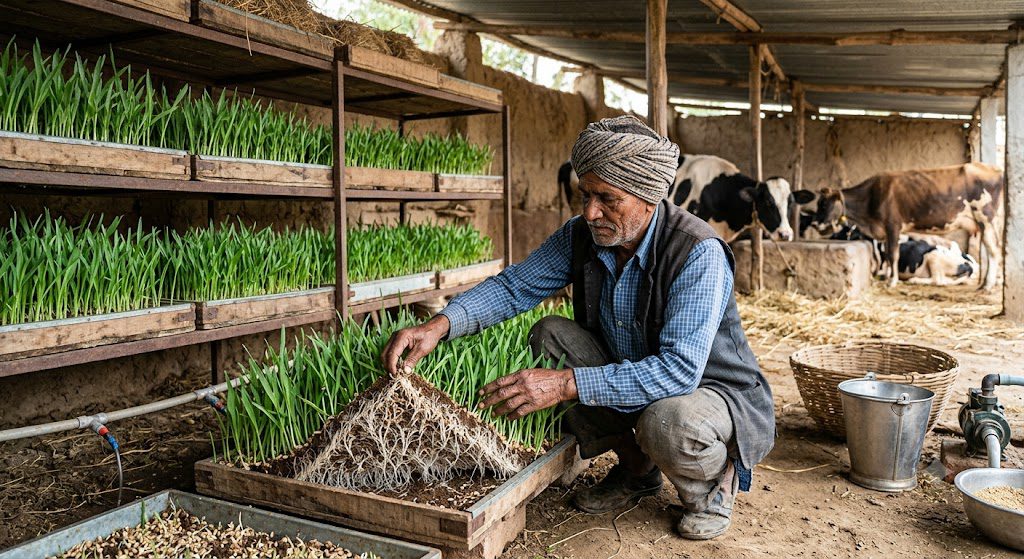
Table of Contents
What Hydroponic Fodder Actually Is
Hydroponic fodder is grass grown without soil, in shallow trays, using only water and a controlled environment. Seeds — maize, barley, wheat, oats, or sorghum — are soaked, spread in trays, and kept in a dark room with high humidity for the first few days. The seeds germinate. Roots form a mat. Then the trays come into light.
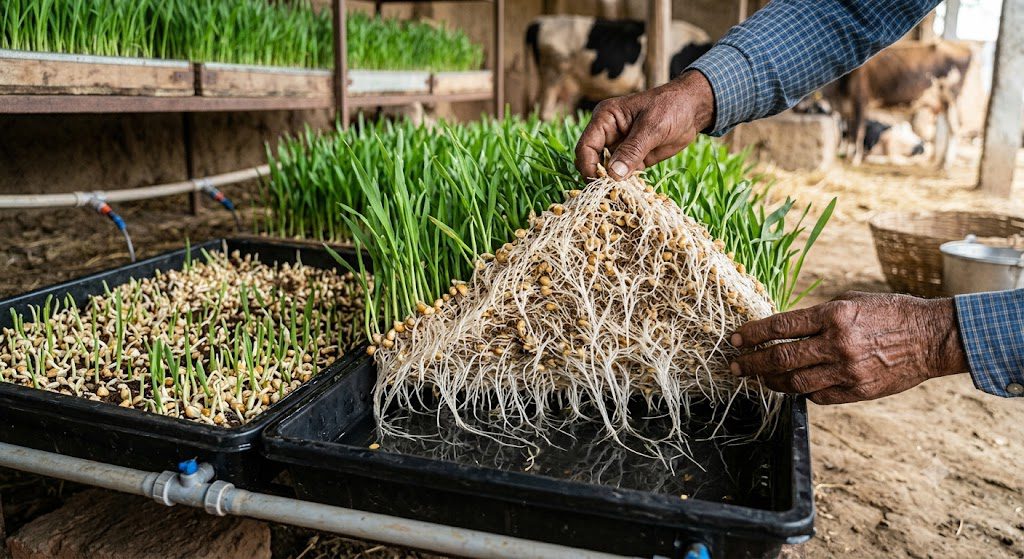
Within 7 to 10 days, you have a dense mat of green shoots and root matter, roughly 6 to 8 inches tall. The whole mat — shoots, roots, and any remaining seed — is fed to animals. Nothing is wasted.
The yield multiplier is the key number. One kilogram of seed produces 6 to 10 kilograms of fresh fodder. That’s a huge improvement over traditional fodder cultivation, where you need months and significant land area to get comparable output.
For a broader look at livestock feeding fundamentals, our guide to animal husbandry and scientific breeding techniques covers the basics that hydroponic fodder complements.
1. Water Use Is Dramatically Lower
Traditional green fodder — like lucerne, berseem, or maize — is water-hungry. A single acre of green fodder can consume over 1 lakh litres of water across its growing cycle.
Hydroponic fodder uses a fraction of that.
Most systems recycle water. The trays are watered a few times daily, and the runoff collects in a tank and gets pumped back up. A well-designed unit uses only about 2 to 3 litres of water per kilogram of fodder produced. Some of that water is actually absorbed into the plant. The rest circulates.
For farmers in rain-shadow regions or areas with falling groundwater tables, this changes the economics of dairy entirely. You’re no longer competing with irrigated crops for water.
The ICAR’s Indian Farming publication on precision livestock farming notes that PLF approaches like hydroponic systems help “improve productivity” while addressing resource constraints. Hydroponic fodder fits directly into that logic.
2. Land Requirement Is Minimal
I have a small farm. Every square foot counts. Traditional fodder crops need land — land that can’t grow food crops, can’t grow cash crops.
Hydroponic fodder doesn’t need land. It needs a shed.
A unit of about 10 feet by 8 feet can produce 150 to 200 kilograms of fresh fodder daily. That’s enough for two to three cows. You can build it on a rooftop, in a spare room, or in a corner of an existing cattle shed.
In India, where average landholdings are shrinking and fragmented, this is a serious advantage. The ICAR publication lists hydroponic fodder as one of the “precision livestock farming” technologies relevant to Indian conditions.
3. Growing Time Is 7 Days, Not 3 Months
This is the part that surprises most farmers.
Green fodder crops take 60 to 90 days from planting to harvest. That means you need land, irrigation, and management across months. Drought or pest outbreak in week six, and your feed is gone.
Hydroponic fodder takes 7 to 10 days. You harvest constantly. Every day, trays go in and trays come out. The system becomes a weekly rhythm, not a seasonal gamble.
The 2025 AGRIS review on smart pasture technologies describes how precision technologies enable “real-time monitoring” that reduces “greenhouse gas emissions” through better resource use. Hydroponic fodder achieves something similar by shortening the production cycle and eliminating waste.
4. Feed Quality Is High and Consistent
Hydroponic fodder isn’t just bulk. It’s nutrition.
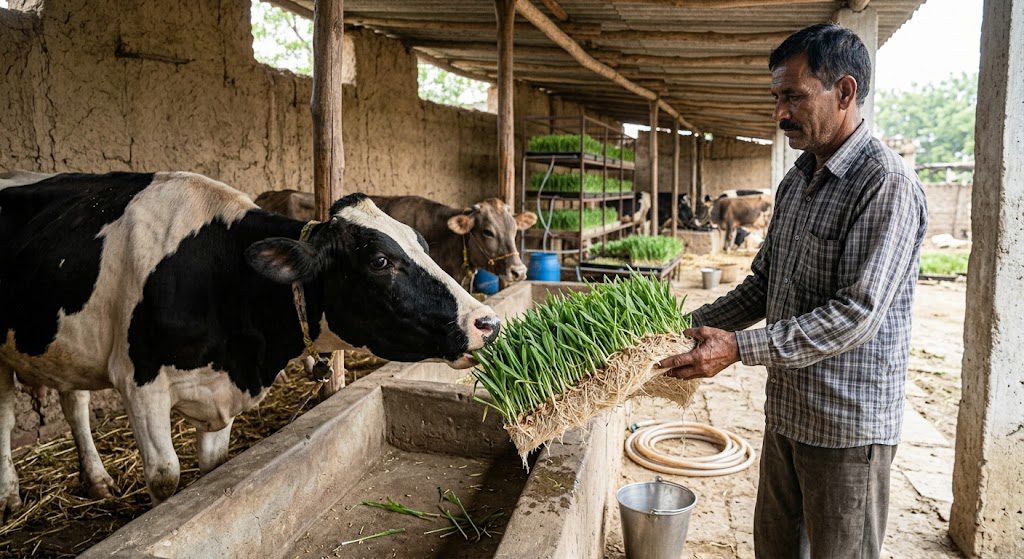
The green shoots are high in protein, digestible fibre, and vitamins. The root mat contains residual seed energy. Animals typically eat the whole mat — there’s no selective feeding, no sorting, no waste.
More importantly, consistency matters in dairy. A cow on a steady diet produces steady milk. Hydroponic fodder gives you the same product every day, regardless of season. No more switching between monsoon fodder and dry fodder and seeing milk fat fluctuate.
I noticed this within a month. My cows’ evening milk fat reading stabilized. No more week-to-week swings.
5. Cost Per Kilogram Can Beat Traditional Fodder
Here’s where it gets interesting.
The main input cost is seed. Good-quality maize seed for fodder purposes costs roughly ₹30 to ₹50 per kilogram. At a 1:8 conversion ratio, that’s 8 kilograms of fresh fodder per kilogram of seed.
If seed costs ₹40 per kilogram, your fodder cost is about ₹5 per kilogram of fresh green feed. When market prices for green fodder spike in summer — and they do — this becomes dramatically cheaper.
Add electricity for pumps and lights (a few hours a day), water (minimal due to recycling), and labor (about 30 minutes daily for a small unit). The total works out favorably against purchased fodder.
The ICAR publication notes that precision livestock technologies like this help “reduce animal mortality, treatment costs and improve productivity”. Feed cost reduction is part of that equation.
6. Year-Round Availability, No Seasonal Gap
The summer fodder crunch is a real problem in India. Green fodder disappears in April and May. Dry fodder prices rise. Milk production drops.
Hydroponic fodder doesn’t care about the season. It grows indoors, in controlled conditions. You can run the same unit every day of the year.
This matters most for farmers who keep crossbred cattle, which are less tolerant of feed quality drops than indigenous breeds. A steady supply of green, high-moisture fodder keeps rumen function stable and milk production steady.
Farmers interested in herd resilience strategies may also find our guide to sustainable livestock farming solutions in India useful.
7. It Complements, Doesn’t Replace, Traditional Feed
Here’s an important clarification. Hydroponic fodder is not a complete diet. It’s a supplement — a high-quality green feed that replaces part of the dry fodder and concentrate ration.
A typical cow needs 15 to 25 kilograms of green fodder daily. Hydroponic fodder can supply 5 to 10 kilograms of that. The rest can come from crop residues, dry fodder, or grazing.
For farmers who already have some traditional fodder, hydroponic units fill the gap. For farmers with no land for fodder, they provide the base. Either way, they make the overall ration better.
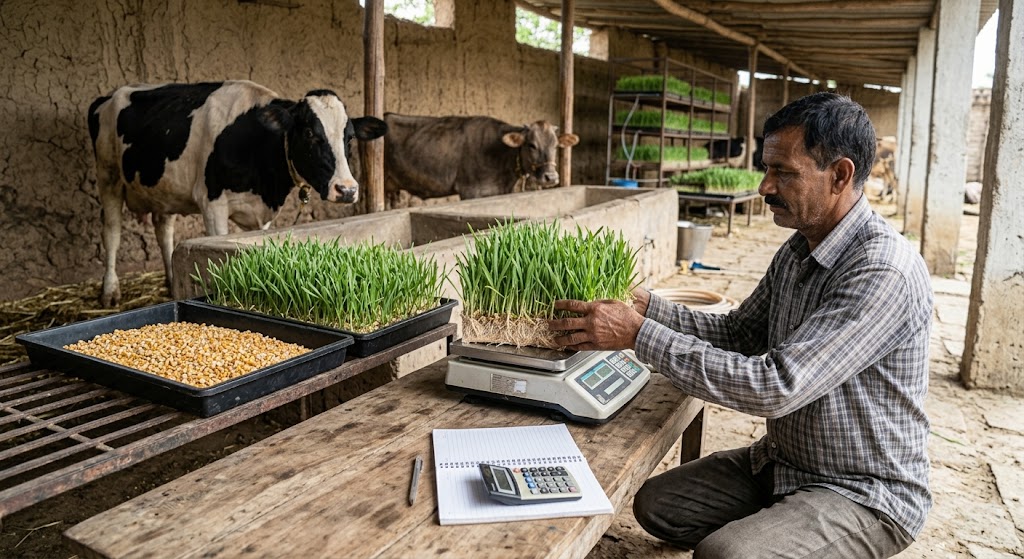
What It Actually Costs to Start
Let me give you real numbers from my setup.
Basic unit (for 2-3 cows):
- Shed or room: existing space, ₹0
- Trays (20): ₹2,000
- Shelving (4 levels): ₹3,000
- Water tank and pump: ₹4,000
- Timer and small fittings: ₹1,500
- Seeds (first month): ₹3,000
- Total: ₹13,500 to ₹15,000
Monthly running costs:
- Seeds: ₹3,000-4,000
- Electricity: ₹300-500
- Labor: your own time
- Total: ₹3,500-4,500
That’s roughly ₹120-150 per day to produce 50-60 kilograms of fresh fodder. Compare that to market prices during summer, when green fodder can cost ₹15-20 per kilogram. The savings are substantial.
For farmers considering larger investments in livestock infrastructure, our guide to indigenous Indian cattle breeds and their disease-resistance advantages may also be relevant to long-term herd planning.
The Honest Limitations
Hydroponic fodder isn’t a magic solution for every farm.
It requires daily attention. Trays need to be soaked, spread, moved, harvested. If you skip a day, the cycle breaks. This is fine if you’re already doing daily cattle work, harder if you rely on hired labor.
Seed quality matters enormously. Poor germination rates kill the economics. Buy certified seed, test a small batch first.
Electricity backup is important. If the pump fails during a hot day, the trays dry out quickly. A small inverter or backup pump is worth having.
It’s not for everyone’s scale. A farmer with 50 cows would need a massive unit. At that scale, traditional fodder cultivation or purchased feed might be more practical.
The 2025 AGRIS review notes that “adoption of PLF technologies in extensive pasture-based systems remains limited due to economic, technical, and infrastructural barriers”. Hydroponic fodder faces similar constraints — it works best for intensive, small-scale operations where land and water are limiting factors.
FAQS On Hydroponic Fodder Production
1. What Is Hydroponic Fodder Production?
Hydroponic fodder production is a method of growing green fodder from seeds without soil. Seeds such as maize, barley, wheat, and oats are placed in trays and supplied with water under suitable growing conditions. The seeds germinate and develop into green shoots and a root mat, usually within 7–10 days.
2. How Much Hydroponic Fodder Can 1 Kg of Maize Seed Produce?
According to the estimates in this article, 1 kg of maize seed can produce approximately 6–10 kg of fresh hydroponic fodder. Actual production depends on seed quality, germination rate, temperature, humidity, and harvesting time. Fresh weight does not represent dry matter or nutritional value, so farmers should measure both yield and feed quality.
3. How Many Days Does Hydroponic Fodder Take to Grow?
Hydroponic fodder generally takes around 7–10 days to reach harvest. During this period, seeds germinate and develop green shoots and roots. Proper moisture management, ventilation, tray hygiene, and suitable growing conditions help maintain fodder quality.
4. What Is the Cost of Setting Up a Hydroponic Fodder Unit in India?
The article estimates that a basic hydroponic fodder unit for a small dairy farm may cost approximately ₹13,500–₹15,000 when an existing shed or room is available. Expenses include trays, shelving, a water tank, a pump, and fittings. Actual investment varies according to equipment quality, capacity, and local prices.
5. How Much Water Is Required for Hydroponic Fodder Production?
The article estimates water consumption at approximately 2–3 litres per kilogram of fresh fodder. Actual water requirements depend on the irrigation system, recycling efficiency, temperature, and growing conditions. Farmers should measure their own water use before estimating potential savings.
6. Which Seeds Are Best for Hydroponic Fodder Production?
Maize is one of the main seeds used for hydroponic fodder production. Barley, wheat, oats, and other suitable cereal grains can also be considered. Select clean, high-germination seeds suitable for fodder production and test a small batch before investing in larger quantities.
7. Can Hydroponic Fodder Be Grown Without Soil or Sunlight?
Yes. Hydroponic fodder is grown without soil, and early germination can take place without direct sunlight. However, after germination, suitable light, temperature, moisture, and airflow help support healthy shoot development. A growing unit must provide appropriate environmental conditions rather than simply relying on water alone.
8. Is Hydroponic Fodder a Complete Feed for Dairy Cows?
No. Hydroponic fodder should not automatically be treated as a complete feed. Dairy cows require a balanced ration containing sufficient dry matter, energy, protein, fibre, minerals, and vitamins. Hydroponic fodder should be incorporated according to the animal’s nutritional requirements and the composition of its existing diet.
9. How Much Hydroponic Fodder Can Be Fed to a Cow Daily?
The article suggests 5–10 kg of fresh hydroponic fodder per cow per day as a possible supplement. However, this is not a universal feeding recommendation. Appropriate quantities depend on the cow’s body weight, milk production, dry matter intake, and the rest of its ration. Consult a qualified animal nutritionist or veterinarian before making substantial dietary changes.
10. Can Hydroponic Fodder Increase Milk Production?
Hydroponic fodder may support dairy production when it forms part of a properly balanced ration. However, increased milk production is not guaranteed. Results depend on feed quality, the diet being replaced, animal health, and overall farm management. Farmers should monitor milk yield, milk composition, feed intake, and feeding costs.
11. Is Hydroponic Fodder Cheaper Than Traditional Green Fodder?
Not necessarily. Hydroponic fodder may be useful where land or irrigation water is limited, but its economic benefits depend on seed prices, usable yield, labour, electricity, equipment costs, and spoilage. Comparing the cost per kilogram of fresh fodder alone can be misleading because moisture content affects the apparent yield.
12. Can Hydroponic Fodder Be Produced Throughout the Year?
Yes. Hydroponic fodder can be produced year-round when seeds, water, suitable growing conditions, and regular labour are available. However, temperature fluctuations, equipment failures, poor ventilation, and mould contamination can affect production. Farmers need consistent daily management to maintain reliable output.
13. What Are the Main Disadvantages of Hydroponic Fodder Production?
The main disadvantages include recurring seed expenses, daily labour, equipment maintenance, electricity requirements where applicable, and the risk of mould growth. Hydroponic fodder can also have lower dry matter recovery than the original seed. Farmers should calculate the total production cost and nutritional value before deciding whether the system is economical.
14. How Can Farmers Prevent Mould in Hydroponic Fodder?
Farmers can reduce mould risk by using clean trays, good-quality seeds, suitable water, adequate drainage, and sufficient airflow. Growing equipment should be cleaned regularly, and contaminated batches should be removed. Do not feed visibly mouldy or spoiled fodder to livestock.
15. Is Hydroponic Fodder Production Suitable for Small Dairy Farmers in India?
Hydroponic fodder production may suit small dairy farmers who face fodder shortages, limited land, or restricted irrigation water. Before investing, farmers should start with a small trial, record seed costs and actual yields, assess fodder quality, and consult an animal nutrition professional. Its suitability depends on local conditions and whether the system is economically viable for the farm.
My Verdict After Three Years
I started with skepticism. I built a small unit to test the concept. Three years later, it’s part of my daily routine.
The main benefits for me were:
- Year-round green fodder without land
- Predictable feed costs
- Better milk fat consistency
- Water savings compared to irrigated fodder
The main challenges:
- Daily labor requirement
- Seed cost fluctuations
- Learning curve in the first month
If you’re running a small dairy operation and struggling with fodder availability or cost, it’s worth testing. Start small. One shelf unit. Twenty trays. See if the rhythm works for you.
The ICAR’s work on precision livestock farming suggests these kinds of technologies will become more important as land and water constraints tighten. Starting early gives you experience before it becomes necessary.
Conclusion
Hydroponic fodder production offers a promising option for Indian dairy farmers facing fodder shortages, limited land, and water scarcity. Its short growing cycle and year-round production potential can be beneficial, particularly for small farms. However, success depends on seed quality, daily management, production costs, and proper livestock nutrition. Start with a small trial, measure actual yields and expenses, and ensure hydroponic fodder complements a balanced cattle diet before investing in a larger system.