
Table of Contents
Introduction
Tulip farming has moved from a niche floriculture activity to one of the most discussed high-value ventures in modern agriculture. Tulips are among the best-known spring bulb flowers in the world. They are sold as cut flowers, potted plants and planting bulbs, and they draw millions of visitors to tulip gardens every spring. One market analysis put the global tulip market at roughly USD 9.92 billion in 2024.
Tulip production is also highly concentrated. The Netherlands grew about 15,000 hectares of tulip bulbs in 2023, up from around 11,400 hectares in 2008, according to Statista. Other countries are trying to build their own bulb supply. In India, scientists at CSIR-IHBT have been testing tulip bulb multiplication in the cold high-altitude valley of Lahaul, as The Tribune reported.
This mix of strong demand and limited suitable growing regions is why farmers, agri-entrepreneurs and agriculture students keep asking how to start tulip farming. The honest answer is that tulips reward careful planning more than most crops. They need the right climate, excellent drainage, healthy planting material and a market before planting.
This guide covers the seven steps that decide success in tulip cultivation, along with realistic notes on cost, profit and risk. Every factual claim is linked to its source, so you can verify it before you invest.

Why Tulip Production Is in Demand Worldwide
1. Strong cut-flower trade. Tulips rank among the leading cut flowers globally. The CSIR-IHBT director has said tulips hold third place in the world’s cut flower trade, according to The Tribune.
2. A large, growing bulb trade. The Netherlands dominates supply. AIPH reports that Dutch growers account for roughly 70% of global flower bulb production and 90% of trade, with tulips the most iconic crop. That concentration is exactly what other countries want to reduce.
3. Import substitution. Indian research institutes want the country to become self-reliant in tulip bulbs. CSIR-IHBT has said it aims to meet domestic demand through local bulb production, as Himachal Headlines noted.
4. Agri-tourism. Gardens turn a farm into a destination. The Indira Gandhi Memorial Tulip Garden in Srinagar is Asia’s largest tulip garden. CSIR-IHBT’s Palampur garden became the country’s second major tulip garden, according to Drishti IAS. The Tribune reported that Palampur drew more than 80,000 visitors in a single season.
5. Multiple income routes. A farm can earn from cut flowers, from bulbs, from garden entry and events, or from a combination. Each route has different investment and skill needs, which we cover below.
Understanding the Tulip Crop
Before the seven steps, it helps to understand how the plant behaves, because most tulip farming problems come from ignoring its natural cycle.
- Botanical type: Tulips (Tulipa species and hybrids) are perennial bulbous plants, but commercial growers treat them as an annual or biennial crop. Bulbs are replanted or replaced regularly for consistent flower quality.
- Life cycle: The bulb is a storage organ. It holds the energy and the flower bud for the coming season. Cold winter temperatures trigger proper flowering. After bloom, the leaves feed the bulb, which is why they must not be cut too early when growing bulbs.
- Two crops in one plant: You can grow a tulip for its flower (cut-flower production) or for the daughter bulbs it forms (bulb production). Bulb production generally needs colder, higher-altitude sites, and flower production can also work in managed or protected environments.
Techniques: 7 Proven Steps in Tulip Farming
Step 1: Choose the Right Climate and Location
Tulips are a strictly cool-climate crop. The bulbs need a long winter chilling period, followed by cool spring conditions of roughly 10 to 18°C during growth and flowering. That is why they perform poorly in hot plains, according to Farmer.in. Agritell gives the chilling range for bulb development and flowering as about 2 to 7°C.
Where tulips grow well
- Traditional producing regions include the Netherlands, France, Poland, Germany, Japan and New Zealand.
- In India, cultivation centres on Jammu & Kashmir, Himachal Pradesh and parts of Uttarakhand.
- For bulb multiplication in India, CSIR-IHBT has said the cold deserts of Lahaul and Ladakh, above about 2,400 metres, are best suited, per this report.
Site checklist
- A gentle slope or raised land that drains naturally
- Open sun for most of the day, with shelter from strong winds
- Reliable access to clean water
- Road access and a reasonable distance to cold storage or markets
Practical note: If your region is warm, do not assume outdoor tulip farming will work. Consider cold-chain forcing of pre-chilled bulbs for cut flowers, or choose a crop better matched to your climate. For water-rich regions, Farm Sutras’ guide on makhana farming is one alternative high-value option.
Step 2: Prepare Well-Drained Soil
If you remember one thing from this guide, make it this: drainage decides whether tulip bulbs survive. Waterlogged soil invites bulb rot and fungal disease.
Soil requirements
- Type: light sandy loam or loam with plenty of organic matter
- pH: about 6.0 to 7.0, which is slightly acidic to neutral, per Agritell
- Structure: loose, deep and crumbly so roots can spread
How to prepare the beds
- Get a soil test before doing anything else. Test pH, organic matter and nutrient levels.
- Dig or plough deeply and break up compacted layers.
- Mix in well-rotted manure or compost. Farmer.in notes that beds are dug deep and enriched with well-rotted manure for tulips.
- Build raised or sloping beds in wetter sites so excess water runs off.
- Clear weeds and crop residue that could harbour pests.
For a soil-first approach that reduces dependence on chemicals, read our organic farming beginner’s guide.
Step 3: Select Quality Bulbs and Varieties
Bulb quality has a huge influence on flower quality and, eventually, your income. Planting material is usually the largest recurring cost in tulip farming, so it pays to choose carefully.
What to look for in a bulb
- Firm, heavy for its size, with an intact outer skin
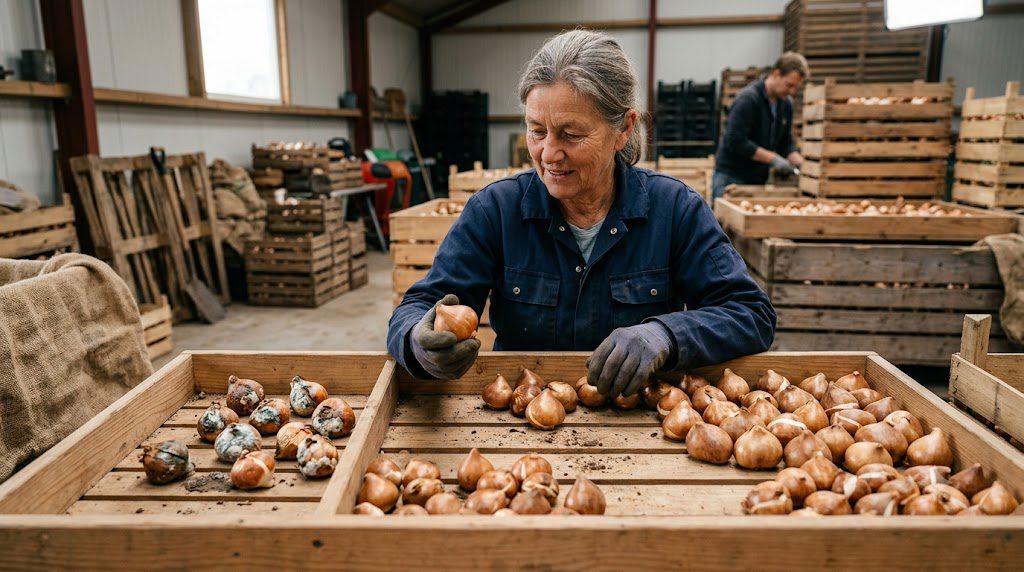
- No soft spots, mould, cuts or signs of shrivelling
- Uniform size within each lot, which gives uniform flowering
- A supplier that can document variety name, size grade and origin
Choosing varieties
Match the variety to your goal: cut flowers, bulb multiplication, or a display garden. Dutch growers plant many Triumph-type tulips. AIPH reports that ‘Strong Gold’, ‘Jan Seignette’ and ‘First Class’ were among the largest tulip crops in the Netherlands, with ‘Strong Gold’ the most-grown at 884 hectares.
Popularity in the Netherlands does not guarantee suitability for your farm. Ask your national horticulture research institute what has been tested locally. In India, CSIR-IHBT and state horticulture departments are the right first contacts.
Buying tips
- Buy from certified, disease-free sources.
- Inspect a sample before ordering a full lot.
- Confirm the chilling status of the bulbs, meaning whether they are pre-chilled or need chilling at your site.
- Keep bulbs cool and ventilated until planting, and never leave them in closed plastic in the sun.
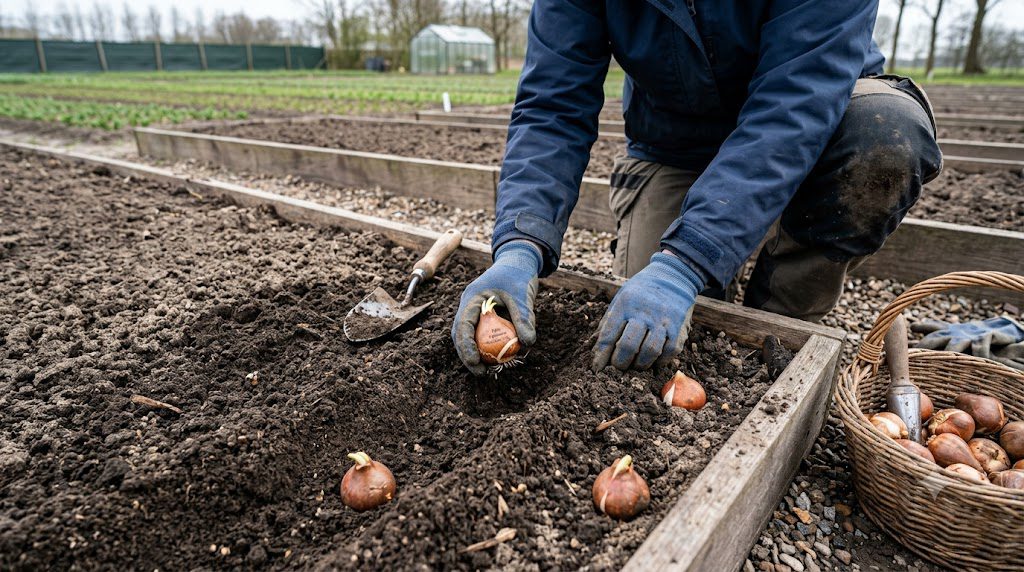
Step 4: Plant Correctly: Timing, Depth and Spacing
Timing
Plant chilled bulbs in autumn, so roots establish over winter and flowers open in spring. In high-altitude regions, planting windows come earlier because winter arrives sooner. Follow your local research institute’s calendar rather than a generic date.
Orientation and depth
- Plant with the pointed tip facing up.
- A widely used horticultural rule is to plant at a depth of roughly two to three times the bulb’s height. Adjust it for soil type and local advice.
Spacing
Farmer.in describes spacing of about 10 to 15 centimetres between bulbs, giving roughly 50 to 100 bulbs per square metre depending on bulb size and purpose. Cut-flower beds are typically planted more densely than beds meant for bulb multiplication, where bulbs need room to bulk up.
After planting
- Water lightly once to settle the soil.
- Mulch in very cold sites to protect bulbs from deep frost.
- Label each block by variety and planting date. This record-keeping becomes essential when you scale up.
Step 5: Manage Water and Nutrition
Water
- Keep soil evenly moist during active growth, but never soggy.
- Avoid overhead watering late in the day, which keeps foliage wet and encourages fungal problems.
- After flowering, reduce watering as leaves yellow, especially in bulb production, because this is when the plant stores energy in the bulb.
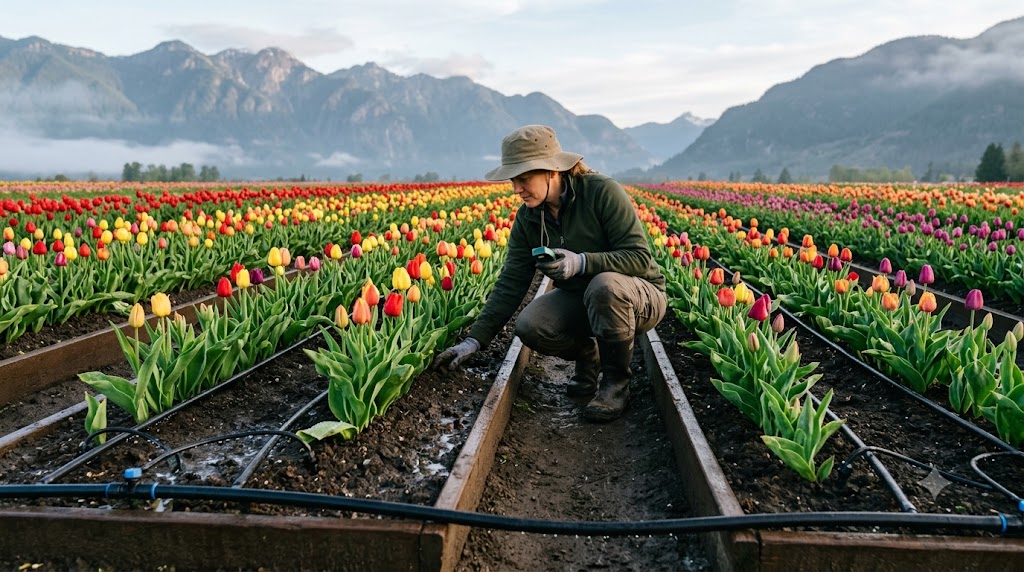
Drip irrigation gives precise control and reduces foliage wetness. Soil moisture sensors help avoid over-watering. Our precision farming guide explains how these tools cut waste and improve consistency.
Nutrition
- Build the base with organic matter and use a soil test to decide on supplemental fertiliser.
- Tulips are generally not heavy feeders when soil is fertile. Excess nitrogen can produce lush leaves at the expense of bulbs and can increase disease risk.
- Apply nutrients according to your soil report and local recommendations, not a fixed formula copied from another region.
Step 6: Protect the Crop From Pests and Diseases
Tulips are relatively hardy, but problems can be costly. Farmer.in lists aphids, which spread viruses, and mites among the pests to watch for. In wet, poorly drained sites, fungal diseases and bulb rot become the biggest threats.
Prevention comes first
- Drainage: the best disease control is well-drained soil.
- Certified bulbs: healthy planting material avoids importing problems.
- Rotation: avoid replanting tulips in the same bed year after year. Rest the land or rotate with another crop.
- Sanitation: remove and destroy diseased plants and debris promptly. Clean tools between beds.
- Airflow: avoid overcrowding beyond recommended spacing.
Scouting
Walk the beds at least weekly during growth. Look for stunted plants, streaked or distorted flowers, spotted leaves and aphid colonies on stems and buds. Virus-affected plants should be removed early, because aphids can carry the virus to healthy plants.
Control options
- Start with cultural and biological methods and IPM approaches.
- Neem-based products are commonly used in low-input systems.
- If you use chemical products, choose only those approved for tulips in your country, follow the label, and observe pre-harvest intervals.
- Get a diagnosis from a plant clinic or agricultural university if you are unsure what you are seeing. Guessing wastes money and can worsen the problem.
Step 7: Harvest, Store and Market
Harvesting cut flowers
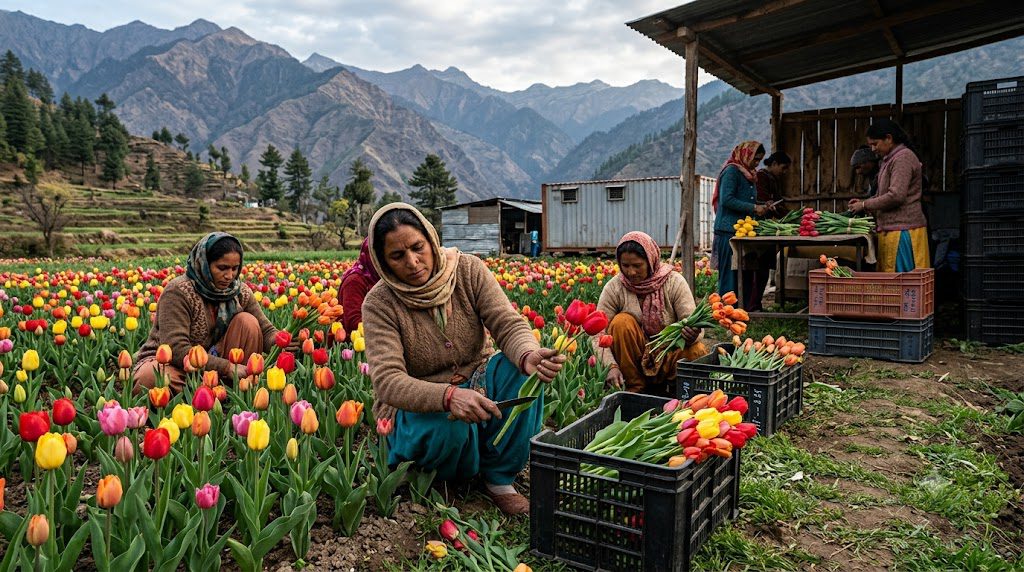
- Cut when buds are colour-streaked but still closed, according to standard cut-flower practice.
- Harvest in the cool of the morning.
- Move stems into clean water and cool storage quickly to extend vase life.
- Grade by stem length and bud quality and bunch consistently for buyers.
Harvesting bulbs
- Let foliage die back naturally, then lift bulbs carefully to avoid bruising.
- Clean, grade by size, and cure in a cool, shaded, well-ventilated place.
- Store in ventilated trays or crates at cool temperatures until replanting or sale. Poor storage can destroy a season’s work.
Marketing
- Wholesale flower markets, florists and event decorators
- Exporters and aggregators, if your quality is consistent
- Direct sales and agri-tourism, where a display garden is viable
- Nurseries and other farmers, for bulb sales
Work as a group
Cooperatives spread the cost of cold storage, transport and marketing. CSIR-IHBT has trained farmers from floriculture cooperatives in Lahaul to grow tulips for both flowers and bulbs, per Himachal Headlines. Shared infrastructure is often what makes the economics work for small farmers.
At larger scale, mechanisation for planting, lifting and grading reduces labour pressure. See our post on essential farm equipment for how to think about machinery choices.
Tulip Farming Profit and Cost: A Realistic View
Many online articles quote precise per-acre profit numbers for tulip farming. Be cautious. Real returns depend heavily on where you farm, what you sell, and how good your market access is.
Main cost drivers
- Bulbs: often the largest cost, especially when imported
- Land preparation: deep tillage, raised beds, manure or compost
- Cold storage and transport: critical for both bulbs and cut flowers
- Labour: planting, weeding, harvesting, grading and packing
- Irrigation and protection: drip lines, mulch, shade or tunnels where needed
- Marketing: packaging, freight and market fees
Revenue depends on
- Whether you sell flowers, bulbs, entry tickets, or all three
- Quality and grading
- Timing, since early or off-season flowers can fetch better prices
- Buyer relationships and volume commitments
A safer way to plan
- Write a simple project plan with local quotes, not international averages.
- Confirm at least one buyer before planting.
- Start with a small pilot plot, for example a few beds, and record every cost and yield.
- Scale in stages once you can show real numbers from your own farm.
- Ask your Krishi Vigyan Kendra (KVK), state horticulture department or the National Horticulture Board about training and any support schemes available in your area.
Treat any profit figure without a stated source, year and region as a marketing claim, not evidence.
Tulip Farming in India: Opportunities and Research Support
India’s tulip story is a good example of how research can open a new farming opportunity.
- Srinagar: The Indira Gandhi Memorial Tulip Garden made tulips a national attraction and is described as Asia’s largest tulip garden.
- Palampur: CSIR-IHBT’s tulip garden in Himachal Pradesh opened to the public and served as a research and demonstration plot, per Drishti IAS. It has featured tens of thousands of bulbs, with 50,000 or more in recent seasons.
- Lahaul: CSIR-IHBT has worked with farmers in Lahaul and Spiti for tulip bulb and flower production. The Tribune reported that the institute has spent about three years supplying planting material, cultivation methods and field support to local farmers, and works with the New Delhi Municipal Council on bulb production. The aim is to reduce reliance on imported planting material.
- Cold-desert advantage: Officials say prolonged winter and cool temperatures in Lahaul suit bulb multiplication.
What this means for you
If you farm in a cold Himalayan region, tulips may be worth a pilot with institutional support. If you farm elsewhere, look at adjacent opportunities such as cold-chain forcing, floriculture services or other crops suited to your climate. Even then, the lesson holds anywhere: partner with a research institute and start small.
Common Mistakes to Avoid
- Planting in poorly drained soil. This is the most common cause of bulb loss.
- Ignoring chilling needs. Without adequate cold, flowering suffers.
- Buying cheap, uncertified bulbs. Savings vanish when disease appears.
- Planting too shallow or too crowded. Both reduce quality and raise disease risk.
- Skipping aphid and virus control. Viruses spread quietly and reduce quality season after season.
- Cutting foliage too early on bulb crops. The bulb needs those leaves to refill.
- Poor storage. Heat, moisture and poor airflow ruin bulbs.
- Growing without a buyer. Flowers and bulbs are perishable or time-sensitive, so secure your market first.
- Scaling before a pilot. Learn on a small plot, then expand.
Expert Tips for Better Tulip Production
- Keep records. Note variety, planting date, treatments, yields and prices for every block. Data becomes your most valuable asset within two seasons.
- Stagger plantings where climate allows, so harvest is spread over more days and gluts are avoided.
- Invest in cooling early. Even simple cold storage improves quality and gives you selling flexibility.
- Test your soil every year. Conditions change with manure, irrigation and rotation.
- Diversify carefully. Pair tulips with other cool-season flowers or crops that suit your climate, so one bad year does not sink the farm.
- Consider small-space options. Tulips can also be grown in containers in cool climates. See our terrace farming guide for balcony and rooftop setups. Pots suit hobby or micro-business use, not commercial bulb production.
- Respect tradition and science together. Older growers’ local knowledge and modern research complement each other. Our post on traditional farming methods shows how.
Frequently Asked Questions (FAQs)
1. What is tulip farming?
Tulip farming is the commercial cultivation of tulips for cut flowers, planting bulbs, or ornamental purposes such as tulip gardens.
2. Is tulip farming profitable?
Tulip farming can be profitable, but returns depend on bulb costs, location, cold-storage requirements, flower or bulb prices, production quality, and market access. Starting with a small pilot can help farmers understand their actual costs and returns.
3. Can tulips be grown in hot climates?
Tulips are difficult to grow outdoors in hot climates because their bulbs require a cold period for proper flowering. Warmer regions may require pre-chilled bulbs, cold storage, or controlled growing conditions.
4. What climate is best for tulip farming?
Tulips perform best in cool climates with a winter chilling period followed by cool spring conditions. The article notes roughly 10°C to 18°C during growth and flowering.
5. Which soil is best for growing tulips?
Well-drained sandy loam or loam soil rich in organic matter is suitable for tulip cultivation. A soil pH of approximately 6.0 to 7.0 is recommended.
6. How do you prepare soil for tulip cultivation?
Farmers should conduct a soil test, break up compacted soil, add well-rotted manure or compost, and use raised or sloping beds where drainage is a concern.
7. Which tulip bulbs are best for farming?
Farmers should select firm, healthy bulbs without soft spots, mould, cuts, or signs of shrivelling. Uniform bulb sizes can help produce more consistent flowering. Disease-free planting material from reliable suppliers is preferred.
8. When should tulip bulbs be planted?
Tulip bulbs are generally planted in autumn so that roots establish during winter and flowers develop in spring. The exact timing should follow local climate and horticultural recommendations.
9. How deep should tulip bulbs be planted?
A commonly used guideline is to plant tulip bulbs at a depth of about two to three times the bulb’s height. The exact depth can vary according to soil type and local recommendations.
10. How much spacing is required for tulip bulbs?
Tulip bulbs are generally planted about 10 to 15 centimetres apart. Spacing can vary depending on bulb size and whether the crop is being grown for flowers or bulb multiplication.
Conclusion
Tulip farming rewards growers who respect its basics: a cool climate, well-drained soil, certified bulbs, correct planting, careful disease control and a ready market. Global demand is strong, and countries like India are investing in research so farmers can produce bulbs and flowers closer to home. But tulips are not a crop for every field or every budget.
If you are considering tulip production, start with a small pilot, keep detailed records, work with your nearest research institute or KVK, and scale only when your own numbers support it. Done this way, tulip farming can become a valuable, high-quality addition to a modern farm.
Explore more practical guides on Farm Sutras, including organic farming, precision farming and farm equipment.