
Table of Contents
Makhana farming has moved from a regional tradition in eastern India to one of the most talked-about opportunities in Indian agriculture. The crop is the source of the crunchy, protein-rich snack sold as fox nut or lotus seed. Demand is rising, policy support is growing, and more farmers are asking how to enter this business.
This guide explains makhana farming step by step. It covers climate, seed, pond preparation, harvesting, processing, costs and government schemes. Every statistic is linked to its original source.
What Is Makhana Farming?
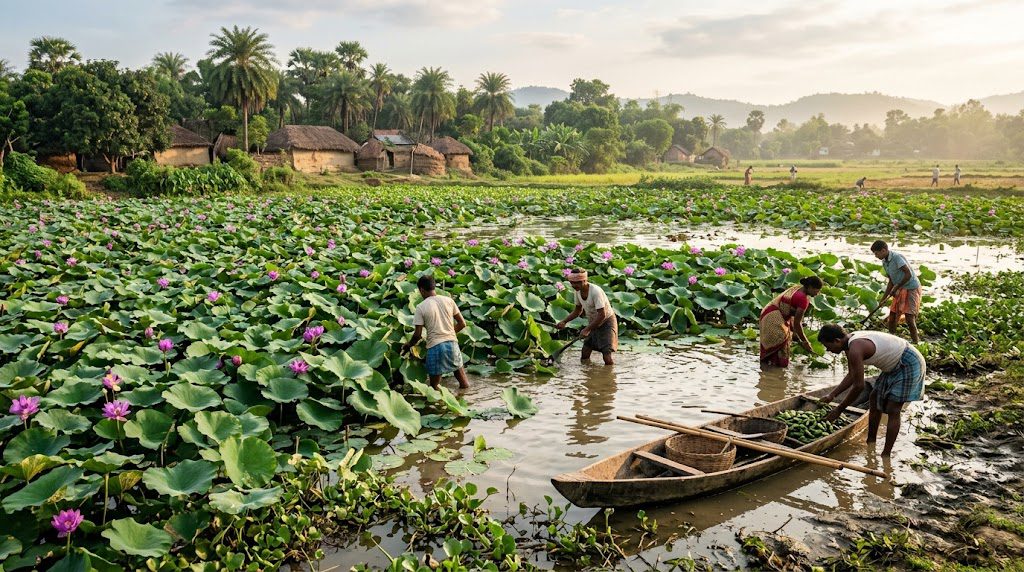
Makhana farming is the cultivation of Euryale ferox, an aquatic plant in the water lily family. It grows in shallow ponds, wetlands and specially prepared fields. Its seeds, called guri, are harvested, dried, graded and popped into the white puffs we know as makhana.
The plant has large, spiny, floating leaves and purple flowers. Its spiny fruit holds many seeds, and the seeds sink to the bottom of the water body when the fruit bursts.
Makhana is also called fox nut, gorgon nut and lotus seed. It has deep cultural roots in Mithila. According to Drishti IAS’s explainer on the GI tag, it is one of the three cultural identities of Mithila, along with pond and fish. The same source notes that makhana contains protein and fibre, along with calcium, magnesium, iron and phosphorus.
Why Makhana Farming Is Trending in 2026
Three forces are pushing makhana farming into the spotlight: health-conscious consumers, government backing and area expansion.
A Superfood With Growing Demand
Makhana is low in fat and easy to flavour. Health-conscious snackers, fitness brands and packaged-food companies have adopted it as a healthy alternative to fried snacks.
The Makhana Board and Policy Push
The Union Budget 2025-26 announced a Makhana Board for Bihar. Down To Earth reported that the board is meant to provide financial and technological support to growers in the flood-prone Mithilanchal, Kosi and Seemanchal regions. It also covers processing and marketing.
Rapid Area Expansion
Cultivation is no longer limited to a single belt. In a written Lok Sabha reply, the Agriculture Ministry said makhana cultivation grew from about 13,000 hectares to 35,000 hectares across several states.
Bihar Still Leads
Bihar is the dominant producer. Estimates range from roughly 80% to 90% of India’s output depending on the source. Its Mithila region has a Geographical Indication (GI) tag, which the India Water Portal notes was granted in 2022.
The same report says growers can receive a 75% subsidy on cultivation. It puts total cultivation cost at about ₹97,000 per hectare, so the farmer bears about ₹24,250.
Rules and subsidy rates change, so confirm current terms with your state horticulture or fisheries office before investing.
Step 1: Choose the Right Climate and Water Body for Makhana Farming
Makhana farming depends on water. The crop needs standing water, warm temperatures and a long growing season.
Ideal Conditions
- Water: still or slow-moving water, ideally from a reliable source
- Soil: clay or clay-loam that holds water and supports the seeds settled on the bottom
- Climate: warm and humid, with hot summers
- Site: low-lying land, existing ponds, oxbow lakes or fields that can hold water for months
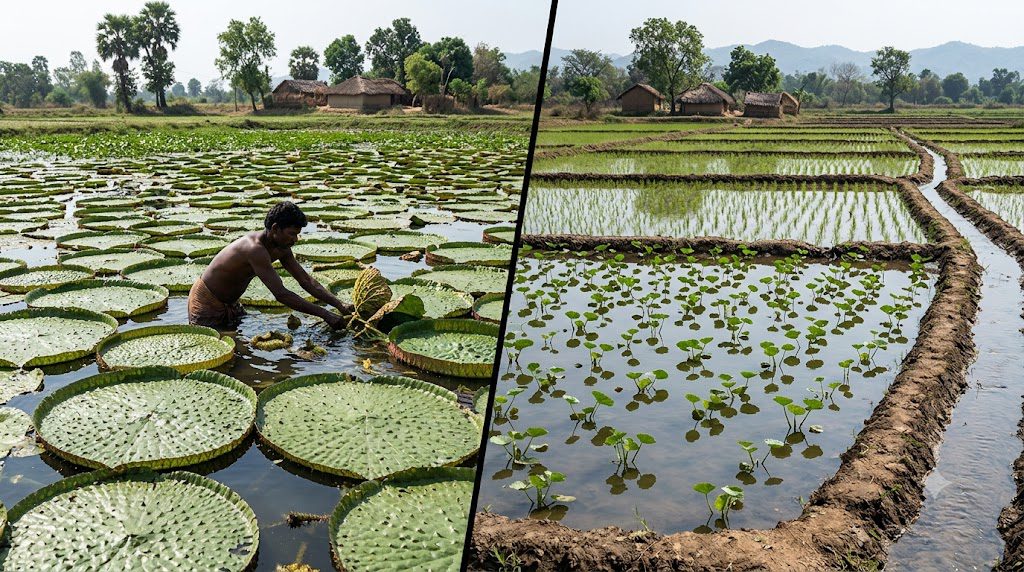
Pond or Field?
Traditional makhana farming happens in ponds. This works but is labour-intensive, because seeds must be collected from the pond bottom.
The alternative is the field system, where a paddy-type field is flooded to a controlled depth. Research institutions have promoted this system because it opens up new acreage. It also makes harvesting easier.
Practical tip: if you already have a fish pond or a waterlogged field that is unsuitable for other crops, evaluate it for makhana. Our guide to fish farming in ponds explains how to assess pond depth and water quality.
Step 2: Select High-Yield Makhana Seed
Seed choice is the biggest lever for your yield. Using unimproved, mixed seed is a common reason for poor returns.
Sabour Makhana-1
Sabour Makhana-1 is a variety developed at Bihar Agricultural University, Sabour. The ICAR Indian Horticulture paper describes these traits:
- large round leaves and dark purple flowers
- small oval seeds with a very thin seed coat (0.29 mm)
- seed yield of 32–35 quintals per hectare
- pop recovery of 55–60%
- moderate field resistance to leaf blight
Where to Buy Makhana Seed
Buy from trusted institutional sources, such as agricultural universities, ICAR centres, Krishi Vigyan Kendras (KVKs) and state horticulture departments. The Agriculture Ministry’s reply cited above says thousands of kilograms of high-yielding seed have been distributed to farmers, KVKs and organisations in several states.
The ICAR-RCER Research Centre for Makhana at Darbhanga works on improved technologies, agro-diversity conservation and dissemination to farmers. It is a good place to start for technical guidance.
Step 3: Prepare the Pond or Field
Good preparation reduces weeds, pests and losses later.
For Ponds
- Drain or lower the water where possible.
- Remove unwanted aquatic weeds and debris.
- Level and repair bunds so water depth is uniform.
- Allow the pond to refill to the recommended depth.
For Fields
- Plough and puddle the field as you would for paddy.
- Strengthen the bunds so they hold water for months.
- Level carefully. Uneven fields create depth variation that hurts plant growth.
- Install an inlet and outlet for water control.
Water Depth Matters
The Sabour Makhana-1 guidance in the ICAR paper sets specific depths:
- Field system: at least 6 inches from transplanting to flower initiation
- Pond system: 5–6 feet is enough
- After flower initiation until harvest: at least 1 foot
Water that is too deep or too shallow at the wrong stage reduces yield, so measure it instead of guessing.
Step 4: Sowing and Transplanting in Makhana Farming
Timing varies by region and system, so check your local calendar. The general pattern is as follows.
Pond System
Seeds are commonly sown directly in the pond during the cooler months. Seedlings emerge as temperatures rise, and thinning is needed to avoid overcrowding.
Field System
Farmers raise seedlings in a nursery and transplant them into the prepared field. Transplanting is usually done in late winter to early spring.
Spacing and Seed Rate
Spacing affects light, airflow and the size of the leaves. The exact seed rate and spacing depend on the variety and system, so follow the recommendation from your agricultural university or KVK.
Field tip: keep a simple logbook. Record sowing date, seed source, spacing, water depth and rainfall. After one season, you will know what to change.
Step 5: Manage Water, Nutrients, Weeds and Pests
This stage decides whether makhana farming gives you a good harvest or a disappointing one.
Water Management
Watch water levels weekly. Heavy rain can raise depth quickly, while dry spells can drop it. Adjust the inlet and outlet to stay within the recommended range.
Nutrient Management
Organic manure improves the soil and supports steady growth. Follow soil-test-based recommendations for any fertiliser. Excess nutrients can pollute the water and encourage algae. Our guide to organic fertiliser for crops covers safe, low-cost options.
Weed Control
Weeds compete for light and nutrients. Remove unwanted aquatic plants by hand early and often. Keep the water body clean at the edges too.
Pest and Disease Management
Watch the leaves for chewing damage, insects and blight symptoms. Choose resistant varieties where possible. The Sabour Makhana-1 variety has moderate resistance to leaf blight.
Use integrated pest management. Because makhana grows in water, chemical residues can harm aquatic life and contaminate the water, so consult local experts before applying any pesticide.
Step 6: Harvest the Seeds
Harvesting is the hardest part of traditional makhana farming.
How Harvest Works
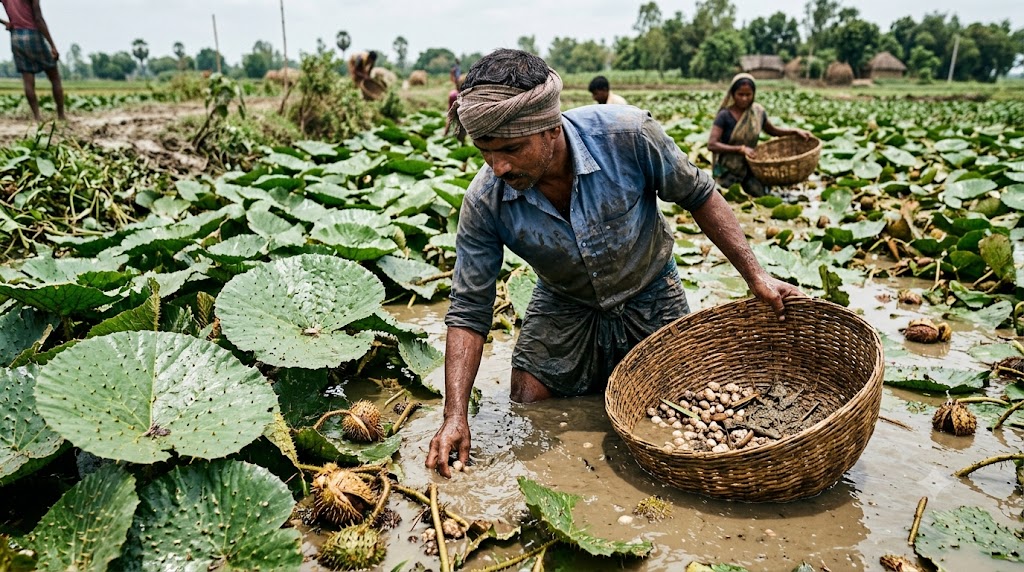
Fruits mature and burst underwater, releasing seeds that sink to the bottom. In ponds, workers dive to collect the seeds by hand. In field systems, harvesting is easier because the water is shallow.
Harvest Timing
Harvest usually falls in the late monsoon and post-monsoon months. Check your region’s calendar and collect regularly during the harvest window. Seeds left too long may be lost.
Post-Harvest Handling
- Wash the seeds to remove mud and debris.
- Sun-dry them thoroughly.
- Grade them by size, because size affects popping and price.
- Store in a cool, dry place away from moisture and pests.
Makhana-cum-fish farming is worth exploring. The Agriculture Ministry’s reply lists it among the achievements of the National Research Centre for Makhana, alongside water-efficient and integrated farming systems. Growing fish in the same water body can add a second income stream.
Step 7: Process, Pop and Sell Your Makhana
Raw seeds have limited value. Processing turns them into the product consumers buy, and value addition is where much of the profit sits.
The Popping Process
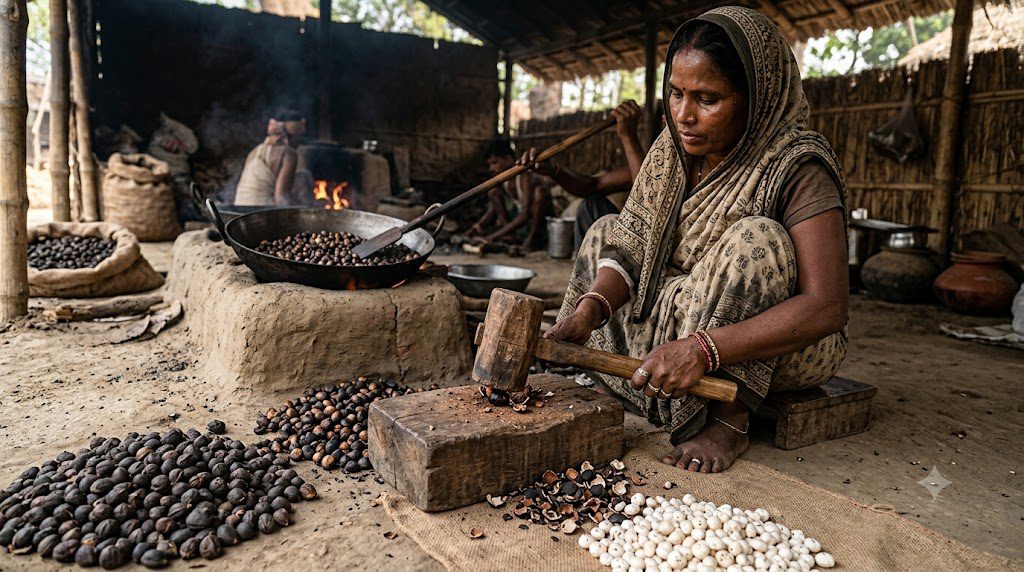
Traditional makhana processing involves three stages:
- Roasting the dried seeds at high heat
- Tempering them briefly
- Striking them with a mallet so the hard shell cracks and the kernel puffs
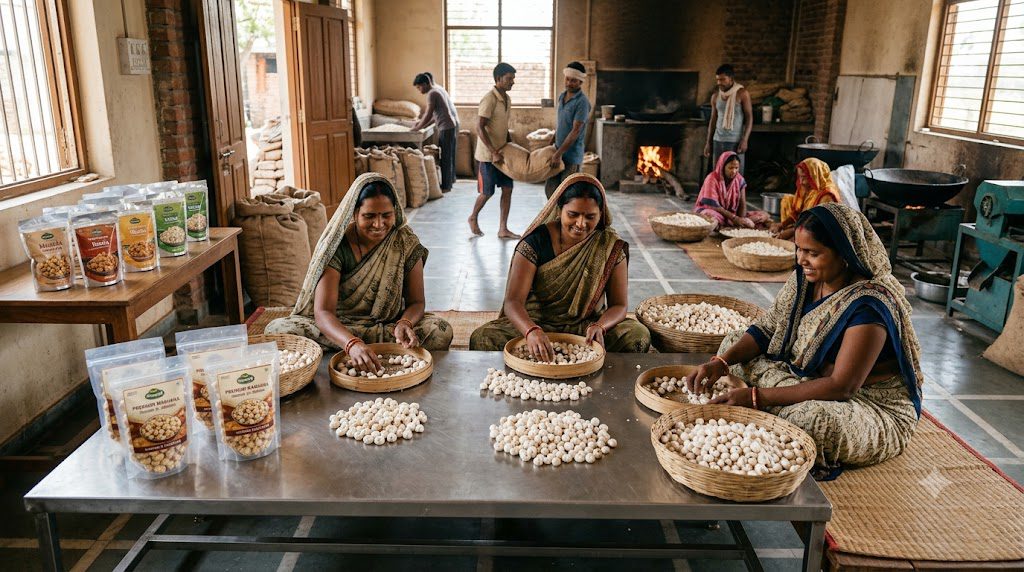
This work is skilled and physically demanding. The mandate of the ICAR-RCER makhana research centre specifically mentions reducing drudgery for women engaged in popping. Mechanised poppers and improved processing methods are gradually changing this.
Grading and Packing
Larger, whiter and more uniform pops fetch better prices. Pack in airtight, moisture-proof bags, because makhana absorbs moisture and loses its crunch.
Selling Options
- Local mandis and traders
- Farmer Producer Organisations (FPOs)
- Direct sales to processors and snack brands
- Online marketplaces and your own branded packs
- Value-added products such as flavoured makhana, flour and ready-to-eat mixes
If your product qualifies under the GI, use the Mithila Makhana name only as permitted by the registered rules. Explore agri-business ideas for small farmers to see how branding and packaging can raise margins.
Makhana Farming Cost, Yield and Profit
Profit depends on your yield, your costs and the price you get. The figures below use sourced data where available and clearly labelled assumptions where not.
Sourced Figures
| Item | Figure | Source |
|---|---|---|
| Total cultivation cost | About ₹97,000 per hectare | India Water Portal |
| Farmer’s share with 75% subsidy | About ₹24,250 per hectare | India Water Portal |
| Seed yield (Sabour Makhana-1) | 32–35 quintals per hectare | ICAR Indian Horticulture |
| Pop recovery (Sabour Makhana-1) | 55–60% | ICAR Indian Horticulture |
A Simple Worked Example
At the published yield of 32–35 quintals of seed per hectare and a 55–60% pop recovery, one hectare could give roughly 18–21 quintals of popped makhana. This holds if the recovery figure is by weight. It is a best-case research figure and not a guarantee.
To estimate your own revenue:
Revenue = quantity sold × your local price
Makhana prices fluctuate with grade, season and demand. Check current mandi and wholesale rates before you plan. Do not rely on any single quoted price.
Costs to Remember
- Land or pond lease
- Seed and nursery
- Labour for harvesting, which is often the largest cost
- Processing and popping labour or machinery
- Packaging and transport
- Water management and repairs
Realistic Expectations
Actual yields on farmers’ fields are often lower than research-station figures because of weather, water management, seed quality and harvest losses. Start small in your first season and scale up after you understand your local conditions.
Government Support for Makhana Farming
Public support is a major reason makhana farming is attractive right now.
Makhana Board
The announced board is intended to strengthen production, processing, value addition and marketing. Down To Earth’s budget coverage says it aims to give farmers technical and financial support. The India Water Portal report describes it as a ₹100 crore initiative aimed at price discovery, branding, research and storage.
Research Backing
The National Research Centre for Makhana in Darbhanga was sanctioned during the IX Five Year Plan for conservation, research and development of the crop, according to a Press Information Bureau release. It supports farmers through improved varieties and farming systems.
Subsidies and Schemes
Farmers in Bihar can access subsidies on cultivation. Other states may offer support through horticulture, fisheries or rural development schemes. Read our overview of government schemes for farmers and contact your district horticulture or fisheries officer for current eligibility and paperwork.
GI Protection
The GI tag helps protect the Mithila Makhana name and can support premium pricing. It also means that not all makhana can be sold under that label.
Common Mistakes in Makhana Farming
Avoid these mistakes to protect your investment.
- Using low-quality seed. Always buy from trusted institutional sources.
- Ignoring water depth. Depth requirements change at different growth stages.
- Over-crowding plants. Poor spacing reduces leaf size and yield.
- Skipping the logbook. Without records, you cannot improve.
- Selling only raw seed. Processing and grading add value.
- Ignoring market research. Find your buyers before harvest, not after.
- Overusing chemicals. Water contamination can damage your pond ecosystem and your reputation.
FAQs About Makhana Farming
1. Is makhana farming profitable?
It can be, especially with improved seed, good water management and value addition. Returns depend on yield, labour cost and the price you receive. Research-station yields are higher than typical farm yields, so plan conservatively.
2. How long does makhana take to grow?
The crop has a long season. It is sown or transplanted in the cooler months and harvested after the monsoon. Exact timing depends on your region and system, so confirm the local calendar with your KVK.
3. Can makhana be grown outside Bihar?
Yes. Cultivation has expanded across multiple states, according to the Agriculture Ministry reply reported by ANI. Success depends on water availability, temperature and access to seed and processing.
4. Do I need a pond for makhana farming?
Not necessarily. The field system uses a flooded, paddy-type field with controlled water depth. It can be easier to manage and harvest.
5. Where can I get training on makhana cultivation?
Contact ICAR research centres, agricultural universities and your local KVK. The ICAR-RCER Makhana centre is a primary technical resource.
6. Which makhana variety is best for cultivation?
Sabour Makhana-1 is an improved variety developed at Bihar Agricultural University, Sabour. The cited research reports a seed yield of 32–35 quintals per hectare and a pop recovery of 55–60%, along with moderate resistance to leaf blight.
7. Where can farmers buy makhana seeds?
Farmers should source quality seed from agricultural universities, ICAR centres, Krishi Vigyan Kendras (KVKs), and state horticulture departments. The ICAR-RCER Research Centre for Makhana in Darbhanga is also a technical resource for improved cultivation practices.
8. How deep should the water be for makhana farming?
Water depth requirements vary by growth stage and cultivation system. The cited Sabour Makhana-1 guidance specifies at least 6 inches in the field system until flower initiation, around 5–6 feet in the pond system, and at least 1 foot after flower initiation until harvest.
9. How long does makhana take to grow?
Makhana has a relatively long growing season. It is generally sown or transplanted during the cooler months and harvested after the monsoon. Exact timing depends on the region and whether the pond or field system is used, so farmers should follow their local agricultural calendar.
10. How is makhana harvested?
Makhana fruits mature and burst underwater, releasing seeds that sink to the bottom. In traditional ponds, workers collect the seeds manually from underwater. Field cultivation can make harvesting easier because the water is shallower.
Conclusion: Is Makhana Farming Right for You?
Makhana farming combines a growing market, strong institutional research and rising policy support. Farmers with access to water can turn a wet, low-lying plot into a productive crop.
The main steps are to choose the right site, use improved seed, prepare the pond or field carefully, manage water depth, harvest on time and invest in processing. Start small, keep records and build your buyer network early.
If you are ready to begin, contact your nearest KVK and visit a working makhana farm before you commit. Then explore our agri-business ideas to plan how you will sell your crop.
This article is for general information. Subsidy rules, prices and dates change, so confirm details with official agencies before making investment decisions.