
Table of Contents
AI soil carbon monitoring — using satellite imagery, machine learning, and archives of lab-tested soil samples to estimate how much carbon a field is storing, without physically digging up soil — is one of the fastest-moving corners of agritech in 2026.
Companies in this space claim it can cut measurement costs by more than 90% compared to traditional soil sampling, which matters enormously for whether smallholder farmers can access carbon markets at all.
But a primary document from the body that actually sets integrity standards for the voluntary carbon market tells a more complicated story than the marketing does — and that’s the story worth understanding before anyone puts a farm’s carbon revenue on this technology.
What Is AI Soil Carbon Monitoring?
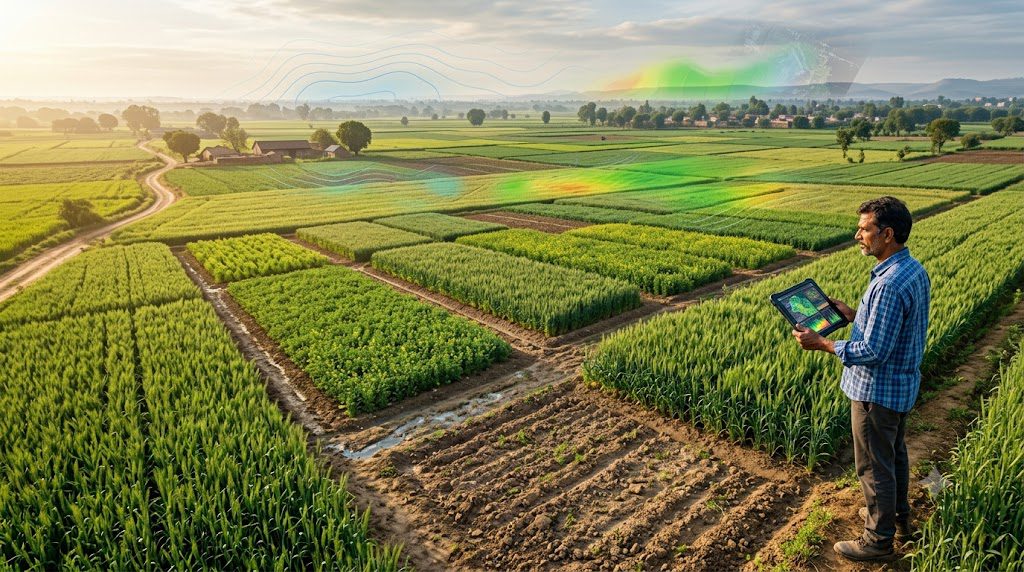
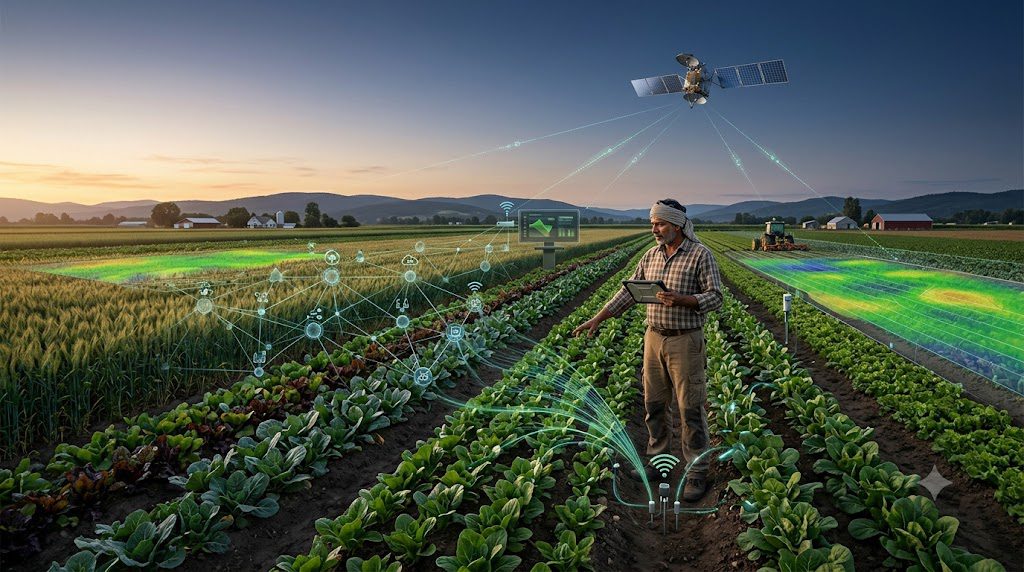
AI soil carbon monitoring combines satellite imagery, machine learning models, and large archives of physically tested soil samples to estimate soil organic carbon (SOC) levels across a field — continuously and remotely, rather than through repeated physical soil coring.
According to a 2026 academic survey on carbon farming, one prominent system built by the company Boomitra combines machine learning with more than 1 million georeferenced soil samples to deliver pixel-level carbon measurements using Sentinel-2, Landsat, and ALOS-2 satellite radar data.
The stated goal is to reduce measurement, reporting, and verification (MRV) costs by roughly 90% while still meeting the accuracy bar required by leading carbon crediting standards.
Why This Matters More in 2026 Than It Did a Year Ago
1. The leading soil carbon methodology was just updated to formally include AI remote sensing as an option. Verra’s own published VM0042 methodology page confirms that version 2.2, active as of October 2025, introduces the option to estimate Soil Organic Carbon stock changes using remote sensing through Digital Soil Mapping (DSM) — a direct, formal recognition of satellite-based measurement inside the industry’s most widely used soil carbon methodology.
2. The market’s top independent integrity body reviewed that exact update — and did not approve it. This is the fact most coverage of this space misses entirely, and it comes directly from ICVCM’s own primary governance document, published October 2025: “Inclusion of DSM as a new SOC measurement technique occurred in the final stages of the ICVCM assessment process, and as such, the ICVCM was unable to complete evaluation of this technique prior to the Governing Board consideration. Consequently, the Governing Board did not grant approval of DSM as a measurement technique in this Decision.”
3. VM0042 itself received a major integrity upgrade in October 2025. ICVCM’s own announcement confirms VM0042 v2.2 was approved as meeting the Core Carbon Principles — the global benchmark ICVCM uses to certify high-integrity carbon credits — making it, alongside one other protocol, the first sustainable agriculture methodology to receive that label at all.
4. Academic literature increasingly supports the underlying science, with a clear caveat. A peer-reviewed article archived on PMC, the National Institutes of Health’s open-access repository, confirms VM0042 is the governing methodology project developers must follow to earn verified carbon units for agricultural soil carbon projects — establishing the legal and scientific baseline this entire technology category has to work within.
5. Real capital and real farmer numbers are already attached to this. According to industry tracking, Boomitra has raised approximately $34.9 million and secured $35 million in additional project financing, currently supporting monitoring across more than 5 million acres and 100,000-plus farmers, according to a 2026 academic survey compiling company-reported figures.
How Satellite AI Soil Carbon Measurement Works
Training Data
Systems in this category are built on archives of physically collected, lab-analyzed soil samples — Boomitra cites more than 1 million georeferenced samples — matched against satellite observations from the same time and location each sample was taken.
Satellite Observation
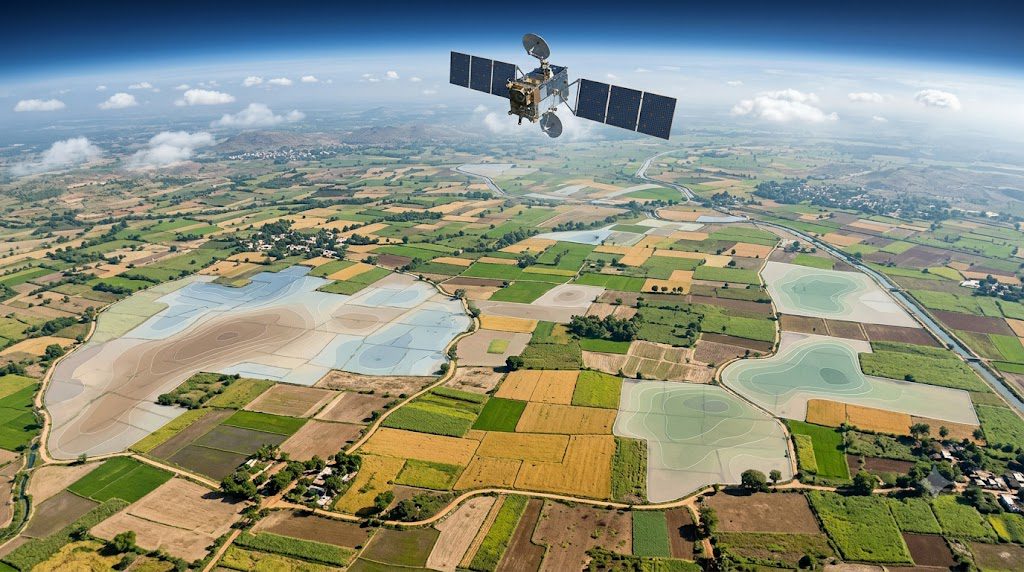
Multiple satellite sources are typically fused together. The academic survey cited above specifies Sentinel-2, Landsat, and ALOS-2 radar imagery as inputs, allowing the system to observe surface and near-surface conditions correlated with soil carbon content across large areas simultaneously.
Machine Learning Calibration
A machine learning model is trained to predict soil organic carbon levels from the combination of satellite signals and the physically verified ground-truth samples, producing continuous, field-level estimates without requiring a physical sample from every acre monitored.
Blockchain Verification Layer
Some platforms add a blockchain record on top of the measurement layer specifically to prevent double-counting of carbon credits. According to the same academic survey, one such system, built by TraceX, automates data collection from satellite imagery, IoT sensors, and mobile apps, then records an immutable transaction history to link each verified credit back to a specific farm and practice.
The Critical Fact Most Marketing Pages Leave Out
This is worth its own section rather than a footnote, because it directly contradicts how several companies describe their own accreditation status.
Company materials in this space commonly describe their systems as “Verra-approved” or state their models “meet or exceed the accuracy thresholds required under Verra’s VM0042 methodology.”
Both of those statements can be technically accurate — VM0042 v2.2 does now permit Digital Soil Mapping as an SOC measurement option — while still leaving out the more important fact: the Integrity Council for the Voluntary Carbon Market, the body that certifies whether a methodology meets the market’s highest integrity bar, explicitly did not evaluate or approve satellite-only remote sensing as an approved measurement technique in its most recent decision, specifically because DSM was added too late in the assessment process to be reviewed.
The same primary document notes the Governing Board sees real potential in digital MRV approaches going forward — this isn’t a rejection of the technology’s promise, it’s a statement that independent evaluation of the AI-only measurement method specifically hasn’t happened yet at the level that matters most for credit integrity.
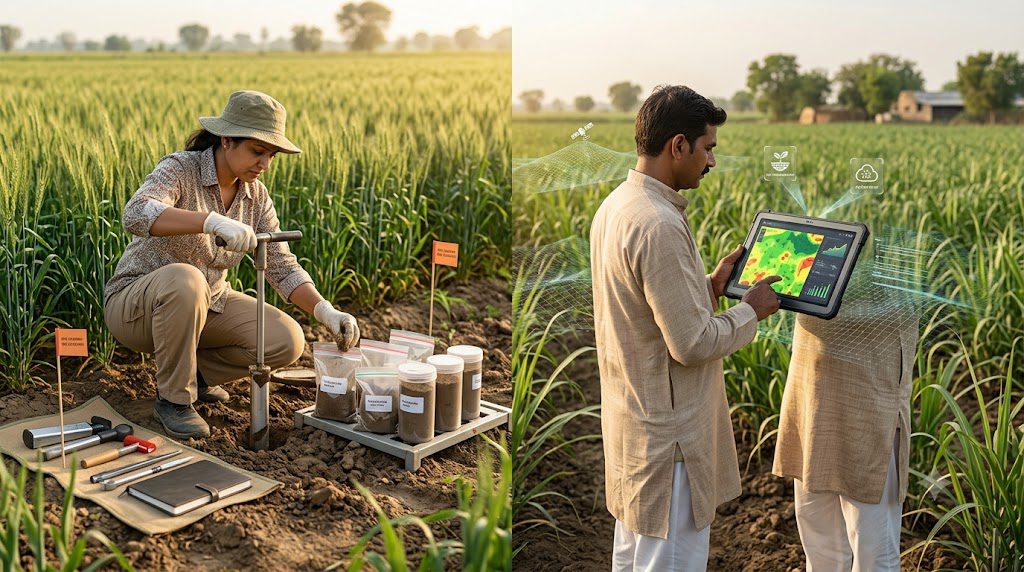
The approved, ICVCM-reviewed SOC measurement techniques under VM0042 v2.2 remain physical and proximal sensing methods: dry combustion (the Dumas method), infrared spectroscopy, laser-induced breakdown spectroscopy, and inelastic neutron scattering — not satellite-based Digital Soil Mapping alone.
AI Remote Sensing vs. Physical Soil Sampling
| Factor | Physical/Proximal Sampling | AI Satellite Remote Sensing |
|---|---|---|
| ICVCM-approved for CCP-labeled credits | Yes, as of October 2025 | Not yet evaluated or approved |
| Cost | Higher — requires physical field visits and lab analysis | Claimed 90%+ lower by industry sources |
| Scalability for smallholders | Limited by sampling cost | Positioned as the path to smallholder access |
| Verification independence | Long-established, third-party lab standards | Newer, company-reported accuracy claims |
| Current role in VM0042 v2.2 | The evaluated, approved measurement techniques | An included option, pending independent evaluation |
The honest takeaway: AI remote sensing isn’t disqualified from this market — it’s ahead of the independent verification process meant to confirm it belongs there. That’s a meaningfully different, more cautious claim than “Verra-approved AI soil carbon monitoring,” and the distinction matters if a farmer’s actual carbon revenue depends on which credits ultimately qualify for the highest-integrity CCP label.
Why Smallholder Access Is the Real Stakes Here
It’s worth stepping back to explain why this technical distinction matters beyond regulatory nitpicking.
Traditional soil carbon MRV requires physical sampling across enrolled acreage, at a cost that scales with the number of fields and farmers involved. That cost structure has historically made carbon programs viable mainly for large operations, where the fixed sampling cost is spread across enough acreage to be worthwhile.
A 2026 industry roundup of soil carbon startups notes this directly: cutting MRV costs by more than 90% is specifically what makes carbon programs financially viable for smallholder farmers in the Global South, who have historically been priced out of voluntary carbon markets entirely.
That’s the genuine promise behind AI soil carbon monitoring, and it’s a real one — Boomitra’s reported acreage and farmer numbers (more than 5 million acres, over 100,000 farmers) suggest the cost reduction is already unlocking access at meaningful scale. The regulatory gap identified above doesn’t erase that promise.
It means the credits generated through AI-only measurement may currently sit in a lower-certainty tier than credits from independently evaluated methods, at least until ICVCM completes its review — a distinction that matters most to buyers purchasing credits for compliance-grade claims, and one worth understanding if you’re a farmer deciding which program to enroll acreage in.
Who’s Building This: Companies and Standards Bodies
Boomitra, founded in 2022 and headquartered in Gurugram, India, is the most visible name specifically building AI-satellite soil carbon measurement, according to a 2026 industry roundup of soil carbon sequestration startups. The company won the 2023 Earthshot Prize and was named among TIME’s 100 Most Influential Companies, per the same source.
TraceX focuses specifically on the blockchain verification layer, automating data collection from multiple sources and creating tamper-evident records to prevent carbon credit fraud and double-counting, according to the academic survey cited throughout this piece.
Verra, operator of the Verified Carbon Standard, is the organization that develops and maintains VM0042, the methodology most agricultural soil carbon projects in this space are built around.
ICVCM, the Integrity Council for the Voluntary Carbon Market, is the independent governance body that evaluates methodologies like VM0042 against its Core Carbon Principles and decides which credits earn the market’s highest-integrity label — the body whose October 2025 decision is the central fact this entire article is built around.
If you’re evaluating a specific AI soil carbon platform, ask the company directly whether their measurement technique has received independent ICVCM evaluation for CCP labeling, not just whether it complies with a Verra methodology that happens to include it as an option.
Real Limitations Regulators Have Identified
Straight from ICVCM’s own primary document, not secondhand interpretation:
- Digital Soil Mapping specifically has not completed independent evaluation, because it was added to the methodology too late in the assessment cycle for the Governing Board to review it before its October 2025 decision
- Robust quantification still depends on clear physical sampling and model calibration procedures, which ICVCM explicitly flags as critical to reducing measurement uncertainty, even for methodologies that also permit remote sensing options
- Stacked-practice accounting remains methodologically challenging, since isolating the carbon impact of combined practices (no-till plus cover crops plus compost, for example) is harder to model precisely than any single practice alone
- Baseline-setting carries an acknowledged, if unlikely, perverse incentive risk — ICVCM notes historical-practice baselines could theoretically reward a project for having degraded soil more before enrollment, though the board considers this unlikely to materialize in practice since it would also hurt pre-project profitability
How to Evaluate an AI Soil Carbon Program
- Ask directly whether the specific measurement technique used has been independently evaluated by ICVCM, not just whether the underlying methodology (like VM0042) permits it as an option.
- Request the physical soil sampling protocol still backing the AI model, since even AI-driven systems rely on ground-truth samples for calibration — understand how often and how rigorously that ground-truthing happens for your specific enrollment.
- Compare the claimed cost savings against what you’d pay for a traditional sampling-based program, factoring in whether the credits you’d generate qualify for the higher-value CCP label or a lower tier.
- Clarify the permanence commitment, since VM0042 v2.2 requires a 40-year monitoring and compensation period — understand what that legally obligates you to over multiple decades, not just what the first payment looks like.
- Ask what happens if a future ICVCM evaluation doesn’t approve the AI measurement technique for the credits you’ve already generated — this is a real, disclosed regulatory uncertainty, not a hypothetical.
This kind of program sits naturally alongside the carbon credit opportunities already covered on this site and connects to the broader remote sensing and precision agriculture tools discussed in our precision farming guide — the same satellite and sensor infrastructure increasingly supports both irrigation decisions and carbon measurement.
Common Mistakes Farmers Make
- Treating “Verra-approved” and “ICVCM-approved” as interchangeable claims, when the primary documents show a real, current gap between what a methodology permits and what’s been independently evaluated.
- Assuming the cheapest MRV option automatically produces the same credit value, when CCP-labeled credits — the highest integrity tier — currently rest on evaluated, not pending, measurement techniques.
- Skipping the fine print on permanence commitments, then discovering a 40-year monitoring obligation attached to a program they thought was a simple one-time enrollment.
- Not asking what physical ground-truthing still underlies an “AI-only” pitch, since even the most AI-forward systems still depend on real soil samples somewhere in the training pipeline.
This kind of scrutiny fits the same evaluation mindset worth applying to any agritech tool covered on this site — treating a vendor’s accuracy and accreditation claims as a starting question, not a settled fact.
FAQs About AI Soil Carbon Monitoring
1. What is AI soil carbon monitoring?
AI soil carbon monitoring uses satellite imagery, machine learning, and physically tested soil samples to estimate soil organic carbon levels across agricultural fields. It can reduce the need for repeated physical soil sampling while allowing carbon levels to be estimated across large areas.
2. How does AI soil carbon monitoring work?
AI soil carbon monitoring combines laboratory-tested soil samples with satellite data from sources such as Sentinel-2, Landsat, and ALOS-2. Machine learning models use these datasets to estimate soil organic carbon levels across fields without physically sampling every acre.
3. Is AI soil carbon monitoring approved by Verra?
Verra’s VM0042 v2.2 methodology permits Digital Soil Mapping as an option for estimating soil organic carbon stock changes. However, this should not be confused with independent approval of satellite-based measurement by ICVCM.
4. Is satellite soil carbon measurement approved by ICVCM?
As stated in the blog’s October 2025 ICVCM evidence, Digital Soil Mapping had not been independently evaluated or approved by ICVCM for its Core Carbon Principles decision because the technique was added too late in the assessment process.
5. Does AI soil carbon monitoring eliminate physical soil sampling?
No. AI-based systems still depend on physical, laboratory-tested soil samples for model calibration and ground-truthing. The technology mainly aims to reduce the amount of ongoing physical sampling required across monitored farmland.
6. How much can AI reduce soil carbon monitoring costs?
Industry and company sources cited in the article claim that AI-based monitoring can reduce measurement, reporting, and verification (MRV) costs by more than 90% compared with traditional approaches. However, this figure is not presented as an independently verified regulatory finding and should be evaluated for each program.
7. Can AI soil carbon monitoring help smallholder farmers?
Potentially, yes. Lower MRV costs could make carbon programs more financially viable for smallholder farmers, who can face high costs when traditional physical sampling is required across many smaller fields.
8. What is Digital Soil Mapping in carbon monitoring?
Digital Soil Mapping (DSM) uses remote sensing, soil data, and modelling techniques to estimate soil properties across geographic areas. In VM0042 v2.2, DSM was introduced as an option for estimating changes in soil organic carbon stocks.
9. What should farmers ask before joining an AI soil carbon program?
Farmers should ask whether the specific measurement technique has been independently evaluated by ICVCM, what physical soil sampling supports the AI model, how cost savings affect credit value, what permanence obligations apply, and what happens if the measurement technique is not approved in a future evaluation.
10. How long is the commitment for a soil carbon program under VM0042 v2.2?
According to the article, VM0042 v2.2 requires a 40-year monitoring and compensation period beginning with the first crediting period. Farmers should understand this long-term commitment before enrolling their land in a soil carbon program.
Final Thought
AI soil carbon monitoring is a genuinely promising technology with real capital, real acreage, and real scientific grounding behind it — and it’s also, as of the most recent primary regulatory record available, ahead of the independent evaluation process meant to confirm its measurement claims for the market’s highest-integrity credits.
Both things are true simultaneously. The responsible way to evaluate a specific program isn’t to dismiss the technology or to take a company’s accreditation language at face value — it’s to ask the direct question this article is built around: has the specific measurement method been independently evaluated, or does it merely comply with a methodology that currently allows it as an unreviewed option.
Related reading on this site: Carbon Credits for Farmers: 7 Amazing Ways to Earn in 2026, Precision Farming Ultimate: Precision Ag & Vertical Farming, and Agric Technology: Transforming Agriculture for Greater Productivity in 2026.