
The Kisan Credit Card scheme gives Indian farmers something that was historically hard to get from formal banking: fast, flexible, low-interest credit without repeated paperwork every season. Nearly three decades after its 1998 launch, the Kisan Credit Card scheme remains one of the most widely used — and most misunderstood — financial tools available to farmers.
This guide explains exactly how the Kisan Credit Card scheme works, what it costs, who qualifies, how the loan limit is actually calculated, and what changed under the Reserve Bank of India’s 2026 policy update. Every factual claim below is linked directly to its official source, so you can verify it yourself rather than taking a blog’s word for it.
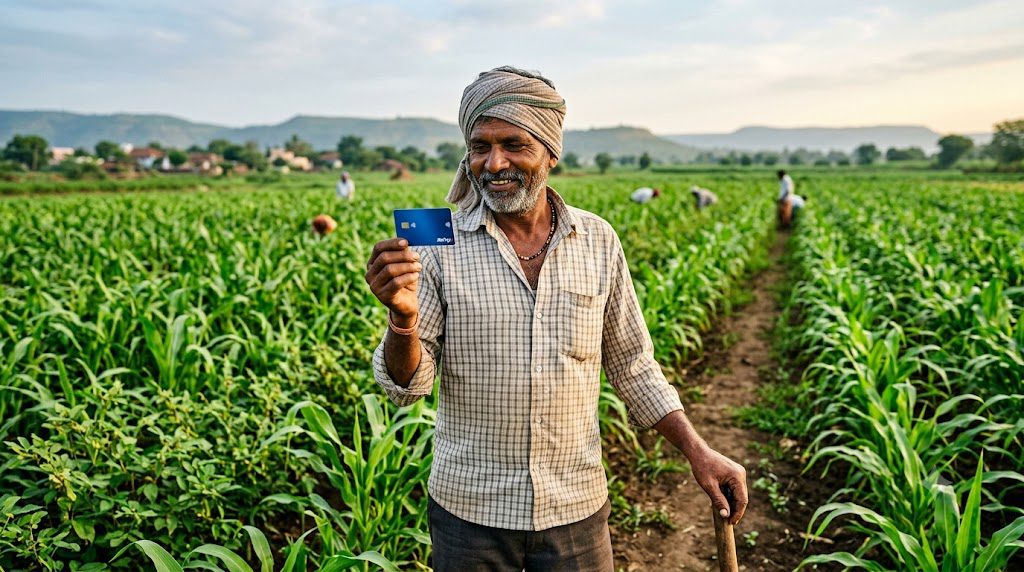
Table of Contents
What Is the Kisan Credit Card Scheme?
The Kisan Credit Card scheme is a government-backed credit facility that provides Indian farmers with a revolving line of credit — similar in structure to a cash-credit account — to meet short-term crop production costs, post-harvest expenses, and, since later revisions, allied activities like dairying and fisheries.
Rather than requiring a farmer to apply fresh for a loan every single season, the RBI’s official Master Circular on the Kisan Credit Card Scheme confirms the scheme is designed as a five-year composite credit facility, with the drawing limit reviewed and adjusted annually rather than re-issued from scratch.
The scheme is implemented by commercial banks, Regional Rural Banks, Small Finance Banks, and cooperative banks, with the Reserve Bank of India supervising implementation by commercial banks and NABARD supervising Regional Rural Banks and cooperatives.
A Brief, Verifiable History of the Kisan Credit Card Scheme
The Kisan Credit Card scheme was announced in the 1998-99 Union Budget speech, and NABARD was directed to design a model scheme in consultation with major banks, based on recommendations from the R.V. Gupta Committee on agricultural credit reform.
Since launch, the scheme has been revised multiple times to expand its scope:
- 2004 — extended to cover investment credit for allied and non-farm activities
- 2012 — comprehensively revised under a working group led by T.M. Bhasin, introducing composite loan structuring and electronic smart-card issuance
- 2019 — extended to cover working capital needs for animal husbandry and fisheries
- 2020 — a national saturation drive launched to bring PM-KISAN beneficiaries under Kisan Credit Card coverage
- 2025 — collateral-free loan limit raised from ₹1.60 lakh to ₹2 lakh per borrower, effective January 1, 2025
- 2026 — RBI issued draft directions proposing a uniform six-year tenure and further revised drawing limits across all lending institution categories
This progression is documented directly in the RBI Master Circular referenced above and in the government’s own public statements on the scheme, not in third-party summaries.
Who Is Eligible for the Kisan Credit Card Scheme
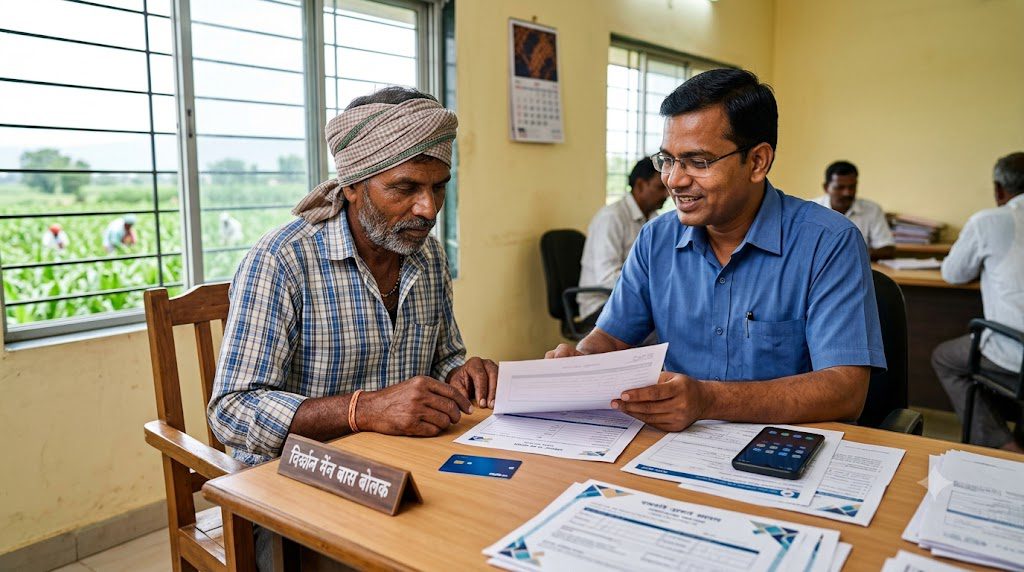
Eligibility under the Kisan Credit Card scheme is intentionally broad, covering more categories of farmers than many assume. According to the official RBI Master Circular, eligible applicants include:
- Individual or joint owner-cultivators
- Tenant farmers, oral lessees, and sharecroppers
- Self-Help Groups (SHGs) or Joint Liability Groups (JLGs) of farmers, including tenant farmers and sharecroppers
This means land ownership is not a strict requirement — a sharecropper or tenant farmer without a formal land title can still qualify, provided they can demonstrate they are actively cultivating the land in question.
What the Kisan Credit Card Scheme Actually Covers
Per the official scheme objectives, the Kisan Credit Card scheme is designed to meet six distinct categories of farmer credit need:
- Short-term credit requirements for crop cultivation
- Post-harvest expenses
- Produce marketing loans
- Consumption requirements of the farmer’s household
- Working capital for maintenance of farm assets and allied agricultural activities
- Investment credit for agriculture and allied activities
The first five components together form the short-term credit limit portion of the card, while the sixth forms a separate long-term credit limit — a structural detail confirmed directly in the RBI circular linked above.
How the Loan Limit Is Calculated
The Kisan Credit Card scheme doesn’t assign a flat loan amount to every farmer. Instead, the limit is calculated using a formula tied to the officially notified “Scale of Finance” for each crop, set by the District Level Technical Committee.
In simplified terms, the calculation works like this:
- Take the scale of finance for the crop, multiplied by the cultivated area
- Add 10% of that figure to cover post-harvest, household, and consumption needs
- Add 20% of that figure to cover farm asset repair and maintenance
- Add any applicable crop insurance or accident insurance premium
- Increase the limit by roughly 10% each year for years two through five, to account for cost escalation
- Add any separate term-loan component for investment purposes, such as a pump set or dairy animal purchase
For marginal farmers with very small landholdings, the scheme instead allows a simpler flexible limit — officially set between ₹10,000 and ₹50,000 as a “Flexi KCC,” based on landholding and cropping pattern rather than the full formula above.
9 Essential Benefits of the Kisan Credit Card Scheme
- Revolving credit, not a one-time loan. Farmers can withdraw and repay repeatedly within their sanctioned limit rather than reapplying each season.
- Collateral-free borrowing up to ₹2 lakh. As confirmed in the government’s own statement on strengthening the KCC ecosystem, this limit was raised from ₹1.60 lakh effective January 1, 2025.
- Deeply subsidized interest rates. Under the Modified Interest Subvention Scheme, short-term agricultural loans through the Kisan Credit Card scheme are available at a concessional 7%, dropping to an effective 4% for farmers who repay promptly.
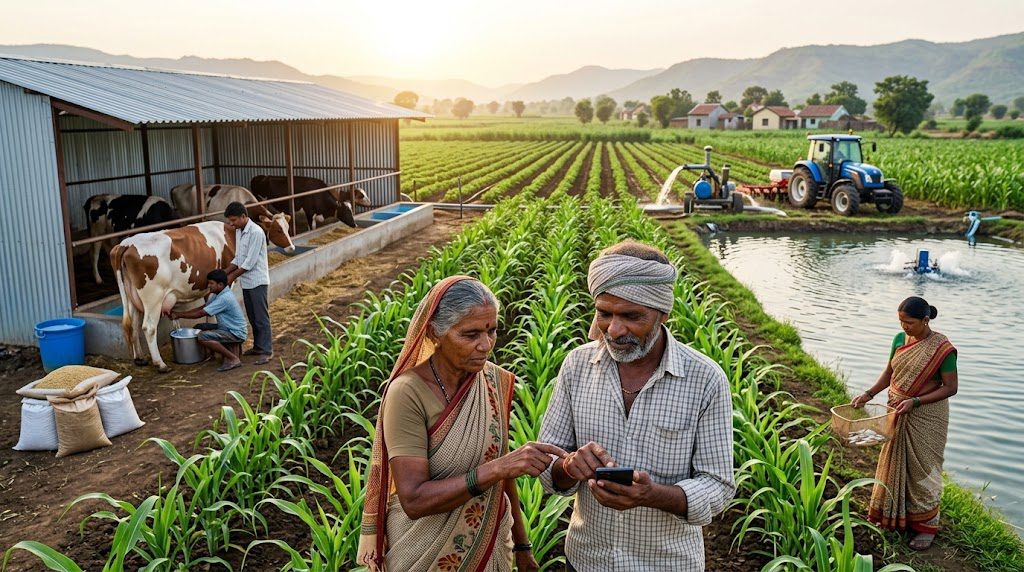
- Coverage beyond crop loans. The scheme extends to post-harvest expenses, household consumption needs, and allied activities like dairying and fisheries, not just input costs.
- Built-in insurance access. KCC holders can have crop insurance, accident insurance, and asset insurance premiums paid directly through their KCC account.
- Digital, low-paperwork renewal. After the initial one-time documentation, renewal in subsequent years requires only a simple declaration of crops grown, not fresh paperwork.
- Broad eligibility. Tenant farmers, oral lessees, sharecroppers, and Self-Help Groups all qualify, not just landowners with formal title.
- Multiple withdrawal channels. Funds can be accessed via ATMs, debit cards, mobile banking, and point-of-sale machines at input dealers and mandis.
- Direct digital application options. The Jan Samarth portal and NABARD’s e-KCC portal allow farmers in several states to apply without visiting a bank branch in person.
Interest Rate and the 4% Effective Rate Explained
The headline “4% interest” figure associated with the Kisan Credit Card scheme is real, but it requires two conditions to apply, and it’s worth being precise about this since it’s the single most misunderstood detail of the scheme.
Under the Government of India’s Modified Interest Subvention Scheme (MISS), short-term agricultural loans through KCC are offered at a base concessional rate of 7%. Farmers who repay their loan on time receive an additional 3% Prompt Repayment Incentive, which brings the effective interest cost down to 4% — but only for farmers who repay within the stipulated period.
This subsidized rate applies up to a specific loan ceiling, which was itself raised in the Union Budget 2025-26 from ₹3 lakh to ₹5 lakh, expanding how much credit qualifies for the concessional structure rather than leaving farmers with larger loans paying standard commercial rates on the excess.
Farmers who do not repay promptly lose the incentive and pay the higher 7% rate, and loans that go into default are subject to standard, non-subsidized agricultural lending rates. This distinction is confirmed directly in the government’s official press release on KCC measures.
What Changed in 2025 and 2026
Several significant updates have affected the Kisan Credit Card scheme recently, and getting the sequence right matters, since some proposed changes have not actually taken effect yet.
January 2025: The collateral-free borrowing limit was raised from ₹1.60 lakh to ₹2 lakh per borrower, a change specifically aimed at improving access for small and marginal farmers, who account for over 86% of the sector according to the government’s own figures.
Union Budget 2025-26: The loan limit eligible for interest subvention under the Kisan Credit Card scheme was raised from ₹3 lakh to ₹5 lakh, as reported by Business Standard’s ongoing coverage of the scheme. This directly expands how much credit a farmer can access at the subsidized 7%/4% rate structure described above, rather than only affecting the collateral-free threshold.
February 2026: The Reserve Bank of India issued draft directions proposing a consolidated, uniform framework for the scheme across Regional Rural Banks and Rural Co-operative Banks, including a standardized six-year credit tenure and expanded digital operations including UPI-based transactions, with stakeholder feedback invited through March 6, 2026.
June 2026: According to subsequent reporting, the RBI deferred implementation of the revised KCC directions to January 2027, citing operational and technology-related concerns raised during the consultation period.
The practical takeaway: as of this article’s publication, the January 2025 collateral-free limit increase and the Budget 2025-26 subvention-limit increase are both confirmed and active, while the broader 2026 directions revamp remains delayed and not yet in force.
Farmers and lenders should treat the newer six-year-tenure and consolidated-framework proposals as pending rather than current until RBI confirms implementation closer to the revised January 2027 timeline.
The Real Scale of the Kisan Credit Card Scheme
Numbers help separate a genuinely widely used scheme from one that sounds significant only in press releases.
As of December 31, 2024, operative Kisan Credit Card loans had crossed ₹10 lakh crore in outstanding amount, benefiting approximately 7.72 crore (77.2 million) farmers, according to a Finance Ministry statement covered by Business Standard.
For comparison, the operative KCC loan amount stood at roughly ₹4.26 lakh crore in March 2014 — meaning the scheme’s outstanding credit volume has grown by well over double in a decade, a trend the Finance Ministry itself has attributed to credit deepening in agriculture and reduced farmer dependency on non-institutional lenders.
That scale matters for a practical reason: a scheme operating at this volume, with active budget-driven limit increases and ongoing digital infrastructure investment (including NABARD’s partnership with the RBI Innovation Hub to speed up digital agricultural lending), is not a dormant or symbolic program.
It is one of the most heavily used formal credit channels in Indian agriculture today, which is also why getting the current, correct terms right — rather than relying on outdated figures — actually matters for a farmer deciding whether to apply.
How to Apply for a Kisan Credit Card
- Approach your primary bank first. A bank where you already hold a savings account or receive PM-KISAN payments typically has faster processing, since your KYC details are already on file.
- Gather required documents. Identity proof, land records or tenancy/sharecropping documentation, and passport-size photographs are generally required for first-time applicants.
- Complete the one-time documentation. After this initial step, subsequent years typically require only a simple declaration of crops grown rather than fresh paperwork.
- Consider digital application channels. Where available, the Jan Samarth portal or NABARD’s e-KCC portal can allow application without an in-person branch visit.
- Confirm your card limit calculation. Ask your bank to show how your specific limit was calculated against the district’s notified Scale of Finance, so you understand what you’re entitled to.
- Track your repayment schedule closely. Since the 4% effective interest rate depends entirely on prompt repayment, missing this window has a direct and immediate cost.
Common Mistakes Farmers Make With the Kisan Credit Card Scheme
- Assuming the 4% rate applies automatically. It only applies with the prompt-repayment incentive layered on top of the base 7% concessional rate — missing repayment deadlines forfeits the discount.
- Not knowing their card covers more than crop loans. Many farmers underuse the scheme by treating it purely as a seasonal crop loan and not accessing the post-harvest, consumption, or allied-activity components it’s designed to cover.
- Skipping the renewal declaration. Even though renewal paperwork is minimal, failing to complete it can lapse the card’s active status.
- Assuming they’re ineligible without land ownership. Tenant farmers and sharecroppers are explicitly eligible under the official scheme rules, a fact many self-exclude on incorrectly.
- Not verifying loan limit calculations. Since the limit is formula-based, not asking the bank to walk through the calculation can result in an under-sanctioned limit going unnoticed.
Kisan Credit Card Scheme vs Informal Moneylenders
| Factor | Kisan Credit Card Scheme | Informal Moneylenders |
|---|---|---|
| Effective interest rate | As low as 4% with prompt repayment | Often significantly higher, frequently unregulated |
| Collateral requirement | None up to ₹2 lakh | Often requires informal collateral or land pledge |
| Documentation | One-time, then simple annual declaration | Informal, inconsistent, legally unprotected |
| Insurance access | Built-in access to crop/accident/asset insurance | None |
| Regulatory oversight | RBI and NABARD supervised | Unregulated |
This gap is precisely why financial inclusion through the Kisan Credit Card scheme remains a policy priority, and why farms already managing risk through crop insurance for farmers are often the same farms making full use of formal KCC credit rather than relying on informal lenders.
FAQs About the Kisan Credit Card Scheme
1. What is the Kisan Credit Card scheme?
The Kisan Credit Card (KCC) scheme provides farmers with flexible credit for crop cultivation, post-harvest expenses, farm maintenance, and eligible allied agricultural activities.
2. Who is eligible for a Kisan Credit Card?
Owner-cultivators, tenant farmers, oral lessees, sharecroppers, and eligible farmer groups such as SHGs and JLGs can apply for a Kisan Credit Card, subject to applicable bank requirements.
3. What are the main benefits of the Kisan Credit Card scheme?
KCC scheme benefits include flexible credit, concessional interest rates, collateral-free loans up to the applicable limit, simplified renewal, and credit support for farming and allied activities.
4. What is the Kisan Credit Card interest rate?
Under the applicable interest-subvention framework, eligible short-term agricultural loans can have a concessional rate of 7%, with the effective rate potentially falling to 4% for eligible farmers who receive the prompt-repayment incentive.
5. Is a Kisan Credit Card loan available without collateral?
Yes. The collateral-free limit for eligible KCC loans was increased to ₹2 lakh per borrower from January 1, 2025, subject to applicable banking rules and conditions.
6. What is the Kisan Credit Card loan limit?
The Kisan Credit Card loan limit is not the same for every farmer. It is generally calculated based on factors such as the crop, cultivated area, notified Scale of Finance, and other eligible credit requirements.
7. How can I apply for a Kisan Credit Card?
Farmers can apply through a participating bank or eligible financial institution. Depending on availability, applications may also be made through digital platforms such as Jan Samarth or e-KCC.
8. Can tenant farmers apply for a Kisan Credit Card?
Yes. Tenant farmers, oral lessees, and sharecroppers are included among eligible categories under the KCC framework, subject to the required documentation and bank eligibility conditions.
9. Can a Kisan Credit Card be used for dairy and fisheries activities?
Yes. The KCC framework has been expanded to cover eligible working-capital requirements for allied activities such as animal husbandry and fisheries.
10. How can farmers get the effective 4% interest rate under KCC?
The effective 4% rate can apply when an eligible farmer receives the applicable interest subvention and prompt-repayment incentive. The farmer must meet the required repayment conditions to receive the incentive.
About the Author
This article was researched and written by the Farm Sutras Editorial Team, and fact-checked directly against the Reserve Bank of India’s official Master Circular, a Press Information Bureau release from the Ministry of Finance, and ongoing financial-news coverage of the scheme — each linked in the Sources section below so you can verify every figure independently rather than take an editorial team’s word for it.
This is an editorial compilation of publicly available government and financial-reporting data, not a personal or professional financial-advisory credential; for a decision specific to your own farm’s finances, confirm final terms with your bank or a NABARD-recognized advisor.
Sources Cited in This Article
- Reserve Bank of India — Master Circular on the Kisan Credit Card (KCC) Scheme
- Press Information Bureau, Government of India — Government Measures Strengthen Kisan Credit Card Ecosystem
- Outlook Money — Kisan Credit Card Scheme To Be Revised, RBI Issues Draft Directions
- Business Standard — Kisan Credit Card News Coverage and Scheme Data
Final Thought
The Kisan Credit Card scheme is one of the rare government financial products where the real terms are actually better than the informal reputation suggests — provided a farmer understands the prompt-repayment condition behind the 4% rate and uses the full scope of what the card is designed to cover, not just seasonal crop input costs.
Before applying or renewing, verify your specific limit calculation with your bank, confirm which of the 2025 and 2026 changes have actually been implemented in your region, and treat the repayment schedule as seriously as the loan itself — since the difference between a 4% and 7% rate on the same credit line comes down entirely to that one factor.
Pingback: e-NAM Platform: 10 Powerful Benefits Transforming Farmer Income in 2026 -