
Table of Contents
Introduction
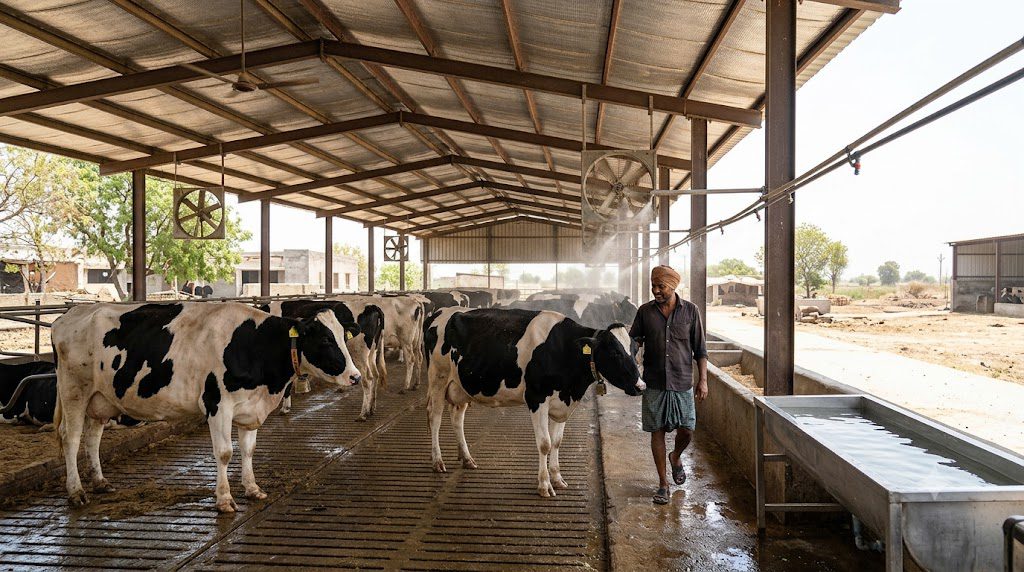
If your dairy cows are drinking more water, eating less, and giving less milk every time the temperature climbs past 35°C, you’re not imagining it, and it’s not “just the season.” What you’re looking at is heat stress, and it is one of the most expensive problems in dairy farming that most farmers never actually diagnose. They just call it a bad summer.
Heat stress doesn’t announce itself with a dramatic event. It shows up quietly, as a few extra litres of milk missing from the evening collection, a cow that skips her feed at noon, a conception that doesn’t take. By the time most farmers notice the pattern, they’ve already lost weeks of production. This guide walks through what heat stress actually is, how to recognize it early using a number most farmers have never heard of, and which cooling interventions are worth the money and which ones aren’t.
What Heat Stress in Dairy Cattle Actually Is
Heat stress happens when a cow can’t get rid of body heat fast enough to keep her internal temperature normal. Cattle generate a huge amount of metabolic heat just from digesting feed a lactating dairy cow produces significantly more internal heat than a dry cow or a beef animal, because rumen fermentation is essentially a slow, continuous furnace. Add high ambient temperature, high humidity, and direct sun, and that furnace has nowhere for the heat to go.
Cows are far more heat-sensitive than most livestock species. Their comfort zone the range where they don’t have to spend extra energy cooling themselves or warming themselves sits roughly between 5°C and 25°C depending on breed, coat colour, and body condition. Once temperatures move past that upper limit, especially combined with humidity, the cow’s body starts diverting energy away from milk production and into cooling itself down: faster breathing, increased sweating, reduced feed intake, and behavioural changes like standing in the shade instead of grazing.
This is not a minor inconvenience. Depending on severity and duration, heat stress can reduce milk yield anywhere from 10% to 25%, and in prolonged, poorly managed conditions the losses go higher. It also affects milk fat and protein percentage, delays return to heat in breeding cows, and in extreme cases contributes to abortion and calf loss. For a herd of even 15–20 milking animals, a sustained heat-stress period across two to three summer months can translate into a real, calculable loss in farm income often more than what it would have cost to prevent it.
The Number Every Dairy Farmer Should Know: THI
Most farmers judge heat stress by temperature alone. That’s the mistake. The number that actually predicts heat stress risk is called the Temperature-Humidity Index, or THI. It combines both air temperature and relative humidity into a single score, because a hot, dry day and a hot, humid day put very different amounts of strain on a cow humidity stops sweat from evaporating, which is a cow’s main cooling mechanism.
As a working guide:
- THI below 68 : No heat stress. Cows are comfortable.
- THI 68–71 : Mild stress. Respiration rate rises slightly; most farmers won’t notice anything is wrong yet, but milk yield is already beginning to soften.
- THI 72–79 : Moderate stress. Feed intake drops, respiration rate climbs noticeably, cows seek shade and reduce activity.
- THI 80–89 : Severe stress. Open-mouth panting, drooling, significant drop in milk yield and fertility.
- THI 90 and above : Emergency-level stress. Risk of collapse and death, particularly in high-producing or heavy-bodied animals.
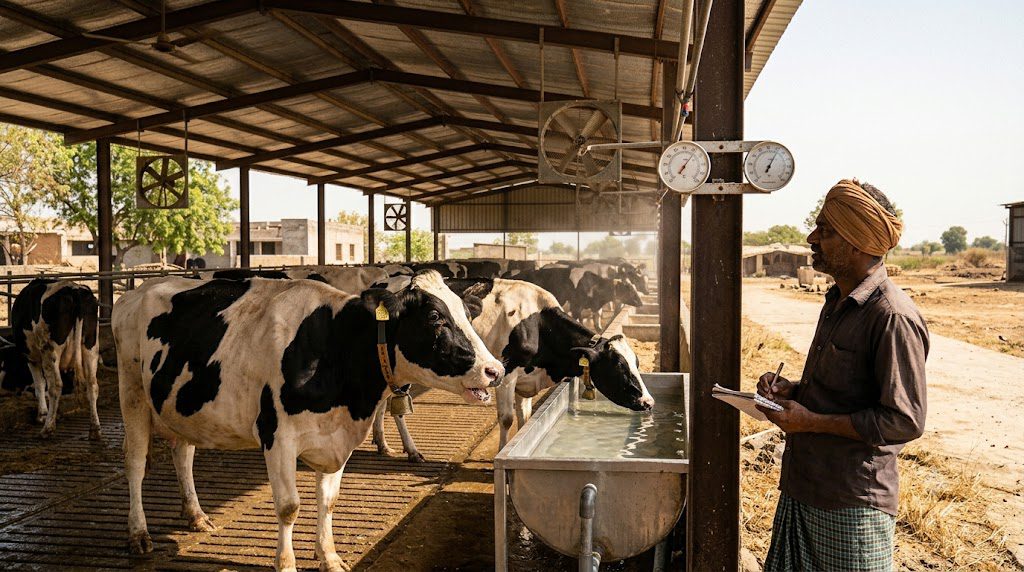
You don’t need an expensive weather station to estimate THI. A basic combined temperature-humidity gauge, the kind used in poultry sheds, costs very little and gives you a working number twice a day the same low-cost sensor logic behind the smart farming tools increasingly used across Indian dairy operations, just applied to your shed instead of your field. Many regions of India routinely cross a THI of 75–80 during April to June and again in the humid months after monsoon onset meaning most dairy herds in these zones are dealing with moderate to severe heat stress for a significant part of the year, whether the farmer is tracking it or not.
Early Signs of Heat Stress in Cattle (Before Milk Yield Drops)
The value of catching heat stress early is that you can intervene before it costs you production. Watch for these signs, roughly in the order they appear:
- Increased respiration rate. A comfortable cow breathes 20–40 times per minute. Under heat stress, this climbs past 60, and in severe cases past 80–100 breaths per minute with visible panting.
- Reduced feed intake, especially at midday. Cows shift their eating to early morning and late evening, avoiding the hottest hours entirely. If your cows are leaving feed in the trough during the day, that’s a signal, not laziness.
- Increased water intake. A heat-stressed cow can drink noticeably more than usual as her body tries to compensate for fluid loss through sweating and panting.
- Standing instead of lying down. Cows lie down to ruminate and rest; under heat stres,s they stand more, often bunched together near whatever shade or airflow is available, which paradoxically raises the local heat load even further.
- Drooling and open-mouth breathing. This is a later-stage sign and indicates the cow is struggling to dissipate heat through normal means.
- Reduced rumination. Less cud-chewing means less saliva production, which affects rumen pH and digestion this is part of why heat-stressed cows are also more prone to acidosis and lower milkfat.
- Drop in milk yield 24–48 hours later. This is the lagging indicator. By the time it shows up in the milk can, the cow has already been under stress for a day or two.
If you’re only checking milk yield to judge whether your cows are struggling, you’re finding out two days too late to do anything about that particular heat event.
Which Cows and Breeds Are Most at Risk
Not every animal in your herd faces the same risk. A few factors stack the odds against a cow:
- High milk production. Ironically, your best milkers are your most heat-vulnerable animals, because higher production means higher metabolic heat generation.
- Dark coat colour. Dark hides absorb more solar radiation than light-coloured ones.
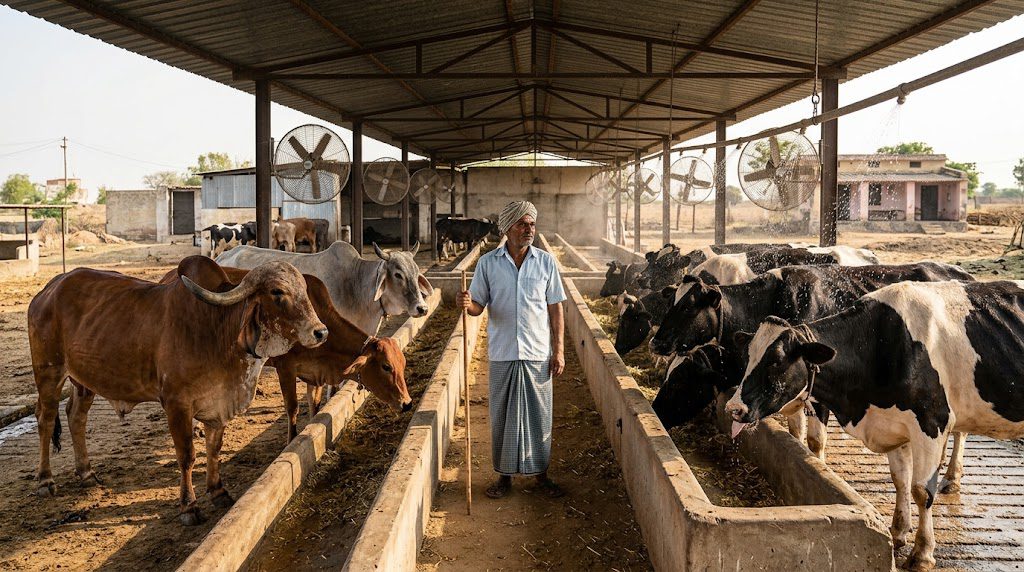
- Crossbred and exotic dairy breeds. Holstein Friesian and Jersey crosses, prized for yield, tolerate heat far worse than indigenous breeds. This is one of the underappreciated trade-offs of the crossbreeding push in Indian dairying higher genetic yield potential, but a narrower thermal comfort zone.
- Indigenous breeds like Gir, Sahiwal, and Tharparkar carry genuine heat tolerance advantages looser skin, more sweat glands, better peripheral blood flow for heat dissipation. Farmers in hot, dry tracts who’ve stuck with these breeds are, in a real sense, already managing heat stress through genetics rather than infrastructure.
- Late pregnancy and early lactation animals, whose metabolic demands are already elevated.
- Overconditioned (overweight) cows, since fat is an insulator and makes heat dissipation harder.
If you’re planning a herd expansion or considering crossbred animals purely for yield potential, factor your local summer THI into that decision. A high-yield animal that loses 20% of her production for three months a year isn’t necessarily the better economic choice over a moderate-yield, heat-tolerant one run the actual numbers for your climate before assuming more milk-per-cow on paper means more milk-per-cow in your shed. If you’re also adjusting how you feed cattle to manage costs, factor in that heat-stressed animals need more energy-dense, not just cheaper, feed during peak summer months.
For breed-specific heat tolerance data and thermoregulation research, ICAR-National Dairy Research Institute publishes detailed studies on indigenous versus crossbred cattle thermotolerance that are worth referencing if you want deeper technical detail: ICAR-NDRI research portal.
Heat Stress Management: What Actually Works
There’s a wide gap between heat stress advice that sounds good and heat stress management that actually moves the needle on milk yield. Here’s what’s worth prioritizing, roughly in order of cost-effectiveness.
1. Shade: The Highest Return for the Lowest Cost
Shade is the single most cost-effective heat stress intervention available, and it’s the one most farmers underinvest in. A cow standing in direct sun can experience a solar heat load significantly higher than one in shade, even at the same air temperature.
- Natural tree shade (neem, banyan, tamarind) works well if trees are positioned to block midday sun and allow airflow underneath dense canopy without airflow can trap heat rather than relieve it.
- Shed roofing matters more than people assume. A tin roof without insulation can radiate stored heat downward for hours after sunset. A simple layer of thatch, straw, or a white-painted / reflective roof coating over tin significantly reduces radiant heat compared to bare metal.
- Allow at least 3.5–4 square metres of shaded resting area per adult cow. Overcrowded shade just concentrates body heat from multiple animals in one spot, undermining the point.
2. Airflow and Ventilation
Moving air helps a cow dissipate heat through convection, on top of whatever evaporative cooling is happening through sweat. Options scale with budget:
- Natural ventilation: open-sided sheds, ridge vents, and correct shed orientation relative to prevailing wind direction cost nothing beyond design planning at construction time.
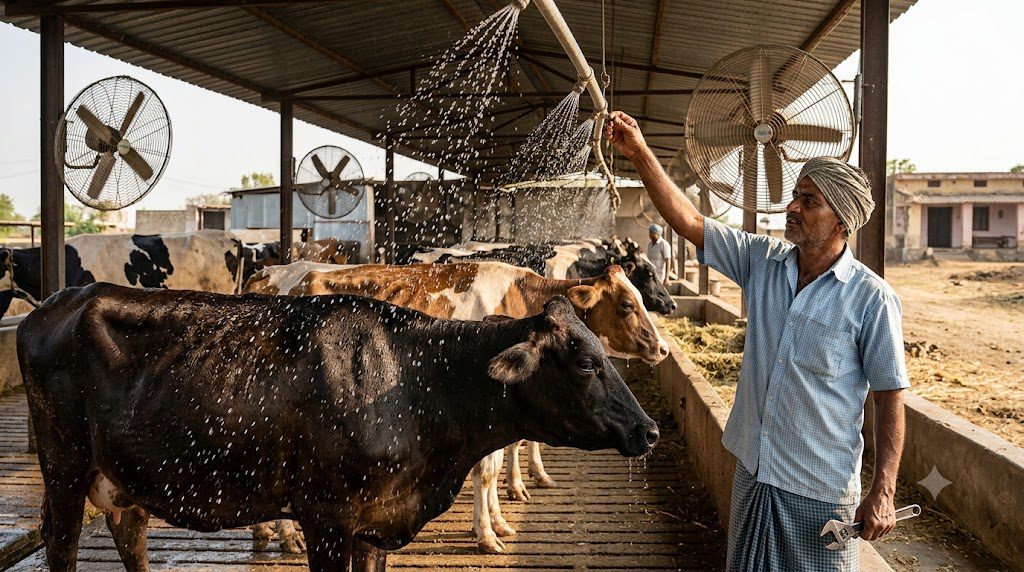
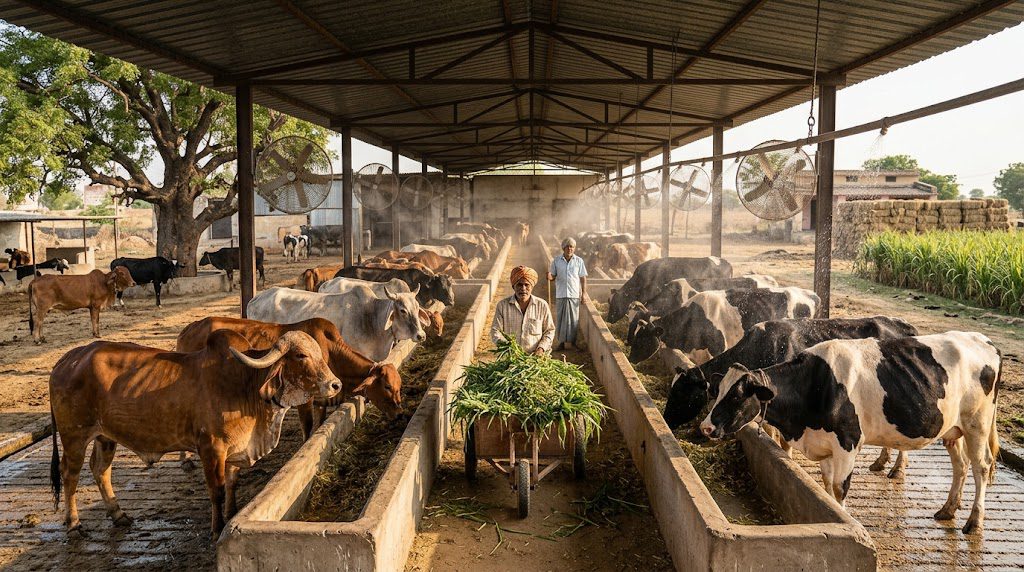
- Mechanical fans: even basic pedestal or wall-mounted fans positioned over feeding and resting areas measurably lower respiration rates. Fans are most effective when combined with misting or sprinkling air movement alone helps, but air movement over wet skin is where the real cooling happens.
3. Sprinklers and Misting : Used Correctly
This is where farmers most often waste money or actively make things worse. There are two very different systems, and they are not interchangeable:
- Misting/fogging creates a fine water droplet that evaporates in the air, cooling the surrounding air temperature. This works well in low-humidity conditions but is close to useless and can even raise perceived heat load in humid conditions, because the moisture can’t evaporate.
- Sprinkling (coarse droplet wetting directly on the cow’s body) followed by airflow from a fan is the combination proven to reduce body temperature most reliably, including in humid climates, because it relies on evaporation directly off the skin rather than off the air.
A practical, low-cost setup many Indian dairy farmers already use effectively: wetting the cow’s back and flanks with a hose or sprinkler line for a few minutes every hour during peak heat (roughly 11 am to 4 pm), followed by fan airflow to accelerate evaporation. This doesn’t require expensive equipment a simple perforated pipe sprinkler line over the feeding area, timed manually or with a basic timer, achieves most of the benefit of commercial systems at a fraction of the cost.
4. Water Availability
A heat-stressed cow can need considerably more water than usual in extreme heat, daily intake can nearly double compared to comfortable conditions. This means:
- Clean, cool, shaded water troughs, checked and refilled multiple times a day, not once.
- Enough trough length that subordinate animals aren’t blocked from drinking by dominant herd members during peak thirst hours.
- Water troughs positioned in shade water sitting in a sun-exposed metal trough can reach uncomfortably warm temperatures by midday, which cows drink less of.
5. Feeding Adjustments
Since heat-stressed cows eat less, especially during the day, what and when you feed matters:
- Shift the largest feeding to early morning and late evening/night, when cows are more willing to eat.
- Increase the energy density of the ration slightly rather than relying on volume, since reduced intake means the cow needs more concentrated nutrition per bite to maintain production.
- Ensure adequate mineral and electrolyte supplementation sodium, potassium, and magnesium losses through sweating are real and often overlooked. A basic electrolyte supplement during peak summer, similar in principle to what’s given to heat-stressed working animals, supports both hydration and appetite.
- Avoid feeding large amounts of dry, fibrous fodder during the hottest part of the day fermentation of high-fibre feed generates more internal heat than more digestible feed, adding to the cow’s thermal load at the worst possible time. If silage is part of your feeding program, note that it ferments faster and can spoil quicker in high summer heat, so check storage more frequently than you would in cooler months.
6. Reducing Overcrowding and Handling Stress
Heat and crowding compound each other. Avoid moving, transporting, vaccinating, or handling cattle during peak heat hours if it can be scheduled for early morning instead. Reduce stocking density in resting areas during summer months even if it means temporarily using more space per animal.
A Simple Summer Action Plan
For a small to mid-sized dairy operation, a practical, low-cost heat management routine looks like this:
- Before summer starts: check shed roofing and shade coverage, repair or add fans, plan a sprinkler line if you don’t already have one, stock up on electrolyte supplements.
- Daily during peak heat (roughly March–June, and again in humid post-monsoon spells): monitor respiration rate on a few animals each morning as an early warning sign, shift major feeding to cooler hours, run sprinkler-plus-fan cooling during the hottest 4–5 hours, check water troughs multiple times daily.
- During heat spikes (THI above 80): increase cooling frequency, delay any non-urgent handling or transport, watch closely for open-mouth panting or drooling as signs requiring immediate intervention.
The Bottom Line
Heat stress isn’t a side effect of summer that farmers have to accept as a fixed cost of the season. It’s a measurable, manageable input, the same way feed quality or breeding timing is. The farms that treat it that way tracking THI instead of guessing from temperature, prioritizing shade and correct sprinkler use over expensive gadgets, and adjusting feeding schedules around the heat rather than against it consistently hold onto more of their summer milk yield than the ones that don’t.
The investment required for the basics shade improvement, a sprinkler line, a couple of fans, and electrolyte supplementation is modest compared to the milk yield it protects. For most dairy farmers, heat stress management pays for itself within a single summer.
Frequently Asked Questions
How much milk yield is lost to heat stress in dairy cows? Depending on severity and how long the heat period lasts, milk yield losses typically range from 10% to 25%, with milk fat and protein percentage also affected. Poorly managed, prolonged heat stress can push losses higher.
What is a safe THI level for dairy cattle? A THI below 68 is considered the comfort zone with no heat stress. Mild stress begins around 68–71, moderate stress at 72–79, and severe stress at 80 and above.
Do misting fans work for heat stress in humid climates? Fine misting alone works best in dry climates, where the water droplets evaporate into the air. In humid conditions, coarse sprinkling directly on the cow’s body combined with fan airflow is more effective, since it relies on evaporation off the skin rather than off the surrounding air.
Which cattle breeds handle heat stress best? Indigenous breeds such as Gir, Sahiwal, and Tharparkar tolerate heat significantly better than high-yield crossbred or exotic dairy breeds, due to looser skin, more sweat glands, and better peripheral heat dissipation.
Can heat stress affect cattle fertility? Yes. Heat stress is well documented to delay return to heat, reduce conception rates, and in severe cases contribute to early embryonic loss, making summer breeding management as important as summer milking management.