
Table of Contents
Key Takeaways
- Zero Budget Natural Farming (ZBNF) is a chemical-free farming method that eliminates purchased fertilizers and pesticides by relying entirely on natural, farm-derived inputs.
- ZBNF rests on four core pillars: Jeevamrutha, Beejamrutha, Acchadana (mulching), and Waaphasa (soil moisture and aeration management).
- The method was developed and popularized in India by agriculturist Subhash Palekar, who was awarded the Padma Shri in 2016 for his contribution to farming.
- ZBNF’s biggest appeal for smallholder farmers is the near-elimination of input costs, which directly addresses the debt burden that pushes many Indian farming households into financial distress.
- The method is not without controversy agricultural scientists continue to debate whether ZBNF can match conventional or organic yields at scale, particularly for input-intensive cash crops.
Introduction
For most Indian farmers, the single biggest financial pressure isn’t the weather or the market it’s the cost of inputs. Fertilizer, pesticide, and seed expenses pile up season after season, often financed through loans that farmers repay only if the harvest goes well. When it doesn’t, the debt carries forward, compounding a cycle that has pushed countless smallholder households into serious financial hardship.
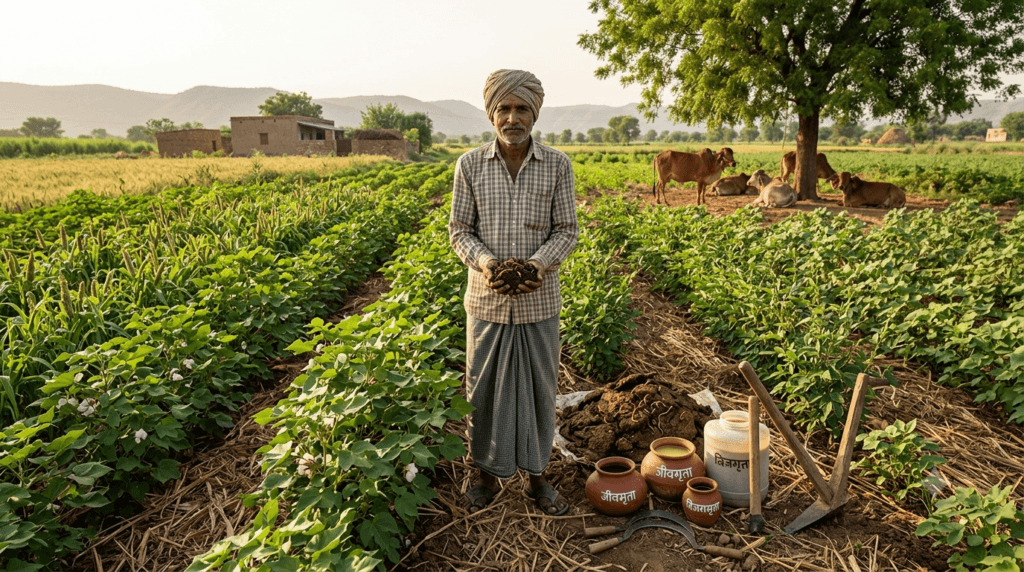
Zero Budget Natural Farming, commonly abbreviated as ZBNF, was developed specifically to break this cycle. Rather than asking farmers to buy organic-certified inputs, which can still be expensive, ZBNF asks farmers to stop buying external inputs altogether replacing them with preparations made from what’s already available on a typical Indian farm: cow dung, cow urine, jaggery, pulse flour, and locally available biomass.
This guide explains what ZBNF actually is, how it differs from organic and regenerative farming, the four foundational practices every ZBNF farmer needs to know, how to prepare the core inputs, the real benefits and criticisms, and a practical roadmap for farmers considering the switch.
What Is Zero Budget Natural Farming?
Zero Budget Natural Farming is an agricultural approach built around the idea that a farm can generate everything it needs to stay fertile and productive without spending money on external fertilizers, pesticides, or soil amendments. The word “zero budget” refers specifically to the elimination of purchased input costs not to zero labor or zero effort, since preparing and applying ZBNF inputs still requires regular, disciplined farm work.
The modern form of ZBNF was pioneered by Subhash Palekar, an agriculturist from Maharashtra who, after years of practicing chemical-intensive farming, became concerned about the long-term damage synthetic inputs were causing to soil health and farmer finances.
Drawing on traditional Indian farming knowledge combined with his own decades of on-farm experimentation, Palekar developed a structured system built around natural microbial cultures derived primarily from indigenous cow products.
ZBNF has since been adopted at scale in several Indian states, most notably in Andhra Pradesh, where the state government backed a large-scale rollout, and it has also spread across parts of Karnataka, Maharashtra, and other agricultural regions. It has been referenced in national policy discussions as a potential low-cost livelihood model for small and marginal farmers.
Zero Budget Natural Farming vs. Organic Farming vs. Regenerative Agriculture
These three approaches often get grouped together as “chemical-free farming,” but each has a distinct philosophy and method.
Organic farming is a certification-based system. It permits certain approved external inputs organic-certified fertilizers, biopesticides, and soil amendments as long as they meet certification standards. Organic inputs can still be purchased, which means organic farming, while chemical-free, is not necessarily low-cost.
Regenerative agriculture focuses on outcomes rebuilding soil organic matter, increasing biodiversity, and improving water retention using a flexible toolkit that can include no-till farming, cover cropping, composting, and rotational grazing. It doesn’t prescribe a single fixed input formula.
Zero Budget Natural Farming is the most input-restrictive of the three. It specifically avoids purchased inputs of any kind organic or synthetic and instead prescribes a defined set of on-farm preparations, primarily based on indigenous cow dung and urine, jaggery, and pulse flour. ZBNF also carries a distinct economic philosophy: it explicitly frames itself as a debt-reduction strategy for smallholder farmers, not just an ecological farming method.
The Four Pillars of Zero Budget Natural Farming
ZBNF is built around four interconnected practices, often referred to as the “four wheels” of the system.
1. Jeevamrutha (Soil Microbial Culture)
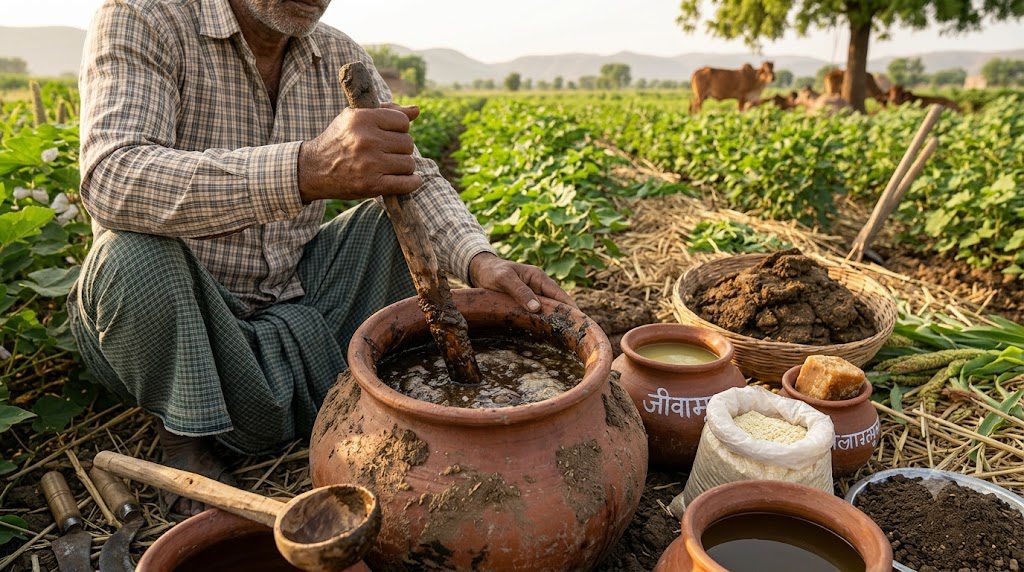
Jeevamrutha is the central input of ZBNF a fermented liquid preparation made from indigenous cow dung, cow urine, jaggery, pulse flour, a small amount of soil, and water. When fermented for the correct duration, it becomes rich in beneficial microorganisms that, once applied to the field, multiply rapidly in the soil and improve nutrient availability, root health, and microbial activity.
Jeevamrutha functions as a biological substitute for synthetic fertilizer rather than adding nutrients directly, it activates and multiplies the soil’s existing microbial population, which in turn makes nutrients already present in the soil more accessible to plant roots. It is typically applied to the field every couple of weeks throughout the growing season, either directly to the soil or diluted and used for irrigation.
2. Beejamrutha (Seed Treatment)
Before sowing, seeds are treated with Beejamrutha a similar preparation made from cow dung, cow urine, lime, and water. This seed treatment is designed to protect germinating seeds from soil-borne and seed-borne fungal pathogens, while also giving young seedlings a healthier microbial environment to establish roots in. Farmers coat or soak seeds in the mixture briefly before planting.
3. Acchadana (Mulching)
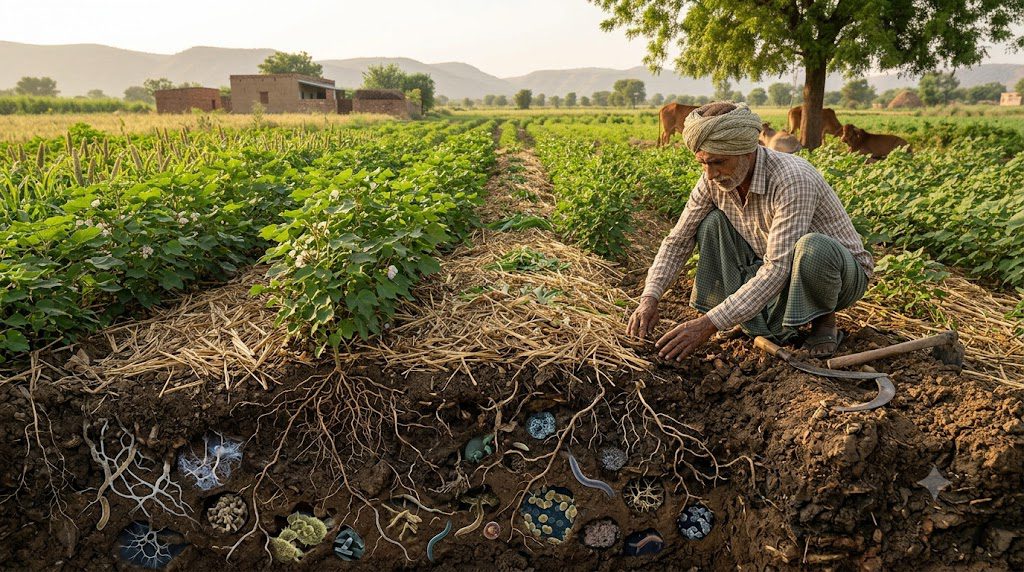
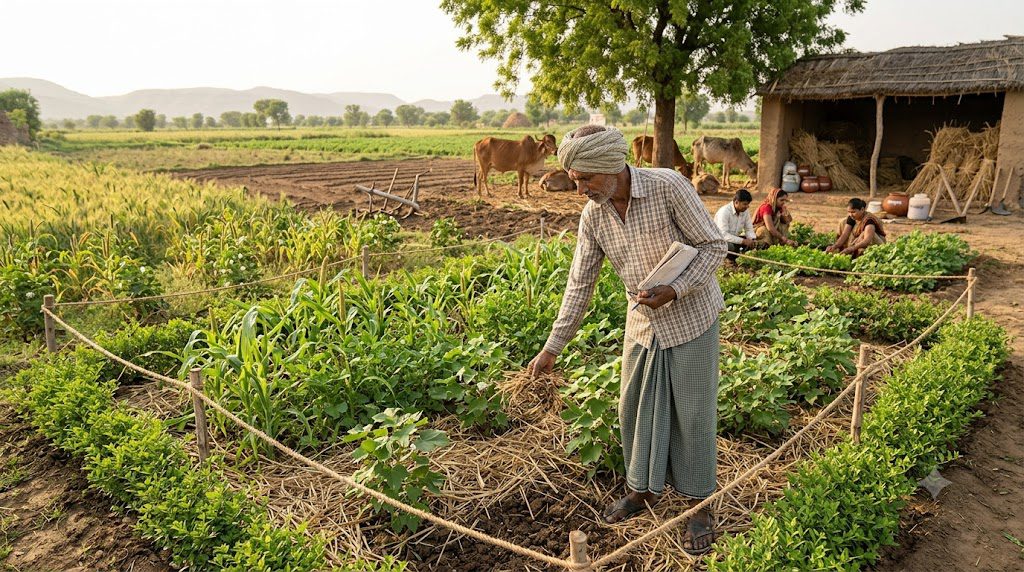
Mulching in ZBNF involves covering the soil surface with crop residue, dried leaves, or other locally available organic material.
This serves multiple purposes at once: it reduces moisture evaporation from the soil, suppresses weed growth without herbicides, moderates soil temperature during extreme heat, and gradually decomposes to add organic matter back into the soil reinforcing the same soil-building principle found in regenerative agriculture.
4. Waaphasa (Soil Moisture and Aeration)
Waaphasa refers to maintaining the right balance of air and moisture in the soil not waterlogged, not bone-dry, but at a level where both moisture and oxygen are available to plant roots and soil microbes simultaneously.
ZBNF practitioners argue that conventional flood irrigation often oversaturates soil and drives out the oxygen that beneficial aerobic microbes need to survive, which is why ZBNF generally favors more controlled, moderate irrigation practices over continuous flooding.
How to Prepare Jeevamrutha: A Practical Walkthrough
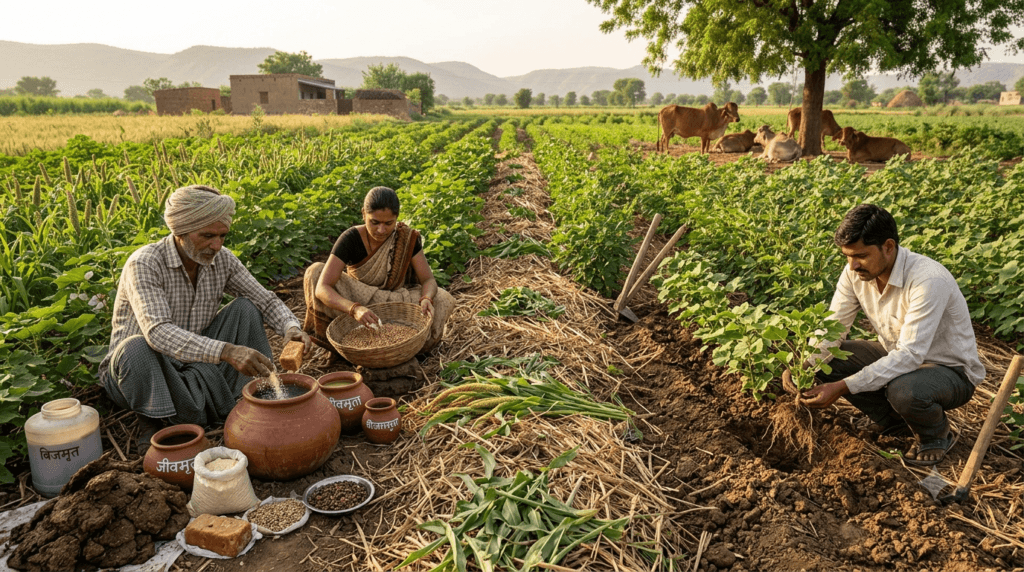
Since Jeevamrutha is the backbone of ZBNF, understanding its preparation is essential for any farmer considering the method.
Ingredients typically used (for roughly one acre of application):
- Fresh indigenous cow dung
- Aged cow urine
- Jaggery (unrefined cane sugar)
- Pulse flour (commonly gram or other legume flour)
- A handful of undisturbed soil from the field edge, used to introduce local native microbes
- Water
Process: The ingredients are mixed together in a container of water and left to ferment. Farmers typically stir the mixture periodically to maintain aerobic conditions, which supports the growth of beneficial aerobic microorganisms rather than the anaerobic organisms that would dominate in a sealed, oxygen-poor environment.
Timing matters the mixture is generally used within a defined fermentation window, since beneficial microbial activity peaks at a certain point and declines if the mixture is left too long or stored rather than applied fresh.
Farmers typically prepare a fresh batch on a recurring schedule throughout the growing season rather than trying to store large batches for later use, since freshness directly affects how much benefit the soil receives from each application.
The Real Benefits of Zero Budget Natural Farming
Dramatically Reduced Input Costs
This is ZBNF’s headline benefit and the reason it has attracted so much policy attention in India. By eliminating purchased fertilizer and pesticide costs entirely, farmers reduce their dependency on seasonal input loans a major contributor to rural farm debt.
For smallholder and marginal farmers operating on extremely thin margins, this cost elimination can be the difference between a profitable season and a season spent repaying interest.
Reduced Water Usage
ZBNF practitioners and several field studies report that natural farming systems, supported by heavy mulching and improved soil structure, require significantly less irrigation water than conventional flood-irrigated systems a meaningful advantage in water-stressed agricultural regions.
Improved Soil Health Over Time
Like regenerative agriculture, ZBNF’s reliance on microbial inoculation and mulching gradually increases soil organic matter and microbial diversity, improving long-term soil structure and fertility rather than depleting it season after season.
Lower Dependency on External Supply Chains
Because ZBNF inputs are produced on-farm from locally available materials, farmers become far less exposed to fertilizer price volatility, supply shortages, or the logistical challenges of accessing agricultural inputs in remote areas.
Support for Indigenous Cattle Breeds
ZBNF’s dependence on indigenous cow dung and urine has created renewed economic incentive for farmers to maintain local cattle breeds, which are often better adapted to regional climate conditions than imported dairy breeds, supporting biodiversity alongside soil health.
Criticisms and Open Questions About ZBNF
An honest guide has to include this, because farmers deserve a full picture before committing to a major change in practice.
Yield concerns for certain crops. Some agricultural scientists have raised concerns that ZBNF, in its early years of adoption on a given plot, may not match the yields of well-managed conventional or organic systems for certain high-input cash crops, particularly before soil biology has had time to fully establish.
Independent, large-scale, long-term yield data comparing ZBNF directly against conventional and organic systems across different crops and regions is still relatively limited, which makes broad yield claims difficult to verify with full confidence.
Scalability questions. ZBNF’s reliance on indigenous cow dung and urine as a core input raises practical questions about scalability a commonly cited guideline suggests one indigenous cow can support a limited number of acres, which means farmers without access to cattle, or with larger landholdings, may face genuine logistical constraints in producing enough Jeevamrutha to cover their full farm.
Labor intensity. While ZBNF eliminates purchased input costs, it does not eliminate labor costs. Preparing Jeevamrutha and Beejamrutha on a recurring schedule, maintaining mulch coverage, and monitoring soil moisture all require consistent hands-on farm labor, which is a real cost even if it isn’t a cash expenditure.
Ongoing scientific debate. ZBNF remains a topic of active discussion within Indian agricultural research circles, with some studies supportive of its soil-health and cost benefits, and others calling for more rigorous, controlled, multi-season trials before it’s promoted as a universal solution.
Farmers considering ZBNF should treat it as a serious, evidence-informed option worth piloting not an unquestioned guarantee.
How to Start Zero Budget Natural Farming: A Step-by-Step Approach
Step 1: Start on a Small Pilot Plot Rather than converting an entire farm at once, dedicate a small section of land to ZBNF for one full crop cycle. This lets you learn the preparation process and observe real results before committing your entire operation.
Step 2: Secure Access to Indigenous Cow Products Since Jeevamrutha and Beejamrutha depend on indigenous cow dung and urine, arrange reliable access to these whether through your own cattle or a nearby farmer or cooperative before starting.
Step 3: Learn the Preparation Timing Jeevamrutha and Beejamrutha both depend on correct fermentation timing to be effective. Spend time learning and practicing the preparation process on a small scale before scaling up applications across your pilot plot.
Step 4: Build a Regular Application Schedule Set a recurring calendar for preparing and applying Jeevamrutha, rather than treating it as an occasional input. Consistency is central to how ZBNF builds soil microbial activity over time.
Step 5: Apply Mulching Consistently Use available crop residue and organic material to maintain soil cover on your pilot plot, reinforcing moisture retention and weed suppression alongside your Jeevamrutha applications.
Step 6: Track Costs, Yield, and Soil Changes Keep a simple farm diary recording input costs (which should trend toward zero), yield outcomes compared to your previous conventional plots, and any visible changes in soil texture, moisture retention, or pest pressure.
Step 7: Connect With Experienced ZBNF Farmers or Extension Programs Several Indian states now have ZBNF-focused extension programs, farmer training centers, and community networks. Connecting with farmers who have already gone through a multi-year transition can help you avoid common early mistakes and get realistic expectations for your specific crop and region.
Step 8: Expand Gradually Based on Your Own Results Only expand ZBNF to additional land once your pilot plot has given you a full season or two of real data. ZBNF, like regenerative agriculture, rewards a patient, evidence-based expansion rather than an all-at-once conversion.
Government Support and Policy Context in India
ZBNF has moved well beyond a single farmer’s personal method into a topic of active state and national policy interest. Andhra Pradesh was among the first states to back ZBNF at a large scale, with state-level programs aimed at transitioning a significant share of its farming households toward natural farming practices over a multi-year timeline.
Other states, including Karnataka and Himachal Pradesh, have run their own pilot and extension programs promoting ZBNF or closely related natural farming approaches.
At the national level, ZBNF has been referenced in economic policy discussions as a potential livelihood model for reducing input costs and farm debt among small and marginal farmers, who make up the overwhelming majority of India’s farming population.
This policy attention has led to increased funding for farmer training centers, natural farming demonstration plots, and extension staff trained specifically in ZBNF techniques in several states.
For farmers considering the switch, this growing institutional support matters practically it often means access to free or subsidized training, demonstration farms where the techniques can be observed firsthand, and local extension officers who can answer region-specific questions about crop suitability and application schedules.
Checking whether your state agricultural department runs a natural farming or ZBNF program is a worthwhile first step before starting on your own.
ZBNF Compared to Conventional Farming: What Actually Changes
For a farmer used to conventional chemical-based methods, it helps to see the practical differences laid out directly.
Input costs: Conventional farming requires recurring purchases of synthetic fertilizer, pesticide, and often certified seed. ZBNF replaces these with on-farm preparations made from cow dung, cow urine, jaggery, and pulse flour, dramatically reducing or eliminating these recurring cash expenses.
Soil impact over time: Conventional chemical-intensive farming often depletes soil organic matter and microbial life over successive seasons, requiring increasing fertilizer inputs just to maintain the same yield. ZBNF is designed to build soil biology over time, aiming for a system that becomes increasingly self-sustaining rather than increasingly input-dependent.
Water requirements: Conventional systems, particularly those relying on flood irrigation, tend to use more water per season than ZBNF systems, which favor moderate irrigation and moisture retention through mulching.
Labor pattern: Conventional farming labor is often concentrated around planting, spraying, and harvest. ZBNF shifts labor toward a more continuous, recurring schedule preparing and applying Jeevamrutha every couple of weeks, maintaining mulch cover, and monitoring soil moisture throughout the season.
Risk profile: Conventional farming carries financial risk tied to input loan repayment if a harvest underperforms. ZBNF, by removing most cash input costs, reduces this specific financial risk, even though it introduces a different kind of risk around yield consistency during the transition period, particularly in the first one to two seasons.
Frequently Asked Questions
Is Zero Budget Natural Farming the same as organic farming? No. Organic farming permits certain purchased, certified organic inputs. ZBNF specifically avoids all purchased inputs, relying entirely on on-farm preparations made from indigenous cow products and locally available biomass.
Who developed Zero Budget Natural Farming? The modern ZBNF system was developed and popularized in India by agriculturist Subhash Palekar, who began developing the method in the mid-1990s after moving away from chemical-intensive farming, and was later awarded the Padma Shri for his agricultural contributions.
Does ZBNF really cost nothing to implement? ZBNF eliminates purchased fertilizer and pesticide costs, which is where the “zero budget” name comes from. However, it does require consistent labor for preparing and applying Jeevamrutha and Beejamrutha, along with reliable access to indigenous cow dung and urine, so it isn’t entirely cost- or effort-free.
Can ZBNF work without owning cattle? It’s more difficult, but not impossible. Farmers without their own indigenous cattle often arrange access through neighboring farmers, local cooperatives, or shared community cattle resources, since even a small amount of cow dung and urine can support Jeevamrutha preparation for a modest plot.
How long before a farmer sees results from switching to ZBNF? Many ZBNF practitioners and field reports suggest that soil systems become largely self-sustaining after roughly three years of consistent practice, though visible improvements in soil texture and moisture retention are often reported much earlier.
Conclusion
Zero Budget Natural Farming represents one of the most economically distinctive farming philosophies to emerge from India in recent decades not just an ecological approach, but a direct response to the debt burden that so many smallholder farmers face.
Its four pillars Jeevamrutha, Beejamrutha, Acchadana, and Waaphasa work together to rebuild soil biology using nothing more than what a typical Indian farm already has access to: cow dung, cow urine, jaggery, pulse flour, and crop residue.
It isn’t a guaranteed solution for every farm, every crop, or every region, and farmers considering the switch deserve an honest picture of both the potential and the open questions particularly around yield consistency and scalability for farms without easy access to indigenous cattle.
But for smallholder farmers looking for a low-cost, low-input path toward healthier soil and reduced financial risk, ZBNF offers a genuinely different model worth piloting carefully, rather than adopting blindly or dismissing outright.
Starting small a single pilot plot, one growing season, careful record-keeping is the same sound advice that applies to any major shift in farming practice. ZBNF rewards patience, consistency, and a willingness to learn a genuinely different way of working with the soil.