
A tenant farmer ID is the Farmer ID that someone who cultivates leased land can get under the AgriStack Farmer Registry. Government-linked reports say tenants and sharecroppers are covered, but the process depends on your state. Start at your village registration camp, Common Service Centre (CSC) or the Krishi Sahayak/ADO office.
Table of Contents
What Is a Tenant Farmer ID?
A tenant farmer ID is a unique digital identity number for a farmer who cultivates land they do not own. It is issued through the Farmer Registry, one part of AgriStack, the government’s digital system for agriculture.
The registry links a farmer’s demographics, Aadhaar, land records and bank account into one profile. That profile generates the Farmer ID. Anantam IAS describes it as a verifiable credential based on Aadhaar.
For an owner-farmer, the land record is the anchor. For a tenant, the anchor is harder, because the name on the record is the landlord’s. That is the whole story of this article.
Why a Tenant Farmer ID Matters
Government documents say the Farmer ID is meant for targeted delivery of schemes, subsidies, crop insurance and market linkages. This comes from the Morigaon district agriculture office, Assam.
If you farm leased land, you have lived the other side of this. Banks ask for land papers you do not hold. Insurance forms ask for a khasra number that belongs to someone else. Compensation after a crop loss goes to the name on the record.
A tenant farmer ID is meant to fix part of that. It is not a guarantee, and I explain the limits further down.
Where the Farmer ID Programme Stands in 2026
Here are the sourced numbers, and nothing else:
- More than 10.31 crore Farmer IDs had been created under AgriStack as of 3 August 2026, according to a BioVoice report on government data.
- The Digital Crop Survey covered 648 districts and over 31.3 crore plots in the Rabi 2025-26 season, per the same report.
- One current-affairs report says the 11 crore target was reached on 23 October 2026, five months before the 31 March 2027 deadline. See Vajiram & Ravi. I could not find a second source for the exact date, so treat it as reported, not confirmed.
- Gujarat alone had registered over 63.35 lakh farmers by 23 September 2026, per GKToday.
Big totals say little about tenants, though. A total counts IDs, not who got left out.
The Problem: Tenants and the Land Record Gap
A Business Standard report quotes the agriculture ministry on a gap. Around a third of India’s operational land holdings are not linked to Farmer IDs. Most states have not yet synced the farmer registry with the Record of Rights. Most have not drafted a standard operating procedure for cultivator categories either.
My reading: tenants are one of those cultivator categories. If your state has no written procedure for them, a village official may not know what to do with your application.
That does not mean you cannot register. It means you should expect a conversation, not a form. Go with your documents and a copy of your lease or cultivation proof, and ask for the written procedure.
The Lok Sabha reply on digital identities to farmers, answered on 3 February 2026, is the official starting point if you want the ministry’s own wording.
Who Can Apply for a Tenant Farmer ID?
Reports on the 9.2 crore milestone in March 2026 described the registry as covering landholding farmers, including women, tenants and sharecroppers. That is the basis for applying.
In practice, you are likely to qualify if:
- You cultivate land that you do not own, under a written or oral lease.
- You are a sharecropper working someone else’s land for a share of the crop.
- You have an Aadhaar number, preferably linked to an active mobile number.
State rules vary. One state may ask for a lease deed, another a landlord’s consent letter, and another a certificate from the village officer. I have not verified the rule for your state, so confirm it before you travel to the office.
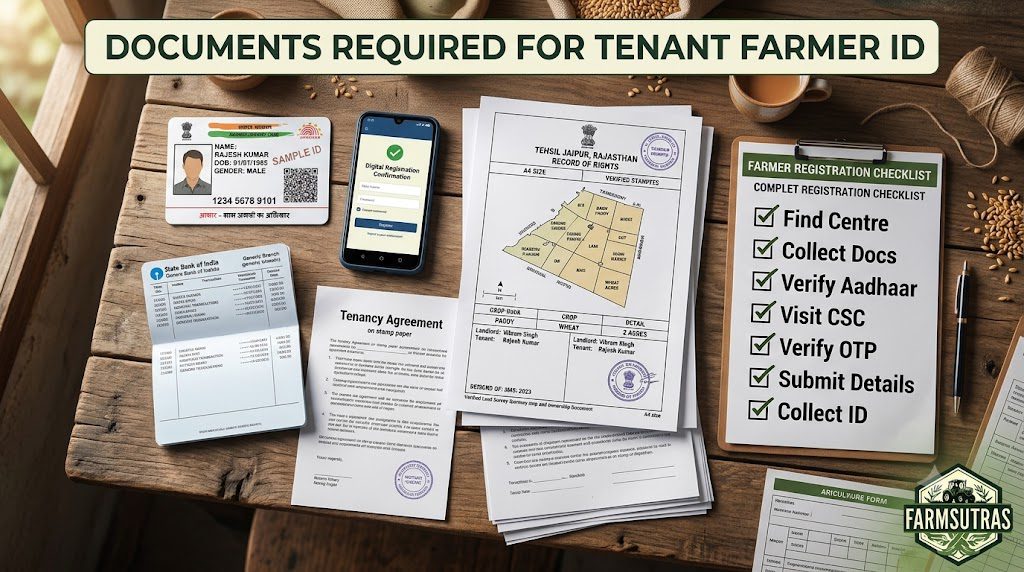
Documents to Keep Ready
Document lists differ by state portal. These are the ones that come up across the sources I read:
| Document | Why it is asked |
|---|---|
| Aadhaar card | Identity and OTP verification |
| Mobile number linked to Aadhaar | The OTP goes here |
| Bank account details | Linked to the farmer profile |
| Land details of the plot you cultivate | Survey or khasra number, village |
| Tenant or lease proof | State-specific, often the hardest paper to get |
If you have no written lease, ask your local agriculture office what they accept instead. Do this before registration day, not during it.
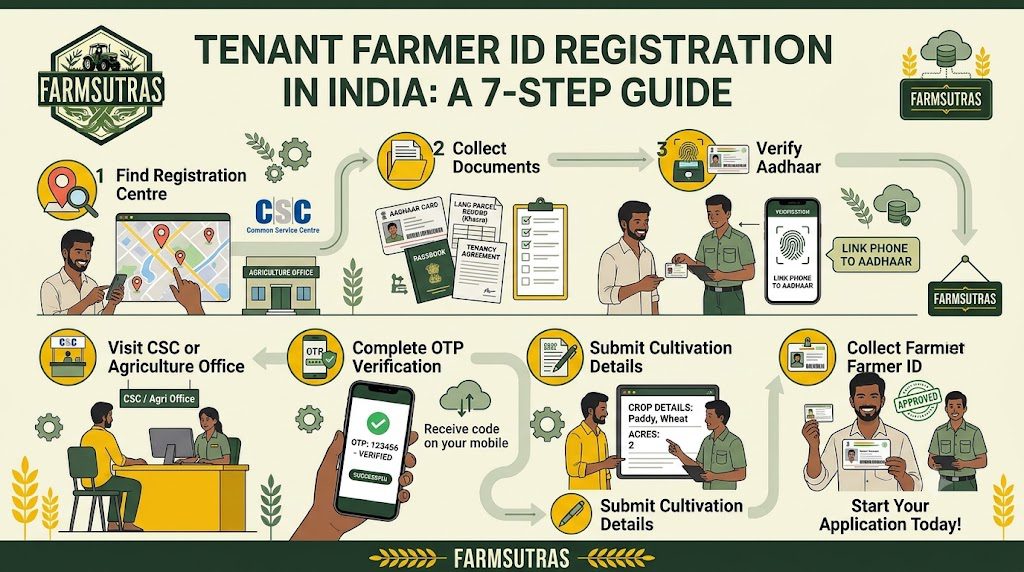
Tenant Farmer ID Registration: 7 Steps
The district office in Morigaon lists the routes: village registration camps, CSCs, and the Krishi Sahayak or ADO office. Haryana’s drive used OTP-based Aadhaar authentication, as The Statesman reported. Combine those and the path looks like this.
Step 1: Find your state’s Farmer Registry channel
Ask at the Gram Panchayat or the block agriculture office. Some states run their own Farmer Registry portal. Others run camps. Do not use a random website that asks for money.
Step 2: Collect your documents
Gather everything in the table above. Make two photocopies of each.
Step 3: Fix your Aadhaar first
If your mobile number is not linked to Aadhaar, the OTP will fail. Sort that before registration, because it is the most common block.
Step 4: Go to a camp, CSC or the Krishi Sahayak
Tell them clearly: “I am a tenant farmer and want a tenant farmer ID.” Ask them to record your cultivator category correctly. A wrong category is hard to correct later.
Step 5: Complete Aadhaar OTP verification
You will receive an OTP on the linked mobile. Share it only with the official doing your registration, and only at the time of verification.
Step 6: Get your land and cultivation details recorded
This is where tenants stall. The official must link your cultivation to a plot. If the system does not offer a tenant option, ask the officer to note it and ask for a written acknowledgment.
Step 7: Collect your acknowledgment and note the ID
Keep the receipt or application number. Once the Farmer ID is generated, store a copy on your phone and a printout at home.
How to Check Status and Fix Errors
Many states let you check status online with your application number or Aadhaar. If your state has no such page, the CSC operator or Krishi Sahayak can check for you.
Common errors include a mismatch in the spelling of your name between Aadhaar and the land record, a wrong village code, and a missing mobile number. Ask for the correction at the same office that registered you. Keep the written acknowledgment, because without it you are arguing from memory.
Mistakes That Delay Your Tenant Farmer ID
- Going without the Aadhaar-linked mobile. The OTP cannot be delivered, and you lose a day’s wages.
- Registering as an owner. Some farmers pick the owner category because the form works. A wrong category can cause trouble in claims later.
- Skipping the acknowledgment. Verbal assurance from a busy camp is not evidence.
- Trusting paid middlemen. I found no source that says registration needs a private agent.
- Waiting for the landlord to sign off on everything. Ask your office whether a landlord’s consent is mandatory in your state. Do not assume.
What the Tenant Farmer ID Does Not Give You
Be careful here, because social media oversells this.
A tenant farmer ID is an identity, not a payment. It does not convert you into a landowner. It does not create a legal tenancy that was never recorded.
PM-KISAN is also worth a clear warning. The 23rd instalment was released on 20 June 2026, and Haryana’s officials said the Farmer Registry will be directly linked with PM-KISAN and other beneficiary schemes. But PM-KISAN’s rules are tied to land records. Read the official scheme page at pmkisan.gov.in before you assume a tenant farmer ID makes you eligible.
For crop insurance, MSP support and state schemes, the Farmer ID is a doorway. Each scheme still has its own rules. The egovtschemes explainer notes the same point: exact benefits vary from state to state.
The Agritech Side: How AgriStack Works
If you like understanding the system, here is the short version.
AgriStack rests on three registries, as MicroSave explains:
- State Farmer Registry. Records all farmers in a state. State registries federate at the central level to create one unique Farmer ID.
- Geo-referenced village maps registry. Digital maps of plots.
- Crop Sown Registry. Records what crop is sown on each farm each season. Vikaspedia describes it as a federated registry updated every season.
The Crop Sown Registry is built from the Digital Crop Survey. That is the ground-level exercise where the 31.3 crore plots figure comes from.
The Unified Farmer Service Interface (UFSI) is described as an open API gateway for public and private apps. For agritech founders, that is the interesting part: a verified farmer identity that apps can plug into, with the farmer’s consent.
For a tenant, this explains why the crop record matters. The registry is designed around who is actually growing a crop. That is the opening for tenants, if states write the procedure for it.
Notes for Students and Scheme Researchers
If you study agriculture or track scheme data, three things are worth watching.
First, the gap between the registry and the Record of Rights. The Business Standard report shows most states had not synced them. Whoever solves that for tenants solves the hard part.
Second, state variation. Gujarat, Haryana, Bihar and Uttar Pradesh have each run drives in different ways. Compare their procedures instead of treating “India” as one system.
Third, the difference between registration count and benefit delivery. A count of IDs is an input. The test is whether a tenant farmer ID shows up as a named beneficiary in insurance and compensation records.
For more rural technology topics on this site, read our seaweed farming guide, browse the Agritech category, or return to the Farm Sutras home page.

FAQs
1. What is a tenant farmer ID?
It is the Farmer ID issued to a farmer who cultivates leased land, under the AgriStack Farmer Registry. It links your identity, Aadhaar and cultivation details into one digital profile.
2. Can tenant farmers get a Farmer ID?
Reports on the registry say it covers landholding farmers, including women, tenants and sharecroppers. The exact method depends on your state’s procedure.
3. Is a tenant farmer ID mandatory?
I did not find a national rule that makes it mandatory for everyone. Requirements vary by state and scheme, so ask your agriculture office.
4. Where do I register for a tenant farmer ID?
Official channels listed by the Morigaon district office are village registration camps, Common Service Centres, and the Krishi Sahayak or ADO office. Some states also run their own portals.
5. Which documents do I need?
Aadhaar, an Aadhaar-linked mobile number, bank details, the survey details of the plot you cultivate, and tenant or lease proof where your state asks for it.
6. Do I need my landlord’s permission?
It depends on the state. I could not verify a single national rule, so ask the registering officer and request the answer in writing.
7. Is there a fee?
I found no source that states a fee, so I will not give a number. If anyone asks for private payment, check with the block agriculture office first.
8. Does a tenant farmer ID give me PM-KISAN?
Not automatically. PM-KISAN rules are tied to land records. Check the official scheme page before you rely on it.
9. How many Farmer IDs have been created?
Over 10.31 crore as of 3 August 2026, according to government data reported by BioVoice. Another report says 11 crore was reached on 23 October 2026.
10. What if my application is rejected or my category is wrong?
Go back to the same office, show your acknowledgment, and ask for correction. If the state has no cultivator-category procedure, ask the block agriculture officer to escalate it.
11. Can a tenant farmer apply for a Farmer ID without a written lease agreement?
Yes, depending on state rules. Some states may accept alternative proof of cultivation. Contact your local agriculture office for guidance.
12. How long does it take to get a tenant farmer ID?
Processing time varies by state and document verification. Collect your application receipt to track the status.
13. Can women tenant farmers register for a Farmer ID?
Yes, women tenant farmers may register if they meet the applicable state eligibility and documentation requirements.
14. Can a tenant farmer register land cultivated in multiple villages?
This depends on the state’s Farmer Registry system. Provide the details of all cultivated plots and ask the registration officer about linking them to your Farmer ID.
15. Can a tenant farmer update their Farmer ID details after registration?
Yes, farmers can request corrections through an authorised registration centre or agriculture office. Keep your Farmer ID and supporting documents ready.
Final Word
The tenant farmer ID is worth getting, but do not expect it to solve your land-record problem on its own. The big counts hide a real gap. A large share of holdings is still not linked, and most states have not written clear rules for tenants.
Register early. Go with documents. Ask for everything in writing. And tell us in the comments which state you are in and what the officer said, because that is the information no portal publishes.