
This article draws on a peer-reviewed study from George Washington University’s Global Food Institute, UN Food and Agriculture Organization data, and reporting from international development organizations including the Global Energy Alliance for People and Planet, all linked below. It has not been reviewed by a food systems specialist prior to publication.
Table of Contents
Solar-powered cold storage for farmers addresses a problem that affects hundreds of millions of people worldwide, not a niche technical curiosity: roughly a third of all food produced globally is lost after harvest, before it ever reaches a consumer, according to the World Resources Institute.
For smallholder farmers without reliable electricity, that loss isn’t an efficiency statistic — it’s the direct difference between a season’s income and a season’s total loss. This article covers what solar-powered cold storage actually is, what a rigorous, farmer-surveyed academic study found about real adoption, and what genuinely global evidence — from Ghana to Kenya to Nigeria — shows about where this technology works and where it still struggles.
What Is Solar-Powered Cold Storage?
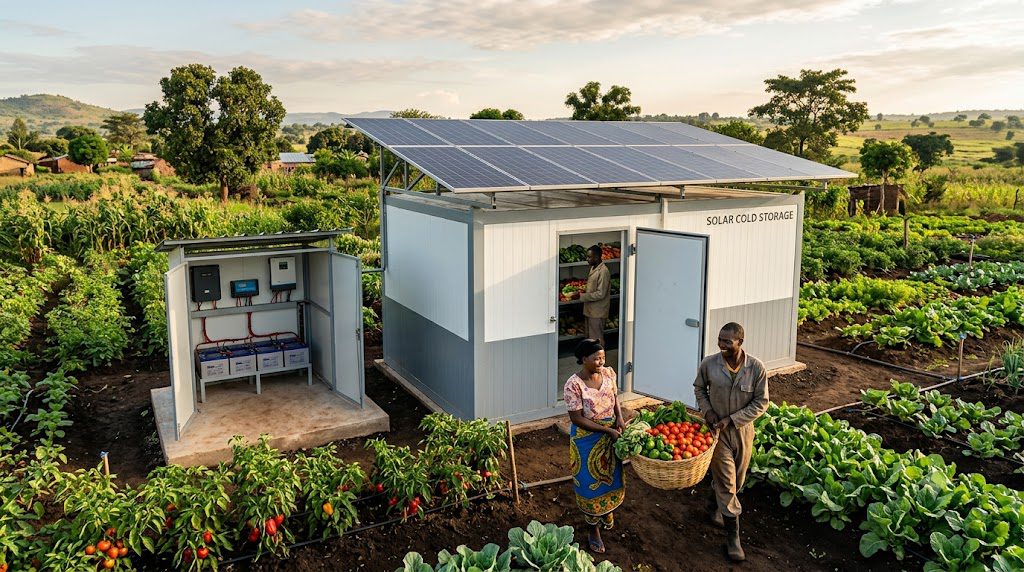
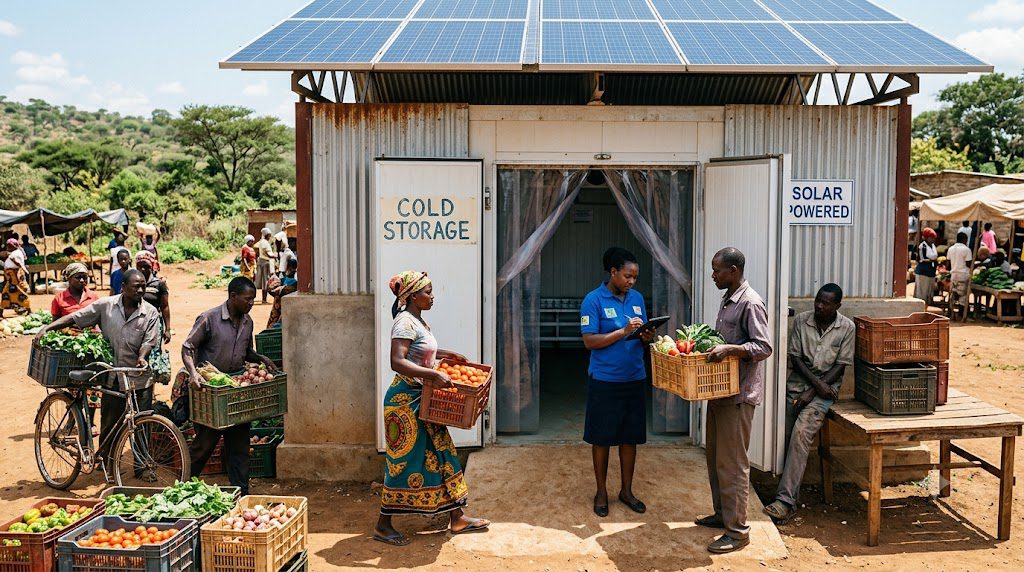
Solar-powered cold storage uses solar panels, battery systems, and insulated cold rooms or mobile units to keep perishable produce refrigerated in areas without reliable grid electricity — commonly the exact rural, off-grid regions where smallholder farmers are most exposed to post-harvest spoilage.
According to a 2025 peer-reviewed academic review cited in the leading study on this topic, these systems are described as “nature-inspired solutions” that offer a timely opportunity to make cold chain technology available in resource-poor, off-grid environments across the world, particularly for smallholder farmers growing perishable fruits and vegetables in tropical climates with abundant sunlight.
Why This Is One of the Highest-Demand Agritech Topics Globally
1. The scale of the underlying problem is genuinely massive. According to research published by George Washington University’s Global Food Institute, around the world, 526 million tons of food production — 12% of the global total — is lost due to lack of cold chains, enough to feed more than 1 billion people.
2. This is a top United Nations climate and food security priority, not a side issue. A peer-reviewed study published in Frontiers in Sustainable Food Systems, co-authored by researchers at George Washington University, notes that at COP27, the United Nations specifically called for innovative research into sustainable cold storage technologies for postharvest loss reduction, launching the Sustainable Food Cold Chains initiative as a direct outcome.
3. Food loss carries a direct climate cost, not just an economic one. The same peer-reviewed research states that food loss is responsible for nearly 8% of total global greenhouse gas emissions, citing UN Environment Programme data — meaning reducing post-harvest loss is simultaneously a climate mitigation strategy and a farmer income strategy.
4. Real-world deployments are already showing dramatic, independently reported results. According to reporting from the Global Energy Alliance for People and Planet, Kenya-based SokoFresh has helped farmers extend produce shelf life by up to 21 days using solar-powered cold storage, and separate reporting on the same company documents spoilage reductions from as high as 50% down to under 2%.
5. This affects a very large share of global food production, concentrated among the world’s most vulnerable farmers. According to World Bank data cited in the same reporting, an estimated 75% of sub-Saharan Africa’s agricultural output comes from smallholder farmers, many without access to the electricity grid at all.
How Solar-Powered Cold Storage Actually Works
The Physical Unit
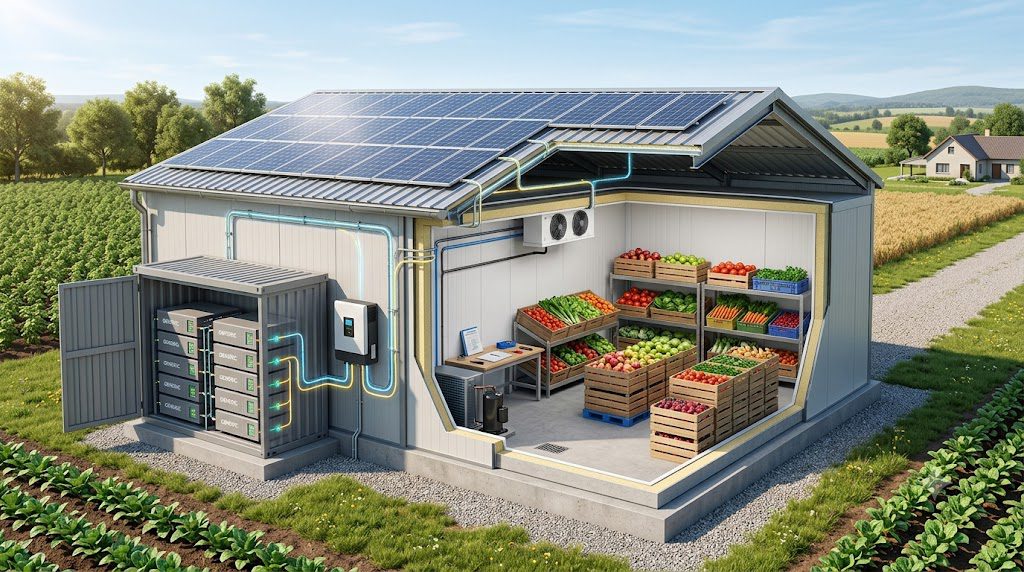
Systems described in academic literature on this topic are mobile or walk-in cold rooms, often built from insulated materials or repurposed shipping containers, with solar panels mounted on the roof.
Power and Storage
Solar panels feed energy into battery systems that power the refrigeration unit continuously, including overnight and during cloudy periods, removing dependency on diesel generators — a meaningful distinction in off-grid regions where diesel is often the only existing refrigeration option, and where it’s both costly and polluting.
Temperature Range and Monitoring
Commercial units in operation, according to industry reporting on Kenya’s SokoFresh, maintain temperatures in the 4 to 15 degrees Celsius range depending on the produce stored, with real-time room conditions monitored remotely through a mobile device.
The Business Model Layer
Many of the most successful deployments don’t sell the physical unit to farmers at all. Instead, they operate on a pay-per-use or “cooling-as-a-service” model, where farmers pay a fee based on volume stored rather than bearing the capital cost of owning a unit outright — addressing the single biggest barrier academic research has identified to adoption.
What the Peer-Reviewed Research Actually Found
This is the section worth reading most carefully, because it’s based on a rigorous, farmer-surveyed academic study rather than vendor case studies.
Researchers at George Washington University surveyed 1,001 smallholder vegetable farmers in Ghana’s Upper West Region and found that 79% were willing to adopt solar-powered cold storage for post-harvest management, with farmers in the sample losing an average of 25% of their total harvest to post-harvest food loss. The study used logistic regression to identify what actually predicts a farmer’s willingness to adopt, and the findings complicate some common assumptions in this space.
Wealth and profitability mattered enormously. Farmers in the wealthiest quintile were roughly 20 times more likely to express willingness to adopt than those in the poorest quintile, and farmers who had made a profit the previous season were significantly more likely to want the technology than those who hadn’t — a reminder that willingness to adopt and ability to afford ongoing service fees are related but distinct questions.
Extension services and training mattered more than raw awareness. Farmers who had never received post-harvest management training, or who lacked access to agricultural extension services, were significantly less likely to want to adopt the technology — even though, per the study, virtually all respondents already had basic knowledge that solar cooling units existed.
Farm size cut against a common assumption. Larger farms were, counterintuitively, less likely to want to adopt — the researchers attribute this to farmers with bigger harvests perceiving the small, shared-service cold storage units as too limited in capacity for their volume, not a rejection of the technology’s value itself.
Perceiving food loss as a real problem was the single strongest predictor. Farmers who did not view food loss as a major challenge were dramatically less willing to adopt cold storage — even after controlling for wealth, education, and every other factor in the model — underscoring that awareness campaigns about the problem itself, not just the solution, remain part of what drives adoption.
Solar Cold Storage vs. Traditional Storage Methods
| Factor | No Cold Storage (Ambient) | Diesel-Powered Cold Storage | Solar-Powered Cold Storage |
|---|---|---|---|
| Typical spoilage rate | Up to 50% for perishable vegetables | Lower, but cost-prohibitive for many smallholders | Reported reductions to under 2% in documented cases |
| Off-grid viability | N/A | Requires fuel supply chain | Purpose-built for off-grid regions |
| Ongoing cost structure | None, but full loss risk | Recurring diesel fuel cost | Often pay-per-use, no fuel cost |
| Environmental impact | None from storage itself | Emissions from diesel combustion | Minimal operational emissions |
| Upfront cost for a 5-tonne unit | None | Lower unit cost, higher lifetime fuel cost | Approximately $30,000 per unit, per industry reporting |
The honest takeaway: solar-powered cold storage solves the off-grid accessibility and ongoing fuel-cost problem that diesel refrigeration can’t, but the upfront capital cost is prohibitively high for an individual smallholder — which is precisely why the pay-per-use service model, not outright ownership, has become the dominant path to adoption in the regions where this technology has scaled furthest.
Real Numbers: What This Costs, and What It Saves
Treat every figure here as reported by the specific program or study cited — results vary by region, crop, and business model.
Unit cost: A 5-tonne solar-powered cold storage unit costs approximately $30,000, according to reporting from Transforming Energy Access, a program supporting clean energy access in developing economies — a cost the same reporting describes as “often prohibitively high for smallholder farmers” when borne individually.
Spoilage reduction: The same reporting confirms Kenya’s SokoFresh piloted a business model that reduced spoilage to just 2%, in a region where up to 38% of fruits and vegetables spoil before reaching the consumer across sub-Saharan Africa.
Shelf-life extension: Nigeria’s ColdHubs, a separate solar cold storage operator, has demonstrated the potential to extend perishable food shelf life from 2 days to 21 days, according to industry analysis, with installations across 22 states benefiting more than 5,250 smallholder farmers and users.
Income impact: According to a report on SokoFresh’s model, the pay-per-use approach has increased farmer earnings by up to 50% per kilogram compared to distress sales made immediately after harvest to avoid spoilage.
Adoption willingness among surveyed farmers: As detailed above, the George Washington University study found 79% of surveyed Ghanaian smallholder farmers willing to adopt the technology — a notably high figure that should temper any narrative that farmers are resistant to this innovation; the barriers identified were economic and structural, not attitudinal.
Who’s Building This: Key Organizations Worldwide
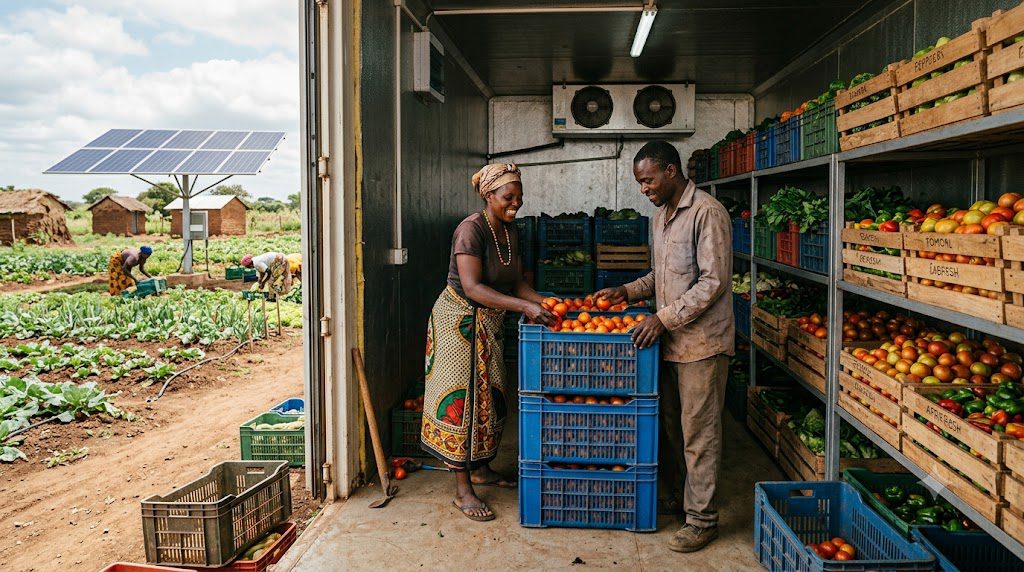
SokoFresh, founded in Kenya in 2019, operates a cooling-as-a-service model and has served approximately 12,000 farmers, 40% of them women in rural areas, in partnership with Enviu, EcoZen, One Acre Fund, the World Food Programme, and financing from the Energy and Environment Partnership Trust Fund.
ColdHubs, launched in Nigeria in 2015, offers solar-powered off-grid cold storage rooms installed directly in major markets and farms, and per industry tracking is developing freezing technology to extend its model to fishing communities in the Niger Delta.
The Global Energy Alliance for People and Planet (GEAPP), an international alliance supporting clean energy access, has directly funded SokoFresh’s Productive Use Financing Facility, describing the underlying challenge as reliance on costly, polluting diesel generators being the only refrigeration option in many off-grid areas.
George Washington University’s Global Food Institute represents the academic research infrastructure behind this space, having conducted the large-scale farmer survey cited throughout this article and framing cold chain expansion as a critical strategy to reduce poverty, increase nutrition and health security, and advance climate action.
If you’re evaluating a specific solar cold storage program, ask directly about the payment structure (ownership versus pay-per-use), the specific temperature range and produce types it’s validated for, and what training or extension support accompanies enrollment — the research above shows these factors, not just the technology itself, determine real-world adoption.
Real Limitations and Adoption Barriers
No credible source in this space claims solar-powered cold storage is a fully solved, universally accessible solution.
- Upfront capital cost remains the central barrier, with a 5-tonne unit priced around $30,000 — a cost that has pushed the industry toward service models rather than individual ownership, but hasn’t eliminated the underlying cost structure
- Adoption is uneven across farm sizes, with the George Washington University research finding larger-scale farmers less inclined to adopt shared, smaller-capacity units — meaning current models may underserve exactly the farmers producing the most volume
- Extension and training access shapes adoption as much as the technology itself, per the same peer-reviewed research, meaning solar cold storage rollouts that skip farmer training and support infrastructure are likely to see lower uptake regardless of the technology’s quality
- Geographic deployment remains concentrated, with the clearest documented successes concentrated in a handful of countries (Kenya, Nigeria, Ghana) rather than uniformly available across all regions facing high post-harvest loss
- Long-term maintenance and service reliability data is still developing, since many of the highest-profile programs are less than a decade old — meaning the multi-decade durability and service-continuity track record that would fully validate this model at scale is still being established
How to Evaluate a Cold Storage Program
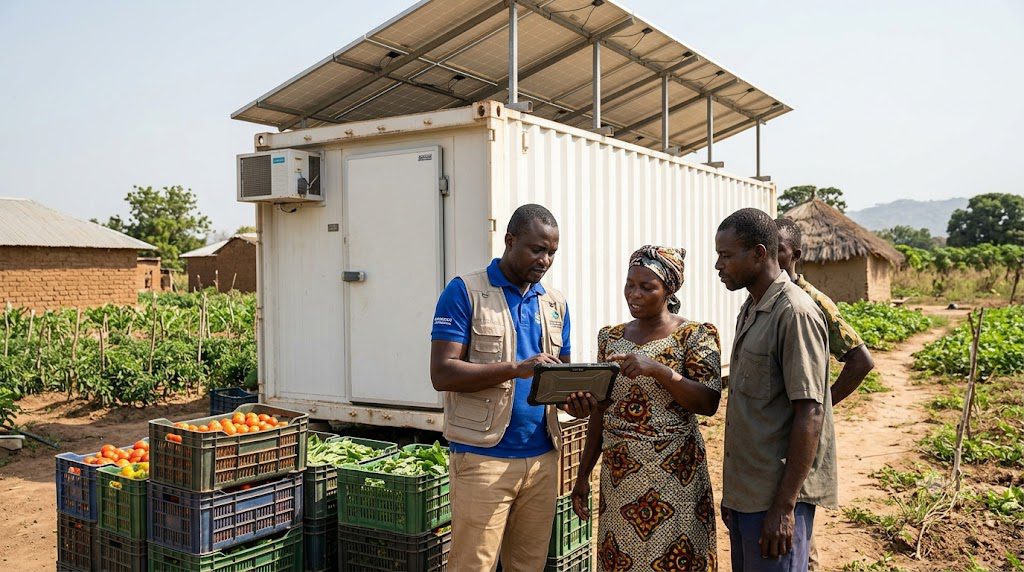
- Ask whether the program uses a pay-per-use or ownership model, since the research and industry evidence strongly favor service models for accessibility, particularly for smaller-scale farmers.
- Confirm what produce types and temperature ranges the specific unit is validated for, since spoilage reduction rates vary meaningfully by crop.
- Ask what training or extension support comes with the program, given that peer-reviewed research found this factor more predictive of successful adoption than raw awareness of the technology.
- Request real spoilage and income data from existing farmer participants, not just headline company statistics, to understand performance specific to your region and crop.
- Understand the capacity limits of the specific unit, particularly if you produce at a larger scale than the shared-service model was originally designed for.
This kind of infrastructure investment connects directly to the rural infrastructure priorities already discussed in our guide to modern farming methods, and to the broader case for solar-powered agricultural equipment covered on this site.
Common Mistakes Farmers and Programs Make
- Requiring outright unit purchase rather than offering a service model, pricing out the exact smallholder farmers the technology is meant to serve.
- Deploying units without accompanying training or extension support, when peer-reviewed research shows this factor is a stronger predictor of adoption than the technology itself.
- Assuming uniform demand across farm sizes, when research shows larger-scale farmers may need higher-capacity solutions than the standard shared-service unit provides.
- Treating awareness of the technology as equivalent to willingness to adopt it, when the strongest predictor identified in the research was whether farmers perceived food loss as a serious problem in the first place — a distinct, addressable communication gap.
This same evaluation discipline is worth applying to storage and market-access planning discussed in our guide to multiple cropping and mixed cultivation, where cold chain access is identified as a key constraint for marketing perishable, diversified harvests.
FAQs About Solar-Powered Cold Storage
1. What is solar-powered cold storage for farmers?
Solar-powered cold storage uses solar panels, batteries, and insulated cold rooms or mobile units to keep fruits and vegetables refrigerated, particularly in areas without reliable grid electricity.
2. How much does solar-powered cold storage cost?
A 5-tonne solar-powered cold storage unit costs approximately $30,000, according to industry reporting cited in the article. Because this upfront cost can be too high for individual smallholder farmers, many programs use pay-per-use models.
3. How does solar-powered cold storage reduce post-harvest losses?
It slows spoilage by maintaining controlled temperatures after harvesting. Documented cases cited in the article report spoilage reductions from as high as 50% to under 2%, although results vary by crop, location, and storage system.
4. How long can solar cold storage extend the shelf life of vegetables?
The article cites Nigeria’s ColdHubs as demonstrating potential shelf-life extension from approximately 2 days to 21 days for perishable food. Actual results depend on the crop and storage conditions.
5. Is solar-powered cold storage suitable for smallholder farmers?
Yes. The technology is specifically being deployed for smallholder farmers in off-grid agricultural regions. However, the high cost of purchasing a unit makes cooling-as-a-service or pay-per-use models more accessible than individual ownership.
6. What is cooling-as-a-service in agriculture?
Cooling-as-a-service allows farmers to pay for the amount of cold storage they use instead of purchasing and maintaining the entire refrigeration system. This reduces the upfront financial barrier to accessing cold storage.
7. What temperature does solar-powered cold storage maintain?
Commercial systems cited in the article operate at approximately 4°C to 15°C, depending on the produce being stored. Farmers should confirm the validated temperature range for their specific crop and storage provider.
8. Can solar cold storage work without grid electricity?
Yes. Solar panels and battery storage provide the electricity required to operate refrigeration systems in off-grid areas, reducing dependence on grid power or diesel generators.
9. Are farmers willing to adopt solar-powered cold storage?
A peer-reviewed study of 1,001 smallholder vegetable farmers in Ghana found that 79% were willing to adopt solar-powered cold storage. The research also found that wealth, profitability, extension services, training, and farmers’ perception of post-harvest losses influenced adoption willingness.
10. Why don’t more farmers own solar-powered cold storage units?
The main barrier identified in the article is the high upfront investment. A 5-tonne unit costs approximately $30,000, making individual ownership difficult for many smallholders. Service-based models therefore provide an alternative.
Final Thought
Solar-powered cold storage addresses one of the largest, most quantifiable problems in global agriculture — a third of all food produced worldwide lost after harvest — with a technology that rigorous, farmer-surveyed research shows the large majority of affected farmers genuinely want.
The documented results from Kenya, Nigeria, and Ghana are real and substantial, not vendor exaggeration. But the honest picture includes real, unresolved barriers: high upfront costs that have pushed the entire industry toward service models, uneven fit across farm sizes, and a geographic footprint still concentrated in a handful of countries relative to the scale of the global problem.
For a farmer or program evaluating this technology, the research points to a clear priority: pair the physical infrastructure with genuine extension support and an accessible payment model, because the evidence shows those factors — not farmer resistance — are what actually determine whether this technology reaches the people who need it most.
Related reading on this site: Modern Farming Methods: The Final Revolution for Indian Agriculture, Powered Machinery: 9 Ultimate Powerful Solar Powered Systems in Agriculture, Multiple Cropping: 7 Proven Benefits of Mixed Cropping and Mixed Cultivation, and Agric Technology: Transforming Agriculture for Greater Productivity in 2026.