
Table of Contents
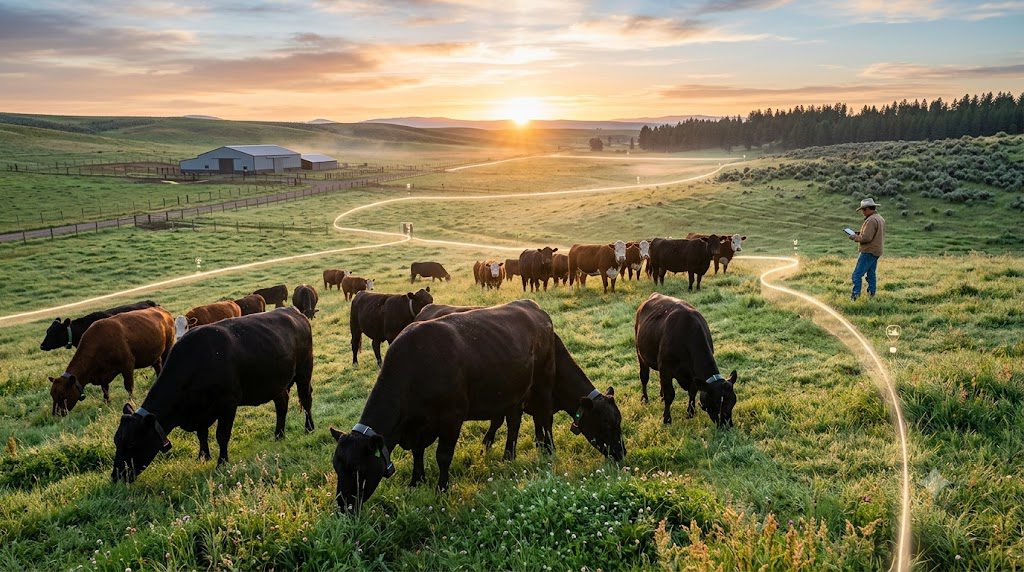
Virtual fencing technology — GPS-enabled livestock collars that replace physical wire with an invisible, app-drawn boundary — went from a niche rangeland research topic to one of the biggest funding stories in agtech history in a single month of 2026. This article covers what the technology actually does, what the peer-reviewed animal welfare research says about it, what it really costs across the four major U.S. vendors, and where genuine friction still exists for ranchers considering it.
What Is Virtual Fencing Technology?
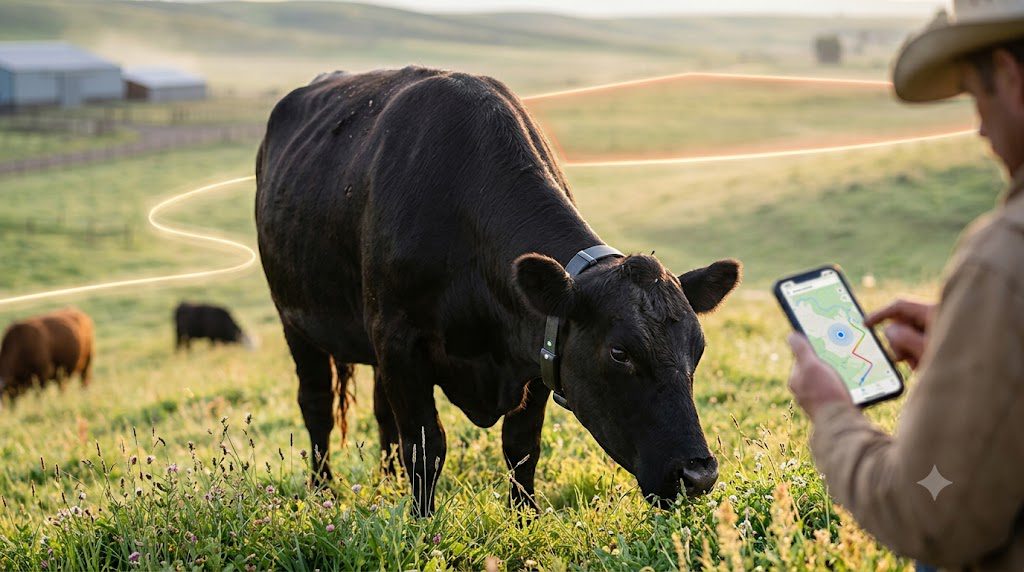
Virtual fencing technology uses GPS-enabled collars worn by livestock, paired with software that lets a rancher draw pasture boundaries on a digital map instead of stringing physical wire. According to research from the University of Arizona Cooperative Extension, the system works through a combination of audio cues and mild electrical stimulus: when an animal approaches a virtual boundary, the collar emits a beeping sound, and if the animal continues past the boundary, it receives a brief electrical pulse — livestock quickly learn to turn back at the sound alone.
A 2021 peer-reviewed case study published in Frontiers in Animal Science, conducted at the University of Tasmania’s College of Science and Engineering, describes the same core mechanism: a neckband-mounted device delivers an audio cue as an animal nears a GPS-defined boundary, followed by an electrical stimulus if it continues past it.
Why This Category Just Became a Big Deal
1. Peter Thiel’s Founders Fund just made one of the largest bets in agtech history on it. According to TechCrunch’s direct interview with Halter CEO Craig Piggott, the New Zealand-based virtual fencing company closed a $220 million Series E in early 2026 at a $2 billion valuation, led by Founders Fund — the same firm behind early bets on Facebook, SpaceX, and Palantir.
2. That valuation is genuinely rare for agtech. The same TechCrunch reporting notes the deal comes at a time when global agrifoodtech funding overall is down sharply from its 2021 peak, making Halter’s raise one of only a handful of agtech companies to ever reach a billion-dollar-plus valuation.
3. Real adoption numbers back the funding, not just hype. Piggott told TechCrunch the company’s collars are now on more than one million cattle across more than 2,000 farms in New Zealand, Australia, and the U.S., where Halter now operates in 22 states — a scale that took nine years to reach, not one funding round.
4. The federal government is now a direct partner, not just a regulator. Halter’s own announcement, corroborated by AgFunderNews’s independent reporting, confirms a partnership with the Bureau of Land Management and its charitable arm, the Foundation for America’s Public Lands, including $2.7 million in funding to support ranchers using the technology on BLM-managed land — the largest land manager in the United States.
5. Peer-reviewed research on animal welfare has been accumulating for years, ahead of this commercial moment. The University of Arizona Cooperative Extension has published multiple technical reports specifically examining training protocols and welfare considerations for virtual fencing, indicating the academic groundwork for responsible adoption predates the current funding surge.
How GPS Collar Virtual Fencing Actually Works
Boundary Drawing
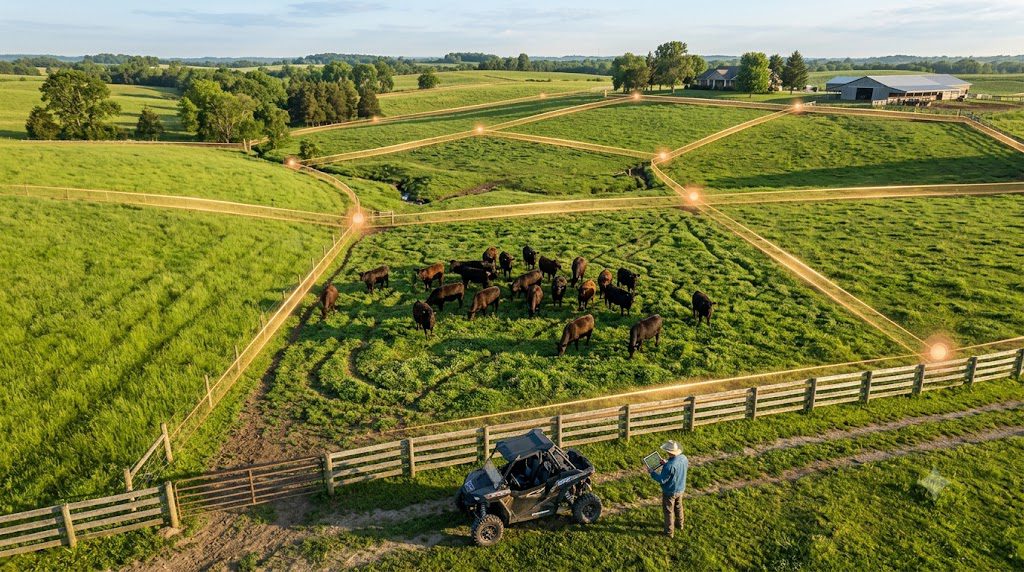
A rancher draws virtual paddock boundaries directly on a digital map through a phone or web app — a process vendor comparisons describe as taking seconds, compared to 30 to 60 minutes of physical fence-building for an equivalent paddock using portable polybraid.
Animal Training
Per the University of Arizona’s research, livestock are trained through repeated exposure to the audio-then-stimulus sequence. Most animals learn to respond to the audio cue alone within a matter of days, according to industry reporting, though the underlying academic research treats this training period as a genuine welfare consideration requiring proper protocol, not an assumption.
Connectivity Architecture
Vendors differ meaningfully here. According to Farm Progress’s reporting, Vence’s collars work directly without requiring cell service, using mobilizable base stations with roughly a 10- to 12-mile range, while Gallagher’s eShepherd offers both direct-to-cellular and long-range (LoRa) connection options depending on the property’s infrastructure.
Data and Health Monitoring
Modern systems extend well beyond containment. Per TechCrunch’s reporting, Halter’s collars are always-on and collect behavioral data continuously, which the company uses to track fertility cycles and flag individual animals that may be sick — capabilities layered on top of the core fencing function.
What the Peer-Reviewed Research Actually Says
This is worth its own section because most commercial coverage of virtual fencing skips past the actual welfare science in favor of ROI numbers.
The Frontiers in Animal Science case study specifically examined whether virtual fencing could support a more complex, intensive grazing system using moving front and back virtual fences with Angus heifers — a harder test than a simple static boundary.
xxThis kind of peer-reviewed, university-conducted research is exactly the standard a genuinely trustworthy evaluation of this technology should be built on, rather than vendor-supplied case studies alone.
Separately, the University of Arizona Cooperative Extension’s two-part technical series — “Foundations of Virtual Fencing: Training and Animal Welfare” and “Foundations of Virtual Fencing: Exploring the Complexities and Challenges” — frames the technology’s core promise directly: traditional wire fencing, while effective for implementing grazing systems, fragments landscape connectivity, poses risks to wildlife, and offers limited flexibility for adjusting pasture size or avoiding sensitive habitat. Virtual fencing is positioned specifically as a tool to address those structural limitations, not merely a labor-saving gadget.
Virtual Fencing vs. Traditional Wire Fencing
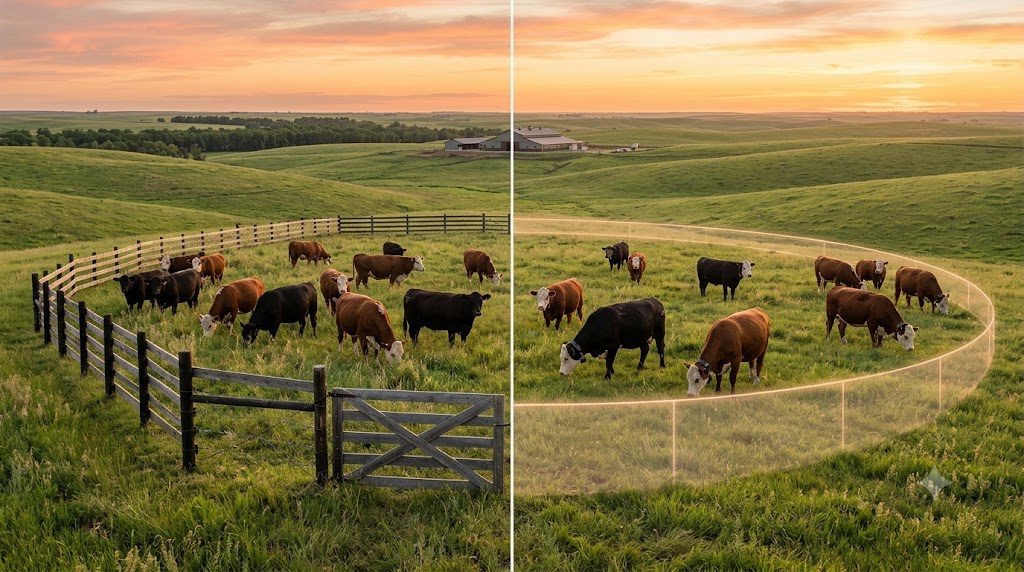
| Factor | Traditional Wire Fencing | Virtual Fencing Technology |
|---|---|---|
| Setup time for a new paddock | 30–60 minutes (portable) to permanent installation | Seconds, drawn in an app |
| Wildlife impact | Can fragment habitat and injure wildlife | Minimal physical barrier impact |
| Upfront cost | Materials and labor, scales with perimeter length | $40+ per head plus infrastructure (towers/base stations) |
| Flexibility to adjust boundaries | Low — requires physical rebuilding | High — redrawn remotely |
| System interoperability | N/A | Vendor-locked; systems generally don’t mix |
| Peer-reviewed welfare validation | Long-established | Growing, multi-year academic research base |
The honest takeaway: virtual fencing solves real structural limitations of wire fencing, particularly around flexibility and wildlife connectivity, but it introduces new considerations — cost structure, connectivity dependency, and vendor lock-in — that wire fencing simply doesn’t have.
Real Vendor Pricing in 2026
Treat every figure here as a planning reference — pricing varies by region, herd size, and infrastructure needs.
According to Lancaster Farming’s reporting, Vence collars run approximately $40 per head with $10 batteries, leased rather than purchased outright, with no herd size limit or data fees — but producers need two communication towers, which cost $10,000 each to build themselves or $12,500 each if Vence builds them.
Gallagher’s eShepherd, per the same and related trade reporting, offers volume-based pricing that decreases as collar count increases, with a minimum deployment of just four collars, making it accessible to smaller operations, and battery life expected to last seven to ten years despite a three-year warranty.
Nofence, the Norwegian-built system now expanding into U.S. cattle operations after establishing itself with sheep and goats, publicly cites metrics of more than 150,000 collars shipped and a reported 99.3% containment rate across herds and species, according to industry tracking — figures worth verifying directly with the company for your specific livestock type, since containment performance can vary by species and terrain.
Halter, while not currently offering its dairy-specific system in the U.S. as of this writing, uses a solar-powered collar with base stations rather than a cellular network, an architecture one New Zealand dairy farmer credited with saving roughly 1,000 hours of annual travel time previously spent moving herds by motorbike, according to industry reporting.
Beyond Fencing: The Health and Reproduction Upside
It’s worth understanding that the fencing function is increasingly just the entry point for what these collar systems do.
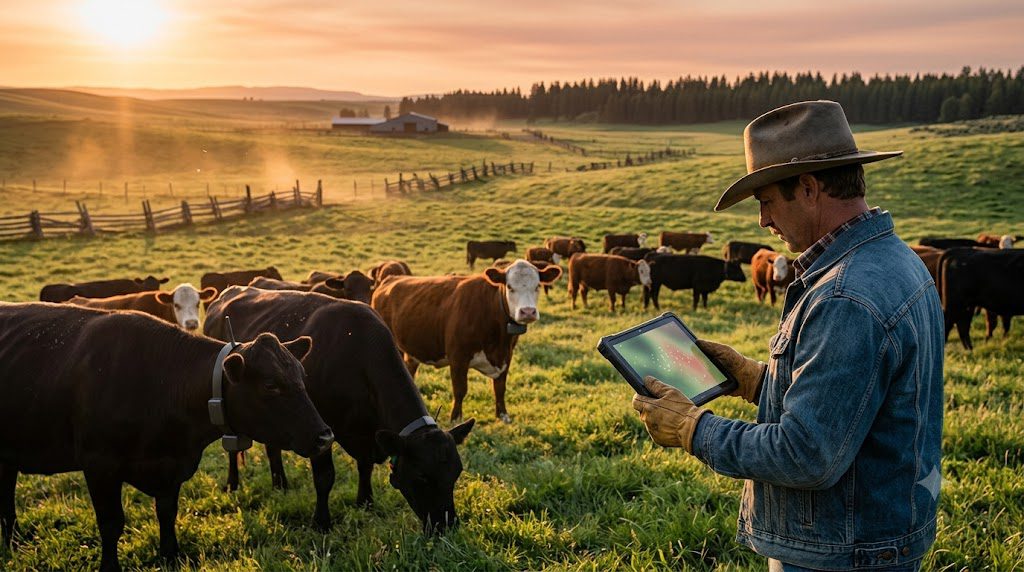
Per TechCrunch’s direct reporting on Halter, the company’s collars are always-on and continuously collect behavioral data, which the company says has produced what is likely the world’s largest dataset of cattle behavior.
That data supports fertility cycle monitoring and early illness flagging — capabilities Piggott described as having “improved dramatically” as the dataset has grown, with a reproduction-focused product currently in beta with U.S. customers as of early 2026.
This matters for how ranchers should evaluate cost: a system priced purely as a fencing replacement may undersell its value, but a system priced as a full herd management platform is a materially bigger commitment and should be evaluated against that broader scope, not just against the cost of wire and t-posts.
The Four Vendors, and Why They Don’t Mix
Four companies currently offer virtual fencing in the U.S., according to consistent reporting across Farm Progress and other trade sources: Vence (owned by Merck Animal Health, rangeland-oriented, no cell service required), Gallagher’s eShepherd (solar-powered, flexible connectivity options), Nofence (Norwegian-built, originally for sheep and goats, now expanding to cattle), and Halter (New Zealand-origin, expanding aggressively into U.S. beef and dairy).
The detail worth flagging clearly: components from different vendors are generally not interchangeable, meaning a rancher isn’t buying a commodity collar — they’re committing to an entire ecosystem, including whichever company’s towers, app, and support infrastructure they choose. That makes vendor selection a more strategic, harder-to-reverse decision than it might first appear, closer to choosing a farm management software platform than buying a physical tool.
Real Limitations Worth Knowing
No credible source in this space claims virtual fencing is a finished, friction-free replacement for physical fencing.
- High upfront and infrastructure cost, particularly for base-station-dependent systems requiring $10,000-plus towers, which is why one Farm Progress headline on the category specifically notes it’s “gaining ground… despite high costs”
- Vendor lock-in, since the four major systems don’t interoperate, making an initial vendor choice a long-term commitment
- Connectivity dependency, since even LoRa and cellular-based systems require infrastructure that isn’t uniformly reliable across remote rangeland
- A genuine, still-developing welfare research base, meaning the University of Arizona Extension’s ongoing “Foundations of Virtual Fencing” series exists precisely because training protocols and welfare implications are still active areas of applied research, not settled science
- Terrain and connectivity variability in the field. A 2025 study conducted across Colorado’s Eagle County Conservation District, spanning private, BLM, and U.S. Forest Service land, specifically examined virtual fencing efficacy on rugged, remote terrain — the kind of real-world complexity that differs meaningfully from flat, well-connected pasture
How to Evaluate a Virtual Fencing System
- Get pricing for your specific herd size and terrain from more than one vendor, since infrastructure needs — and therefore total cost — vary significantly by property.
- Ask directly about connectivity requirements and whether your specific rangeland has adequate cellular or line-of-sight coverage for the system’s base stations.
- Understand the vendor lock-in before committing, since switching systems later means replacing collars, towers, and retraining your herd from scratch.
- Ask what peer-reviewed or university research the vendor points to, beyond their own case studies, for welfare and training protocol validation.
- Start with a pilot group rather than a full-herd rollout, particularly given the University of Arizona’s ongoing research into training complexities specific to different herd compositions and terrains.
This kind of structured evaluation fits the same due-diligence approach worth applying to any precision agriculture investment covered on this site — treating vendor claims as a starting question rather than a settled fact.
Common Mistakes Ranchers Make
- Choosing a vendor based on price alone, without factoring in the real infrastructure cost (towers, base stations) that can dominate total spend for base-station-dependent systems.
- Underestimating the training period, treating collar deployment as instant rather than the multi-day process the research literature describes.
- Ignoring interoperability before committing, then discovering an initial vendor choice locks out switching without a full hardware and retraining cost later.
- Skipping a pilot phase, rolling out to a full herd before confirming the specific system performs reliably on their particular terrain and connectivity conditions.
For operations already exploring broader livestock technology, this connects directly to the precision livestock and animal husbandry technology already covered on this site, and to the emissions and productivity case made in our sustainable livestock farming guide.
FAQs About Virtual Fencing Technology
1. What is virtual fencing technology?
Virtual fencing technology uses GPS-enabled livestock collars and digital mapping software to create invisible pasture boundaries. When cattle approach a boundary, the collar provides an audio warning and, if the animal continues, a brief electrical stimulus.
2. How does virtual fencing work for cattle?
A rancher creates a virtual boundary through an app or digital map. GPS tracks the animal’s location, while the collar provides an audio cue as cattle approach the boundary. If the animal continues across it, the system delivers a brief electrical stimulus.
3. How much does virtual fencing technology cost?
Costs vary by vendor, herd size, and property infrastructure. For example, Vence collars are reported at approximately $40 per head plus $10 batteries, while communication towers can cost around $10,000–$12,500 each.
4. Do virtual fencing collars hurt cattle?
Virtual fencing collars use a brief electrical stimulus combined with an audio warning. Research and university extension publications continue to examine animal training and welfare considerations, so ranchers should evaluate the specific training protocol used by a vendor before deployment.
5. Which companies offer virtual fencing technology?
The article identifies four major companies offering virtual fencing systems in the U.S.: Vence, Gallagher’s eShepherd, Nofence, and Halter. Their connectivity, hardware, pricing, and operating models differ.
6. Can virtual fencing replace traditional wire fencing?
Virtual fencing can replace physical fencing for certain grazing and pasture-management applications, but it should not automatically be viewed as a complete replacement in every operation. Connectivity, terrain, training, infrastructure, and animal welfare considerations need to be evaluated first.
7. Can GPS cattle collars work without cellular service?
Some systems are designed to operate without conventional cellular service. For example, Vence uses mobile communication base stations, while Gallagher’s eShepherd offers different connectivity options depending on infrastructure. Requirements vary by vendor and property.
8. Can virtual fencing technology monitor cattle health?
Some modern systems collect behavioral data in addition to controlling grazing boundaries. Halter, for example, uses continuously collected behavioral data for capabilities such as fertility-cycle monitoring and early illness detection.
9. Does virtual fencing work on rugged or remote land?
Performance can vary depending on terrain and connectivity. Research is still examining virtual fencing in rugged and remote environments, including a 2025 study conducted across private, BLM, and U.S. Forest Service land in Colorado.
10. What should ranchers consider before buying a virtual fencing system?
Ranchers should compare total costs, connectivity requirements, vendor lock-in, animal training protocols, independent research, terrain suitability, and pilot-program options. Starting with a smaller pilot group can help determine whether a system works reliably before a full-herd rollout.
Final Thought
Virtual fencing technology just received one of the largest funding validations in agtech history, and the underlying peer-reviewed research base — while still actively developing — genuinely supports its core welfare and land-management claims.
It also comes with real, disclosed friction: high infrastructure costs, strict vendor lock-in, and connectivity dependency that varies by terrain.
The responsible way to evaluate it isn’t to treat a $220 million funding round as proof it’s right for your operation, nor to dismiss it as unproven hype — it’s to get vendor-specific pricing for your actual herd and land, ask what independent research backs the training protocol, and start with a pilot before committing to a full-herd, single-vendor ecosystem.
Related reading on this site: Sustainable Livestock Farming: Unlocking Powerful Solutions to Cut Emissions & Boost Returns 2025, Animal Husbandry: 6 Powerful Types of Animal Husbandry & Breeding, Precision Farming Ultimate: Precision Ag & Vertical Farming, and Carbon Credits for Farmers: 7 Amazing Ways to Earn in 2026.