
Table of Contents
What Are Methane-Reducing Feed Additives for Cattle?
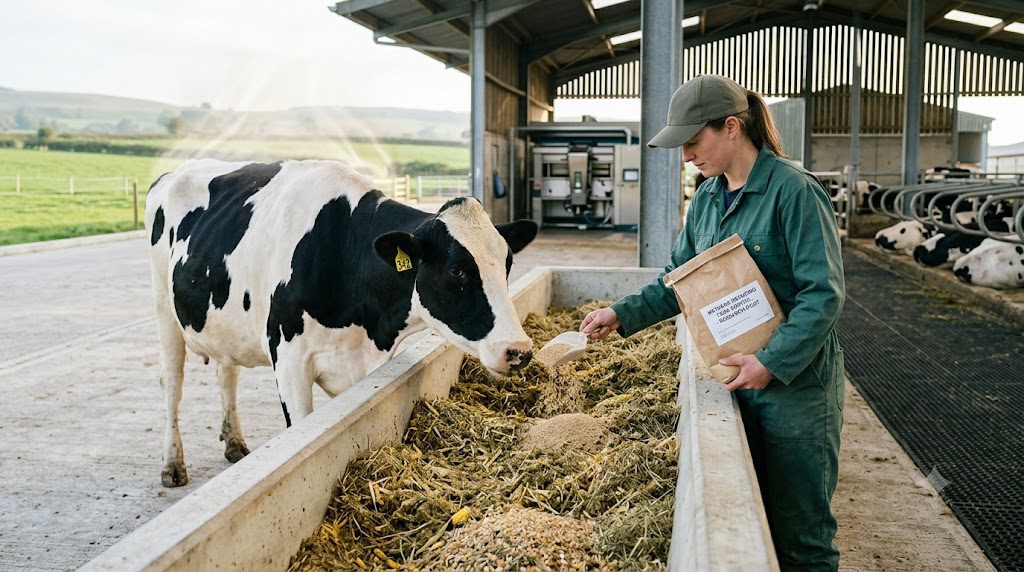
Methane-reducing feed additives for cattle are substances mixed into a cow’s daily ration that interfere with the digestive process responsible for producing methane gas. Instead of changing what a cow eats in bulk, these additives target the microbial chemistry inside the rumen the cow’s largest stomach chamber where methane is actually formed.
This isn’t a fringe idea anymore. Methane-reducing feed additives for cattle have moved from university research trials into commercial dairy and beef operations across more than 60 countries, backed by a growing body of peer-reviewed science and, in some regions, direct government subsidies.
For farmers, the appeal is straightforward: lower emissions, potential access to carbon credit income, and in several markets, compliance with tightening agricultural climate regulation that is no longer optional.
It also matters that this is a livestock-specific solution rather than a generic sustainability slogan. Methane-reducing feed additives for cattle don’t ask a farmer to change their breed, their grazing system, or their herd size. They work inside the existing ration, which is exactly why adoption is spreading faster than most climate-related farm interventions typically do.
Why Cattle Methane Is Suddenly a Global Priority
Enteric methane the methane produced during a ruminant’s digestion accounts for nearly 30% of global human-caused methane emissions, and methane itself traps more than 80 times the heat of carbon dioxide over a 20-year period. That combination of scale and potency is why cattle methane has become a specific target of climate policy rather than being lumped in with general agricultural emissions.
Three forces are pushing methane-reducing feed additives for cattle into the mainstream right now:
- Climate policy is naming livestock explicitly. Denmark now requires all dairy farms with more than 50 cows to use approved methane-reducing feed additives, and the government is fully reimbursing additive costs for farmers who enrolled in 2024–2025.
- Dairy and beef buyers are asking for emissions data. Large food and dairy companies are building supply-chain emissions targets that flow down to individual farms.
- The science has matured fast. What was a lab curiosity in the early 2020s now has multi-year commercial data behind it.
If you’re already following the emissions-reduction angle covered in our sustainable livestock farming guide, methane-reducing feed additives for cattle are the most direct, measurable lever most farms can pull today.
How Cattle Actually Produce Methane
To understand why methane-reducing feed additives for cattle work, it helps to understand where the methane comes from in the first place.
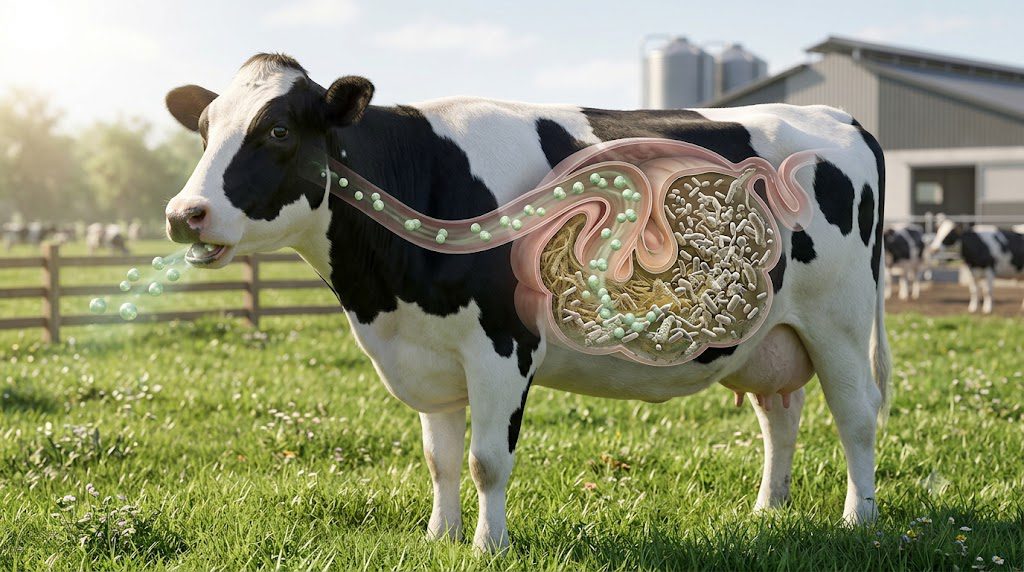
Cattle are ruminants, meaning they ferment fibrous plant material in the rumen using billions of microbes before it’s digested further. A specific group of these microbes, called methanogens, produce methane as a byproduct of breaking down hydrogen generated during fermentation. The cow then belches out roughly 90–95% of that methane, with the remainder released through manure.
This is a normal digestive process, not a disease or inefficiency in the traditional sense but it does represent lost energy. Methane a cow burps out is energy that didn’t go toward milk, meat, or weight gain, which is part of why methane-reducing feed additives for cattle can sometimes improve feed efficiency alongside cutting emissions.
Researchers estimate that anywhere from 2% to 12% of the gross energy a cow consumes is lost as methane rather than converted into productive output. That range depends heavily on diet quality, forage type, and the animal’s stage of production. A cow on poor-quality, high-fiber roughage typically loses more energy to methane than one on a well-balanced, higher-grain ration which is one reason methane-reducing feed additives for cattle tend to show the biggest relative impact in extensive, pasture-based systems rather than tightly managed feedlots that already minimize energy loss through diet formulation alone.
It’s also worth understanding that methane output isn’t constant across a cow’s life. Methane per unit of milk or meat produced (methane “intensity”) tends to be higher in younger, less productive animals and lower in high-yielding, efficient ones meaning breed selection, herd health, and productivity itself are already indirect methane levers, even before an additive enters the picture. Methane-reducing feed additives for cattle work on top of that baseline, not as a replacement for good herd management.
7 Methane-Reducing Feed Additives for Cattle Farmers Are Using in 2026
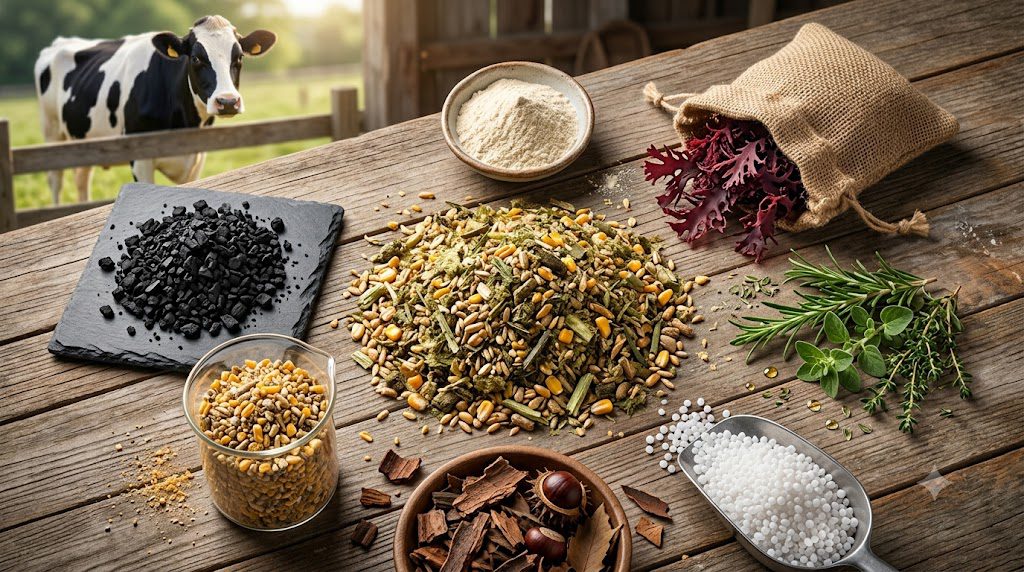
Not all methane-reducing feed additives for cattle work the same way or deliver the same results. Here are the seven approaches with the strongest evidence behind them right now.
1. 3-NOP (Bovaer)
3-nitrooxypropanol, sold commercially as Bovaer, is currently the most widely authorized methane-reducing feed additive for cattle, approved in more than 60 countries. It works by directly suppressing the enzyme methanogens use to produce methane. Studies show 3-NOP can reduce enteric methane emissions in dairy cattle by 25–30%, and it’s the additive Denmark’s mandatory-use policy is built around.
2. Asparagopsis Seaweed (Bromoform-Based Additives)
Red seaweed from the Asparagopsis genus contains bromoform, a compound that blocks methane production even more aggressively than 3-NOP trial results show reductions of 80–95% at inclusion rates of just 0.5–2% of dry matter intake. It’s currently the most potent methane-reducing feed additive for cattle in scientific literature, though commercial-scale seaweed farming and supply chains are still catching up to demand.
3. Essential Oil Blends
Plant-derived essential oils (often blends of oregano, clove, and cinnamon compounds) alter rumen microbial activity in ways that reduce methanogen populations. Results are more modest and variable than 3-NOP or seaweed, but essential oil additives are cheaper, more widely available, and easier for smaller farms to source without specialized supply contracts.
4. Nitrate Supplements
Nitrate additives work differently they compete with methanogens for the hydrogen those microbes need to form methane, redirecting it elsewhere in digestion instead. Nitrate supplementation has shown consistent, moderate methane reductions, though it requires careful dosing since excess nitrate can be toxic to cattle if introduced too quickly.
5. Tannins and Polyphenol Additives
Condensed tannins and polyphenol-rich additives, such as the sugarcane-derived product Polygain, reduce methane by altering rumen fermentation pathways while also offering a secondary benefit: some tannin sources can reduce bloat risk and improve protein use efficiency, making this one of the more farmer-friendly methane-reducing feed additives for cattle on pasture-based systems.
6. Ionophores (Monensin)
Monensin has been used in cattle feed for decades primarily to improve feed efficiency, but research confirms it also delivers a modest methane-reduction effect as a side benefit. It’s not the most powerful option on this list, but it’s cheap, already familiar to most beef producers, and easy to introduce without a major change in farm routine.
7. Biochar-Based Feed Additives
An emerging and lower-cost option: mixing biochar directly into cattle feed. Early research suggests biochar can bind compounds in the gut that influence methane production, while also improving gut health and reducing ammonia in manure. If you’re already exploring biochar for soil health on your farm, feeding it is an active area of research worth watching rather than a proven, standardized practice yet.
Do Methane-Reducing Feed Additives Affect Milk Yield or Weight Gain?
This is usually the first question dairy and beef farmers ask, and it’s a fair one methane-reducing feed additives for cattle are worthless if they quietly cost you production.
The honest answer: it depends on the additive. 3-NOP trials generally show no negative effect on milk yield or milk composition when dosed correctly, and in some cases feed efficiency improves slightly because less energy is lost as methane. Seaweed-based additives show similarly neutral-to-positive results in controlled trials, though palatability at higher inclusion rates has been a challenge some producers report.
Nitrate and essential oil additives show more variable results across studies productivity effects range from neutral to mildly positive depending on diet composition and dosing. This variability is exactly why on-farm trials with a control group matter more than any single published study.
Cost and ROI: Are Methane-Reducing Feed Additives Worth It?
Cost is where methane-reducing feed additives for cattle get complicated, because the return isn’t always a direct line to your milk check.
Direct costs vary widely: 3-NOP and commercial seaweed products currently carry a per-head daily cost that many independent farmers find hard to justify without a subsidy or buyer premium. Ionophores, nitrates, and essential oil blends are considerably cheaper and more accessible to smaller operations.
Indirect returns come from three places: modest feed efficiency gains, buyer premiums from dairy processors building low-carbon supply chains, and carbon credit or government subsidy programs where they exist. Denmark’s full-reimbursement model is the clearest example, but voluntary carbon markets in other regions are beginning to recognize verified methane reduction from feed additives as a saleable credit.
For most farms outside a subsidized market, methane-reducing feed additives for cattle are currently a cost center you adopt for compliance, buyer relationships, or long-term positioning not yet a guaranteed short-term profit driver, unless a specific incentive program applies to your region.
Government Policy and Carbon Credit Programs
Policy is moving faster than most farmers expect. Denmark’s mandatory-use rule for larger dairy farms is paired with an agricultural emissions tax beginning in 2030, effectively forcing early adoption of methane-reducing feed additives for cattle well before the tax takes effect.
Several other countries are developing similar frameworks, and international climate researchers have flagged livestock methane as one of the fastest, most cost-effective near-term levers for slowing warming a WRI analysis outlines more than 25 potential agricultural methane interventions, with feed additives among the most immediately scalable.
Farmers evaluating carbon credit eligibility should treat this as a fast-moving area verification standards, payout structures, and eligible additives differ by program and region, and what qualifies today may expand significantly within a year or two.
Challenges and Limitations to Know Before You Buy
Methane-reducing feed additives for cattle aren’t a plug-and-play fix, and a few real limitations explain why adoption hasn’t gone faster:
- Supply chain constraints. Seaweed-based additives in particular face bottlenecks in large-scale, consistent-quality production.
- Regulatory approval gaps. Not every additive approved in one country is approved everywhere yet, which limits options depending on where you farm.
- Dosing precision matters. Nitrate additives especially require careful introduction to avoid toxicity risk.
- Inconsistent results across diets. The same additive can perform differently depending on forage type, feed composition, and regional rumen microbial populations.
- Cost without local incentives. Outside subsidized markets, the economics can be a hard sell for smaller operations.
None of these issues make methane-reducing feed additives for cattle impractical they simply mean sourcing, dosing, and expectations need to be set with real information rather than marketing claims.
How Farmers Actually Measure Methane Reduction On-Farm
One practical question rarely gets a straight answer: how does an individual farmer actually know whether a methane-reducing feed additive for cattle is working, without access to a university respiration chamber?
Proxy indicators are the realistic starting point for most operations. Feed conversion ratio, milk yield per unit of feed intake, and rumen health markers (like manure consistency and cud-chewing rates) won’t measure methane directly, but sudden shifts after introducing an additive can flag whether it’s having a broader digestive effect worth investigating further.
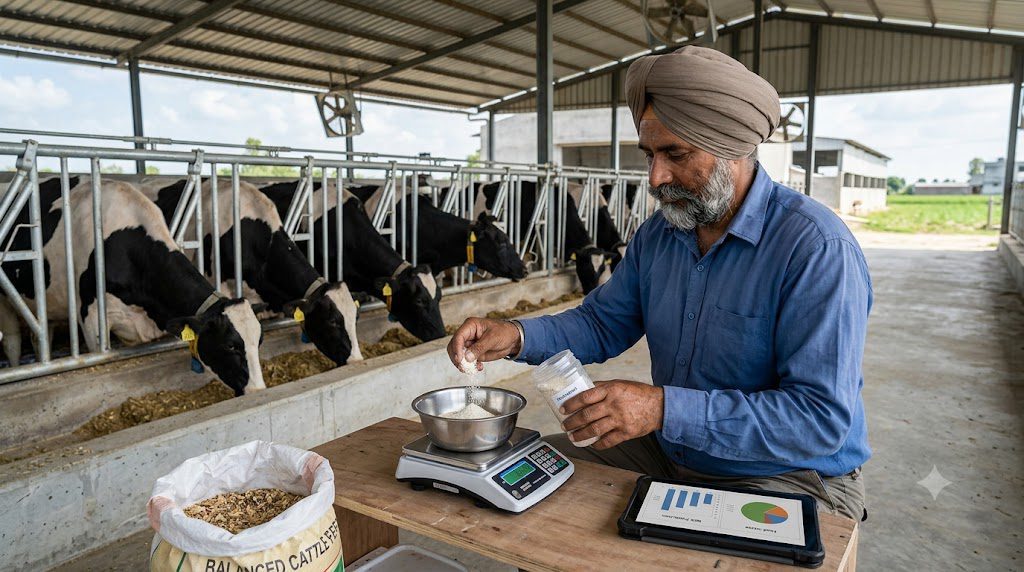
Portable methane sensors handheld or collar-mounted devices that estimate methane concentration in a cow’s breath have become considerably more affordable in the last two years and are increasingly used by extension programs and larger commercial farms to spot-check herds without lab equipment.
Third-party verification becomes necessary the moment carbon credits or processor premiums are involved. Most current programs require standardized measurement protocols sulphur hexafluoride tracer methods, chamber testing, or approved modeling rather than accepting a farm’s own estimates, which is why partnering with a verified program early matters more than the additive choice itself if monetization is the goal.
For farms without access to any of the above, the pragmatic approach is simple: track productivity and health metrics closely, trust the peer-reviewed reduction ranges published for your specific additive, and treat exact on-farm methane numbers as something you’ll likely need external support to verify rather than something to estimate alone.
Methane-Reducing Feed Additives for Cattle in Pasture-Based and Smallholder Systems
Most of the headline research on methane-reducing feed additives for cattle comes from confined dairy systems in Europe, North America, and Australia but the majority of the world’s cattle are raised in pasture-based or smallholder systems, particularly across South Asia, where feeding logistics look very different.
Delivering a precisely dosed additive to a herd grazing open pasture is far harder than mixing it into a total mixed ration in a confinement barn. This is one reason tannin-rich forages, certain tree fodders, and locally available feed supplements are drawing renewed research interest in these regions they can be introduced through existing feeding routines rather than requiring new equipment or daily precision dosing.
For India specifically, where dairy is dominated by smallholder herds rather than large confined operations, the more realistic near-term path toward methane-reducing feed additives for cattle likely runs through locally sourced tannin and polyphenol feed supplements, cooperative-level bulk sourcing to bring costs down, and extension-supported pilot programs rather than direct adoption of higher-cost options like 3-NOP or commercial seaweed extracts.
Farms already balancing feed costs and productivity the way we’ve covered in our organic farming in India guide should watch this space closely, since affordability and local sourcing will likely determine adoption speed more than the underlying science does.
How to Choose the Right Methane-Reducing Feed Additive for Your Herd
- Confirm local regulatory approval. Check whether your target additive is authorized for use in your country or state before sourcing it.
- Match the additive to your system. Pasture-based herds, feedlots, and confined dairies respond differently to tannins, nitrates, or 3-NOP.
- Start with a control group. Run the additive on part of your herd first and compare milk yield, feed intake, and health outcomes against untreated animals.
- Check for buyer or subsidy incentives. Some dairy processors and government programs offset additive costs directly.
- Monitor animal health closely. Especially with nitrate supplementation, introduce additives gradually and watch for signs of toxicity.
- Track data over multiple seasons. Methane reduction is easy to measure in trials but harder to verify on-farm without proper monitoring the kind of tracking covered in our precision livestock farming guide can help quantify real results.
- Review carbon credit eligibility annually. Programs recognizing methane-reducing feed additives for cattle are expanding quickly, so eligibility you don’t qualify for today may open up soon.
The Future of Methane-Reducing Feed Additives in Livestock Farming
Several developments will shape where methane-reducing feed additives for cattle go next:
- Combination additives. Recent research on combining additives (such as 3-NOP with tannins or essential oils) shows potential for greater methane reduction than any single additive alone, though interaction effects are still being studied.
- Cheaper seaweed production. Scaling Asparagopsis farming is the biggest bottleneck standing between lab results and widespread commercial use.
- Expanding carbon markets. More verification protocols are being built specifically around enteric methane reduction, which should make it easier for individual farms to monetize adoption.
- Regulatory harmonization. As more countries follow Denmark’s lead, approval and subsidy frameworks are likely to become more consistent globally.
Peer-reviewed research continues to expand rapidly in this space a recent meta-analysis published in Frontiers in Animal Science reviewed data across multiple additive categories and found consistent, measurable reductions in enteric methane, reinforcing that this is no longer an experimental technology but a maturing category of livestock management tools. For a plain-language technical overview of how 3-NOP specifically works, the AHDB knowledge library is a useful independent reference.
Frequently Asked Questions
What are methane-reducing feed additives for cattle? They are feed ingredients such as 3-NOP, seaweed extracts, nitrates, tannins, or essential oils that interfere with rumen microbial processes to lower the amount of methane cattle produce during digestion.
Do methane-reducing feed additives for cattle hurt milk production? Not when dosed correctly. Most well-studied additives, including 3-NOP and seaweed-based products, show neutral or slightly positive effects on milk yield in controlled trials.
Which methane-reducing feed additive works best? Asparagopsis seaweed shows the highest reduction rates (up to 90%+) in trials, while 3-NOP is currently the most widely approved and commercially available option at 25–30% reduction.
Are methane-reducing feed additives for cattle expensive? Costs vary significantly by additive and region. Ionophores and essential oils are relatively affordable; 3-NOP and seaweed products cost more but may qualify for subsidies or carbon credit income in some markets.
Is this mandatory anywhere yet? Yes. Denmark requires larger dairy farms to use approved methane-reducing feed additives as part of its national climate strategy, with other countries watching the results closely.
Can smallholder farmers use methane-reducing feed additives for cattle? Access is more limited for smallholders due to cost and supply availability, though cheaper options like tannins and essential oil blends are more realistically accessible than 3-NOP or seaweed products today.
Final Thought
Methane-reducing feed additives for cattle are one of the rare places where climate policy, animal science, and farm economics are actually pointing in the same direction at the same time. The technology is no longer experimental, the regulatory pressure is real and growing, and the range of options from low-cost tannins to high-potency seaweed extracts means there’s likely an entry point for most herd sizes. The farmers who start testing now, carefully and with real on-farm data, will be the ones ready when incentives and requirements catch up everywhere else.